

On this page
When aldehydes and ketones react with semicarbazide (H₂N–NH–CO–NH₂), they undergo a nucleophilic addition-elimination reaction to form a crystalline solid called a semicarbazone. These crystalline derivatives are incredibly useful in the laboratory because they have sharp, well-defined melting points that help chemists identify unknown aldehydes and ketones. If you need a refresher on the general mechanism, read our guide on aldehydes and ketones: nucleophilic addition and named reactions.
If you look at the chemical formula of semicarbazide, you will see two –NH₂ groups. However, only one of these groups ever attacks the carbonyl carbon. Getting this detail right is a classic test of your ability to spot nucleophiles and electrophiles in exam situations.
Which NH2 group in semicarbazide is nucleophilic?
Semicarbazide has three nitrogen atoms in total, but to understand its reactivity, we only need to compare the two extreme ends of the molecule:
The hydrazine end: The terminal –NH₂ group on the left (H₂N–NH–).
The amide end: The –NH₂ group on the right, attached directly to the carbonyl carbon (–CO–NH₂).
In any reaction with aldehydes and ketones, the terminal hydrazine end is the only nucleophilic site. The nitrogen attached directly to the carbonyl group is effectively unreactive. If you draw the product using the amide nitrogen, the structure will be fundamentally incorrect.
Why does only one NH2 group form a semicarbazone?
For a nitrogen atom to act as a nucleophile, its lone pair of electrons must be fully available to attack an electrophilic target. It cannot be tied up in other molecular interactions.
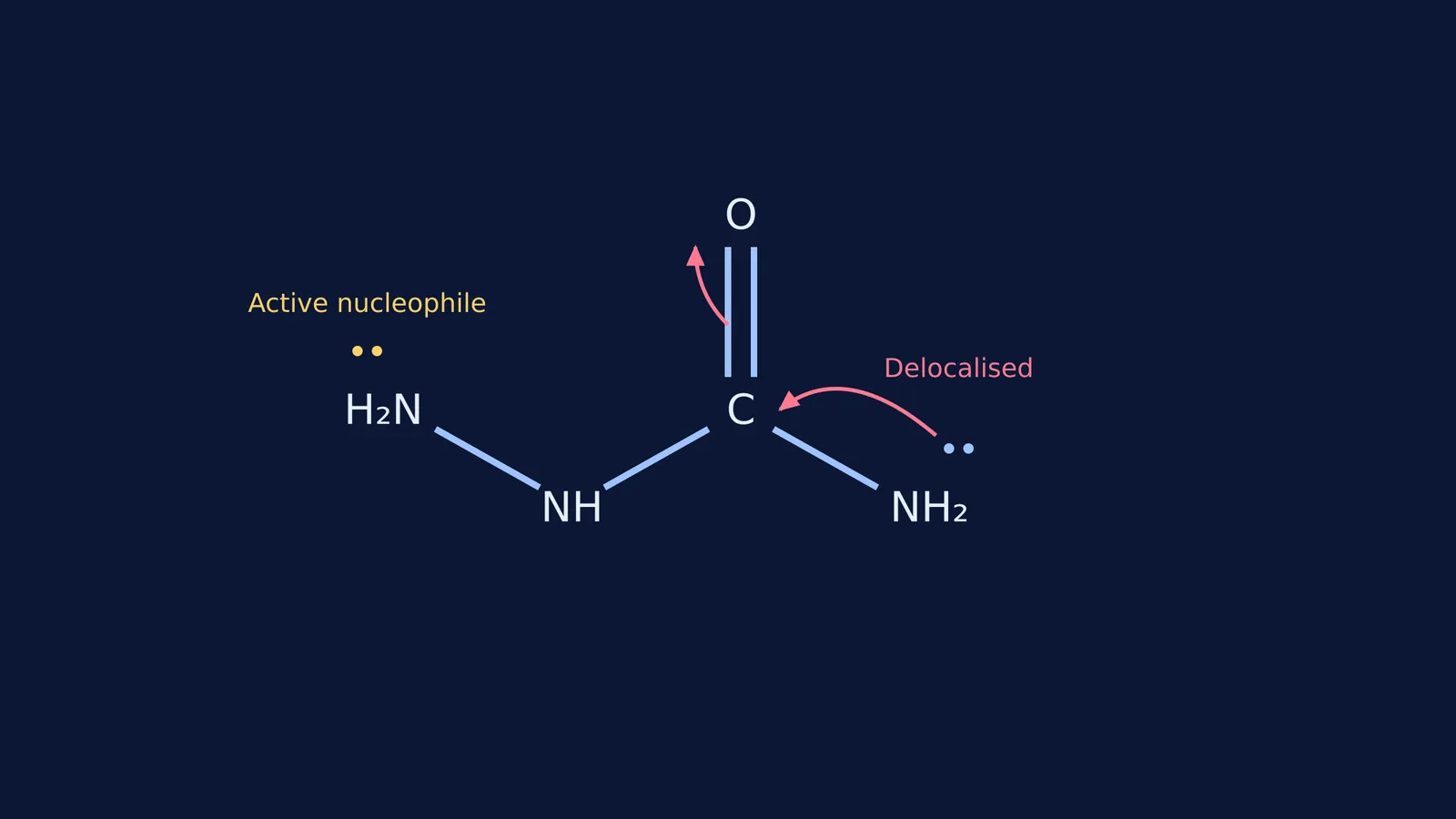
In semicarbazide, the –NH₂ group next to the C=O group is part of an amide functional group. As explained in the Wikipedia article on Semicarbazones, the lone pair of electrons on this specific nitrogen atom is heavily delocalised over the carbonyl group through a process called resonance.
Because oxygen is highly electronegative, it pulls electron density towards itself. The lone pair on the adjacent nitrogen shifts towards the carbon atom, giving the C–N bond a partial double-bond character, while pushing the pi electrons of the C=O bond up onto the oxygen atom. Because this lone pair is drawn deeply into the molecule's internal electron cloud to stabilise the structure, it is physically unavailable to reach out and attack an external molecule.
Conversely, the terminal –NH₂ group is separated from the carbonyl group by another nitrogen atom. It does not participate in this resonance system. Its lone pair remains completely localised on the nitrogen atom itself. This concentration of negative charge makes it a strong, active nucleophile, completely ready to attack the slightly positive electrophilic carbon of an aldehyde or ketone. This is the exact same principle that governs the reactivity of other carbonyls with ammonia derivatives: oximes, hydrazones, 2,4-DNP.
How do you find the reactive site in ammonia derivatives?
Identifying the correct reactive nitrogen is a common stumbling block for students. If you find yourself repeatedly attaching the wrong end of a molecule during practice tests, Fermi's AI tutor can help. Most learning tools answer questions. Fermi teaches — it holds a line of reasoning across a whole session, notices where a student is stuck, and decides whether to explain, ask, or show. If you have concept gaps around electron delocalisation, the Fermi Concept Library holds every concept in physics, chemistry, biology, mathematics and computing, each with its own lesson and its place in the map.
To reliably predict the product of a nucleophile attacking a carbonyl, you can use this simple four-step checklist every time you face a new reagent:
Locate the electron-withdrawing groups: Look at the reagent and spot any C=O or SO₂ groups that might pull electron density towards themselves.
Find the furthest nitrogen: Identify the –NH₂ group that is separated from the electron-withdrawing group by at least one other atom.
Verify localisation: Ensure the lone pair on this specific nitrogen cannot form a resonance structure with a nearby double bond. If it is isolated, it is your nucleophile.
Draw the elimination: Remove the two hydrogen atoms from this nucleophilic nitrogen, and remove the oxygen atom from the aldehyde or ketone. Join the carbon and nitrogen atoms with a double bond to form the final product, plus a water molecule.
Applying this systematic framework to semicarbazide guarantees you will draw the correct, functional semicarbazone on every single attempt.
How does semicarbazide react with acetone?
Let us apply the checklist to a real exam scenario: predicting the reaction between acetone (propanone) and semicarbazide.
Acetone has the structure CH₃–CO–CH₃. The central carbon is our electrophilic target. Semicarbazide is H₂N–NH–CO–NH₂.
Following our steps, we locate the carbonyl group inside semicarbazide. We then find the furthest nitrogen — the terminal H₂N group on the left. We verify that its lone pair is localised and unaffected by the amide resonance on the right side of the molecule.
Finally, we draw the product by eliminating water. We remove the oxygen atom from acetone and the two hydrogen atoms from the terminal nitrogen of semicarbazide. We join them with a double bond to get acetone semicarbazone: (CH₃)₂C=N–NH–CO–NH₂.
By isolating the correct nitrogen atom first, you bypass the trap of the unreactive amide group entirely and secure the correct final structure.


