

On this page
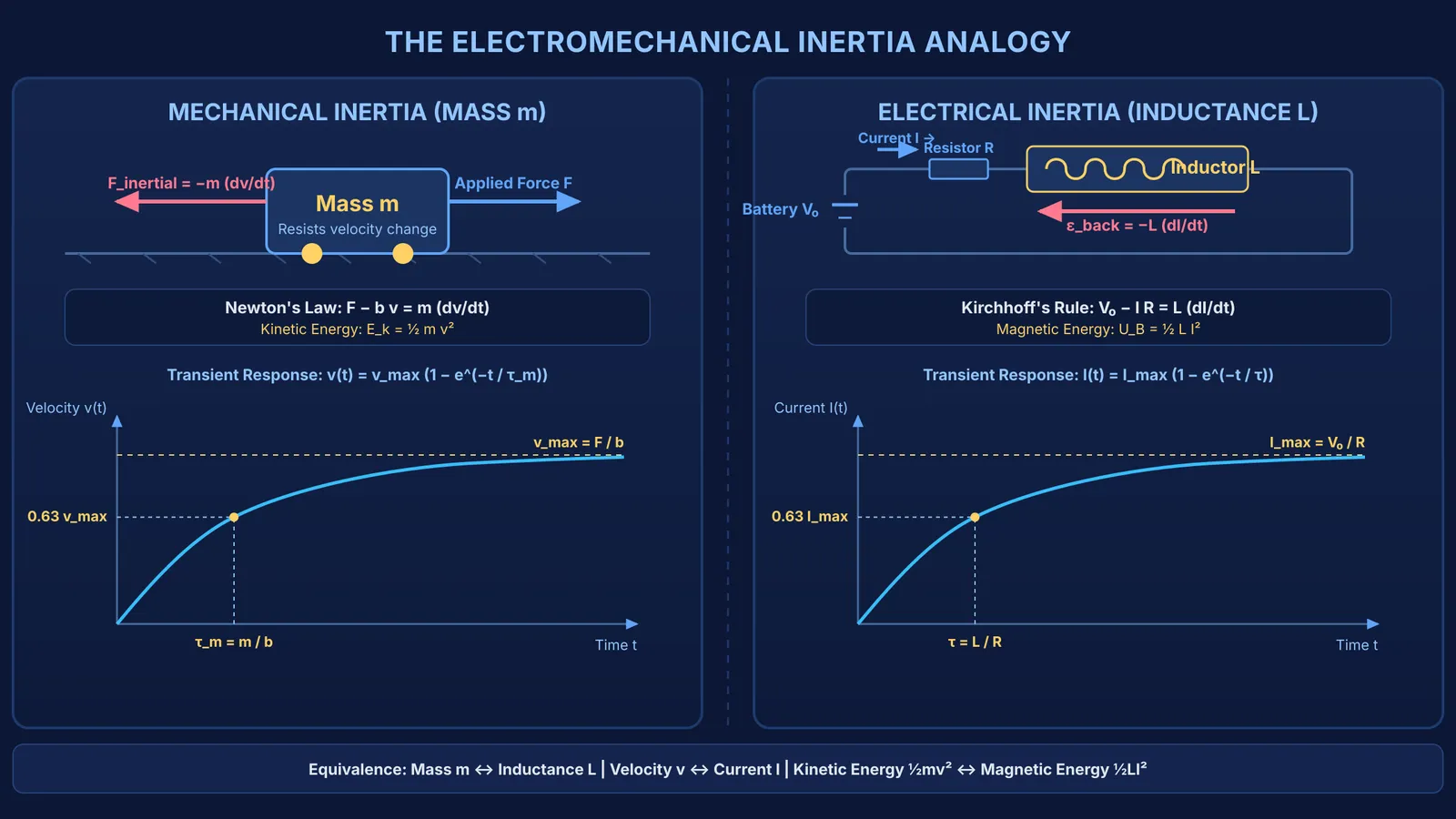
Newton's first law defines mechanical inertia as the resistance of mass to changes in motion. In electric circuits, self-inductance plays the identical role for electric current, as outlined in the NCERT Class 12 Physics curriculum. When a switch closes, current does not jump immediately to its Ohm's law limit; when opened, it cannot plunge to zero instantaneously. Instead, the coil produces an induced electromotive force (EMF) that opposes the ongoing change.
The dynamical theory of self-induction was formalized in 1865 by James Clerk Maxwell in his paper A Dynamical Theory of the Electromagnetic Field. According to Faraday's law of electromagnetic induction combined with Lenz's law, a time-varying current produces a changing magnetic flux through the coil turns, inducing a back EMF:
ε = −L (dI/dt)
Here, L represents the self-inductance of the coil, measured in henries (1 H = 1 V·s/A), while dI/dt denotes the instantaneous rate of current change, as explained in OpenStax University Physics. This matches Newton's second law written as inertial resistance, F_inertial = −m (dv/dt). Just as mass m opposes acceleration dv/dt with an opposing inertial force, an inductor with inductance L opposes current acceleration dI/dt with an opposing back EMF. Self-inductance is the electrical analogue of mechanical inertia.
If you want to explore the connections between field equations and mechanics, the Fermi Concept Library covers every concept in physics, each with its own lesson and its place in the map.
How does magnetic energy mirror mechanical kinetic energy?
The analogy between mass and inductance is an exact mathematical mirror for energy storage. In *The Feynman Lectures on Physics*, Vol. II, Chapter 17, Richard Feynman showed that an inductor stores supplied work within its magnetic field rather than dissipating it (Feynman Lectures on Physics, Vol. II, Ch. 17). Pushing charge against back EMF requires power P = −ε × I = L I (dI/dt). Integrating power over time from zero to steady current I gives the stored magnetic energy:
U_B = ∫ P dt = ∫₀ᴵ L i di = ½ L I²
This relationship is also derived in OpenStax University Physics. As analyzed by Wayne M. Saslow in the American Journal of Physics, this formula is the exact electrical counterpart to mechanical kinetic energy, E_k = ½ m v². In this electromechanical mapping:
Inductance L corresponds to mechanical mass m.
Electric current I corresponds to linear velocity v.
Electric charge q corresponds to linear displacement x.
Magnetic flux linkage λ = L I corresponds to mechanical momentum p = m v.
Back EMF ε corresponds to reactionary inertial force F.
When a moving vehicle brakes, its kinetic energy cannot vanish instantly; work must be done against friction. Similarly, when current in an inductor is interrupted, the stored magnetic energy ½ L I² must be delivered somewhere, often creating an electrical spark across switch contacts as the collapsing field forces charge forward. You can explore how this stored energy drives oscillations in energy swapping between capacitors and inductors in LC oscillations.
What happens inside an LR circuit when the switch is flipped?
Consider what happens when a DC source of potential difference V₀ is connected in series with a resistor R and an inductor L. Applying Kirchhoff's loop rule gives:
V₀ − I R − L (dI/dt) = 0
Solving this first-order differential equation reveals the growth curve of the current:
I(t) = (V₀ / R) × (1 − e^(−t / τ))
The quantity τ = L / R is the inductive time constant, measured in seconds, as detailed in OpenStax University Physics. This equation reveals why an inductor creates electrical inertia:
At switch-on (t = 0), current cannot change discontinuously because an instantaneous jump (dI/dt → ∞) would demand infinite back EMF. Current starts strictly at zero, and the inductor acts as an open circuit.
After one time constant (t = τ = L / R), the current reaches approximately 63% of its maximum value (1 − 1/e ≈ 0.632).
At steady state (t → ∞), the rate of change vanishes (dI/dt = 0), the back EMF drops to zero, and the inductor acts as an ideal zero-resistance wire with steady current I_max = V₀ / R.
To review how to apply these asymptotic conditions under timed exam constraints, see our guide on the boundary behaviour of inductors at switch-on and steady state, as well as our detailed analysis of the growth of current in LR circuits.
For students who want to verify their circuit derivations step by step, the Fermi Problem Library offers worked problems with a step-by-step solver that explains the reasoning rather than printing an answer.
How do you solve electrical inertia problems in exams?
Physics exams frequently test the physical consequences of electrical inertia. Here is a worked example demonstrating the mass-inductance analogy, using the circuit transient framework in OpenStax University Physics.
Worked Example: A solenoid with self-inductance L = 2.5 H and internal resistance R = 5.0 Ω is connected across an ideal 10 V DC battery at time t = 0.
Find the initial rate of change of current (dI/dt) at t = 0⁺.
Calculate the magnetic energy stored in the solenoid once the circuit reaches steady state.
Determine the back EMF at t = τ.
Step-by-step Solution:
Initial rate of change: At t = 0⁺, electrical inertia keeps current at zero (I = 0). The full voltage appears across the coil: V₀ − L (dI/dt) = 0. Thus, dI/dt = V₀ / L = 10 / 2.5 = 4.0 A/s.
Steady-state magnetic energy: At steady state (t → ∞), the inductor offers zero back EMF. The steady current is I_max = V₀ / R = 10 / 5.0 = 2.0 A. Using the kinetic energy mirror, U_B = ½ L I_max² = ½ × (2.5 H) × (2.0 A)² = 5.0 J.
Back EMF at one time constant: With τ = L / R = 0.5 s, the rate of change at t = τ is dI/dt = (V₀ / L) e⁻¹ = 4.0 × 0.3679 ≈ 1.47 A/s. Thus, |ε| = L (dI/dt) = 2.5 × 1.47 ≈ 3.68 V (or V₀ / e ≈ 3.68 V).
When encountering complex networks or coupled circuits, remembering that an inductor acts like a heavy mass on a viscous track keeps you from making timing errors on boundary conditions. If you find circuit transients difficult to picture, the Fermi Simulation Lab provides interactive simulations for the ideas that are easier to see than to read.


