

On this page
When you study Mendelian genetics, the laws of inheritance can sometimes blur together. Two of the most important are the law of segregation and the law of independent assortment. Both explain how alleles—different versions of a gene—are passed from parents to offspring, but they apply to different scales.
What is the law of segregation?
Mendel's law of segregation focuses on a single trait. It states that paired unit factors (genes) must segregate equally into gametes, so that offspring have an equal likelihood of inheriting either factor (OpenStax).
Because fertilisation is a random event, a monohybrid cross between two heterozygotes (like *Aa* × *Aa*) produces a 3:1 phenotypic ratio in the F2 generation, where three-quarters express the dominant trait and one-quarter express the recessive trait (OpenStax).
The biological basis for this is the first division of meiosis. During anaphase I, homologous chromosomes separate and move to opposite poles of the cell. As a result, each gamete receives only one allele for a given gene. This mechanism ensures that a gamete is "pure" for that trait, whether it carries the allele for a functional enzyme or a mutant allele that causes Mendelian disorders.
What is the law of independent assortment?
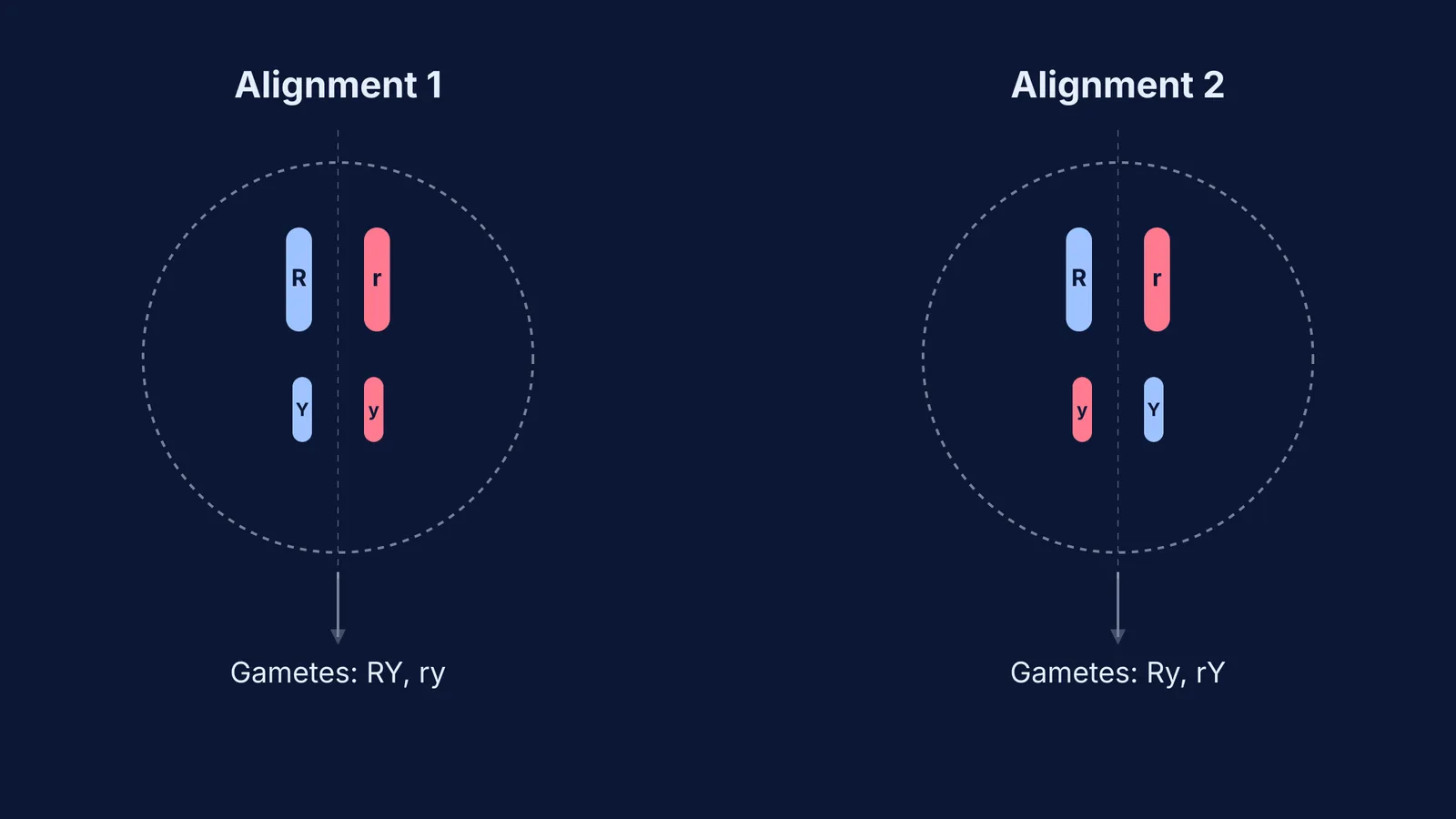
The law of independent assortment scales up to two or more traits. It states that genes do not influence each other with regard to the sorting of alleles into gametes, making every possible combination of alleles equally likely to occur (OpenStax).
This law is typically demonstrated in a dihybrid cross, such as mating plants that differ in both seed colour and seed shape (*YyRr* × *YyRr*). The resulting F2 phenotypic ratio is 9:3:3:1 (OpenStax). Because the two sets of alleles assort independently, the inheritance of yellow or green seeds does not change the chance of getting round or wrinkled seeds.
Independent assortment happens because of how homologous chromosome pairs line up during metaphase I of meiosis. Their orientation on the metaphase plate is completely random. If you are struggling to picture this microscopic alignment, the Fermi Simulation Lab provides interactive simulations for the ideas that are easier to see than to read, helping you visualise the independent sorting of chromosomes.
Where does independent assortment break down?
The law of independent assortment comes with a major caveat: it assumes genes are on different chromosomes (or far apart on the same one). When genes are located in close proximity on the same chromosome, their alleles tend to be inherited together unless recombination occurs (OpenStax). This physical connection is called linkage.
Linkage violates the expectation of independent assortment. Instead of a 9:3:3:1 ratio, a cross involving linked genes will produce a higher frequency of "parental" offspring and fewer "recombinant" ones. However, this is not a rigid rule. Recombination, or crossing over, can break the linkage between two genes. As the distance between two genes increases, the probability of one or more crossovers between them increases, and they behave more like they are on separate chromosomes (OpenStax). Geneticists use this crossover frequency as a mapping function that turns recombination into distance.
How do you solve genetics crosses systematically?
Whether you are dealing with a simple monohybrid problem or a test cross vs back cross, guessing the gamete combinations can lead to errors. If you often get stuck halfway through a complex genetics problem, the Fermi Problem Library has worked problems with a step-by-step solver that explains the reasoning rather than printing an answer. Furthermore, if you are unsure where to begin with a difficult dihybrid scenario, Fermi's AI tutor works out what you already know and builds a plan for the session.
For a reliable approach to exam questions, use this standard checklist:
Identify the alleles: Write down the dominant and recessive alleles clearly (e.g., *Y* for yellow, *y* for green). Do not mix up upper and lower case letters.
Determine parental genotypes: Translate the text description (e.g., "heterozygous for both traits") into letters (*YyRr*). Double-check this step, as a wrong parental genotype ruins the rest of the problem.
List the gametes: Apply the law of segregation to separate the alleles. For dihybrid crosses, use the FOIL method (First, Outside, Inside, Last) to ensure you find all four independent combinations (e.g., *YR*, *Yr*, *yR*, *yr*).
Draw the Punnett square: Align the gametes on the top and side axes. Fill in the boxes systematically by combining the alleles from the row and column.
Count the phenotypes: Tally the resulting genotypes and convert them into phenotypic fractions or ratios to answer the specific question asked by the examiner.


