

On this page
When you burn fuel in an engine, gas expands and pistons move. Whether it is a scooter navigating city traffic or a massive coal power plant, a huge fraction of the energy produced just goes out the exhaust pipe as waste heat. Why? Is it just bad engineering, or a fundamental rule of nature?
It turns out to be a rule of nature. Even if you could eliminate all friction and build the most perfect machine imaginable, you would still lose energy. According to the US Department of Energy, conventional gasoline vehicles are notoriously inefficient, converting only 12% to 30% of the energy stored in gasoline into forward motion (Source). The rest is lost, primarily as heat.
What is the Kelvin-Planck statement?
In 1851, Lord Kelvin and later Max Planck formalized a core principle of physics known as the Second Law of Thermodynamics. Their conclusion, known as the Kelvin-Planck statement, sets a hard boundary on what engineers can build:
"It is impossible to devise a cyclically operating device, the sole effect of which is to absorb energy in the form of heat from a single thermal reservoir and to deliver an equivalent amount of work" (Source).
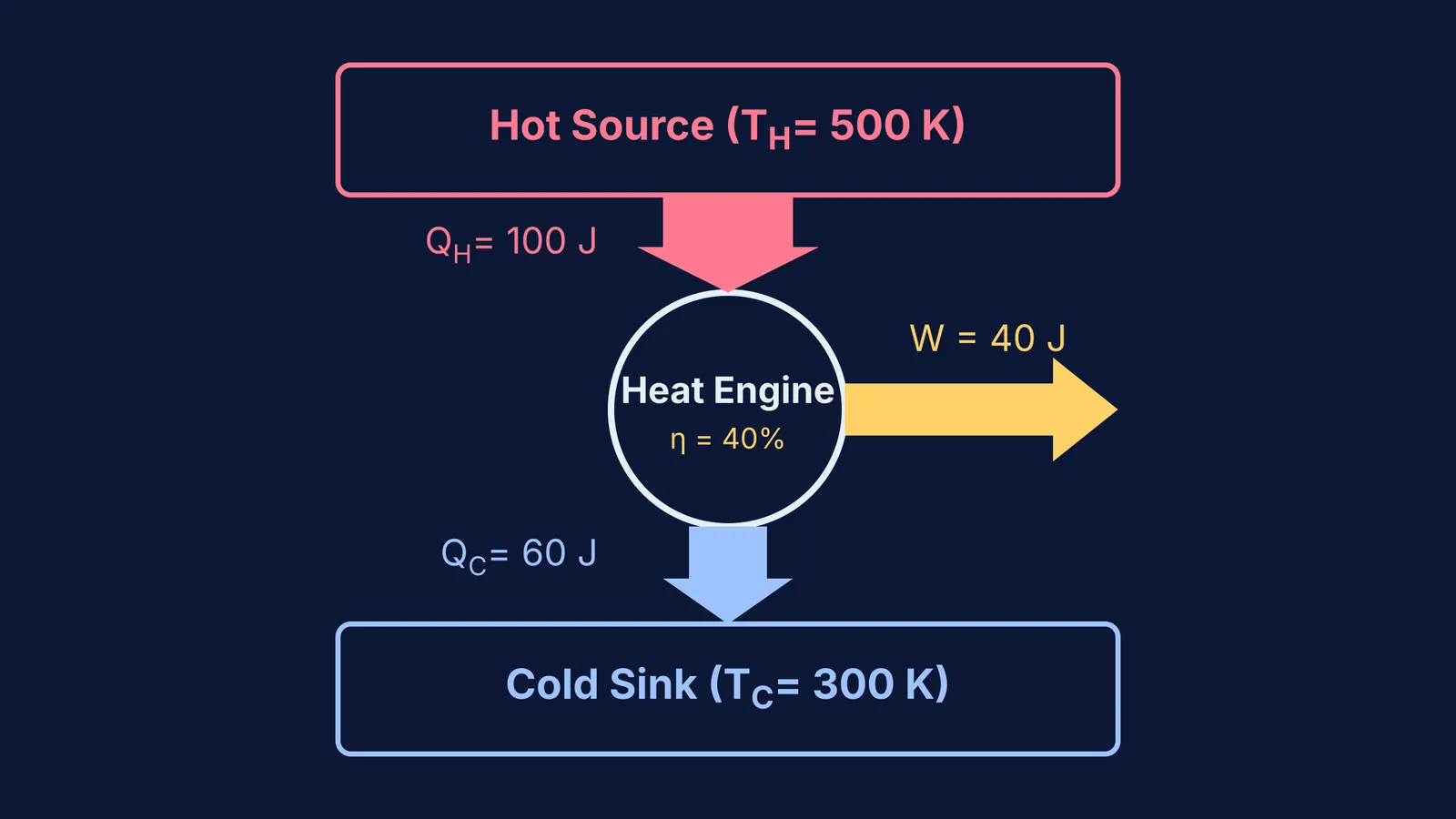
In plain English, this means you cannot build a heat engine that absorbs heat and turns 100% of it into work. For an engine to run in a continuous cycle, it needs a temperature difference. It must absorb heat from a hot source, extract some of it as useful work, and reject the rest to a cold sink (like the surrounding air or a river). Without this dumping of waste heat, the thermodynamic cycle cannot complete.
How does the Carnot efficiency limit work?
Even before Kelvin and Planck formulated the law, a French engineer named Sadi Carnot calculated exactly what the maximum efficiency could be. In his 1824 treatise, *Reflections on the Motive Power of Fire*, Carnot proved that the maximum efficiency of any heat engine is determined purely by the temperatures of the hot source and the cold sink (Source).
The absolute maximum efficiency, or Carnot efficiency (η), is calculated using absolute temperatures (measured in Kelvin):
η = 1 − (T_C / T_H)
Even a perfect engine with zero friction operating between 500 K and 300 K loses 60% of its energy to the cold sink. This also explains the limits on Work in irreversible expansion: w = −p_ext ΔV, worked—real-world processes are never perfectly reversible, meaning actual efficiency is always lower than the Carnot limit.
The Clausius statement: The flip side of the coin
The Second Law of Thermodynamics can actually be stated in two different ways. While the Kelvin-Planck statement focuses on heat engines, the Clausius statement approaches the problem from the perspective of refrigerators and heat pumps.
Rudolf Clausius stated that heat cannot spontaneously flow from a colder body to a hotter body. If you want to cool something down—like the inside of a refrigerator on a hot Indian summer day—you have to put in external work (usually electricity running a compressor).
Interestingly, physicists proved that the Kelvin-Planck and Clausius statements are logically equivalent. If you could build a magic heat engine that breaks the Kelvin-Planck rule and is 100% efficient, you could use its perfect work output to power a refrigerator that breaks the Clausius rule. Since one is impossible, the other must be impossible too.
How do you tackle thermodynamics in exam prep?
For students preparing for JEE or NEET, the Second Law of Thermodynamics is heavily tested. Examiners will often combine efficiency questions with graphical problems. Knowing how to calculate the Net work in a cycle: reading the loop on an indicator diagram is a vital skill. You also have to recognize when no work is being done at all, such as in the Free expansion of an ideal gas: why work and ΔU are both zero.
A checklist for heat engine problems
Identify the reservoirs: Pinpoint the hot source (T_H) and cold sink (T_C).
Check the units: Convert all temperatures from °C to K (add 273.15).
Calculate the ideal limit: Find η = 1 − (T_C / T_H).
Compare to reality: If the problem gives actual work output (W) and heat input (Q_H), the real efficiency is W / Q_H. The real efficiency must be less than or equal to the Carnot limit.
Let's look at a classic exam scenario. A student is told that a heat engine operates between boiling water at 100 °C and a room temperature of 27 °C, absorbing 1000 J of heat. How much work can it realistically perform?
First, follow the checklist. The hot source (T_H) is 100 °C, which is 373 K. The cold sink (T_C) is 27 °C, which is 300 K. Next, find the Carnot limit: η = 1 − (300 / 373) = 0.196. Finally, calculate the maximum work. Since the engine absorbs 1000 J of heat, the absolute maximum work it can deliver is 0.196 multiplied by 1000 J, which is 196 J. The remaining 804 J is inevitably dumped into the room as waste heat.
If you are stuck on setting up these ratios, the Fermi Concept Library holds clear derivations for the Carnot cycle and the Second Law. When you need to practice, the Fermi Problem Library has worked problems with a step-by-step solver that explains the reasoning rather than just printing an answer. And if you are not sure where your gaps are, Fermi's AI tutor can work out what you already know and build a plan for the session, so you sit down to a clear next step.


