

On this page
The second derivative test is a quick way to classify critical points. If you find a point x = c where the first derivative is zero (f′(c) = 0), you can plug it into the second derivative. If f″(c) > 0, the curve is concave up, meaning you have found a local minimum. If f″(c) < 0, it is concave down, making it a local maximum. This is usually much faster than testing points on a number line, which is why students prefer it.
But this test is not foolproof. There are times when f″(c) = 0 or is undefined. When this happens, the second derivative test fails and gives you no information. If the second derivative test fails and gives you no information, you might be tempted to guess the shape from the function's equation, but guessing often leads to mistakes. Even if a function looks straightforward, an inflection point can masquerade as a minimum if you are not careful. This is why having a robust method like the first derivative test is critical for success in competitive exams.
What does it mean when the second derivative test is inconclusive?
When the second derivative evaluates to exactly zero at a critical point, the test is strictly inconclusive. According to OpenStax Calculus Volume 1, this happens because different functions with a zero second derivative at a critical point can behave in entirely different ways. The curvature is completely "flat" for an instant, so the simple concave up or concave down rule cannot decide the shape.
Why does the second derivative test fail for x⁴ and x³?
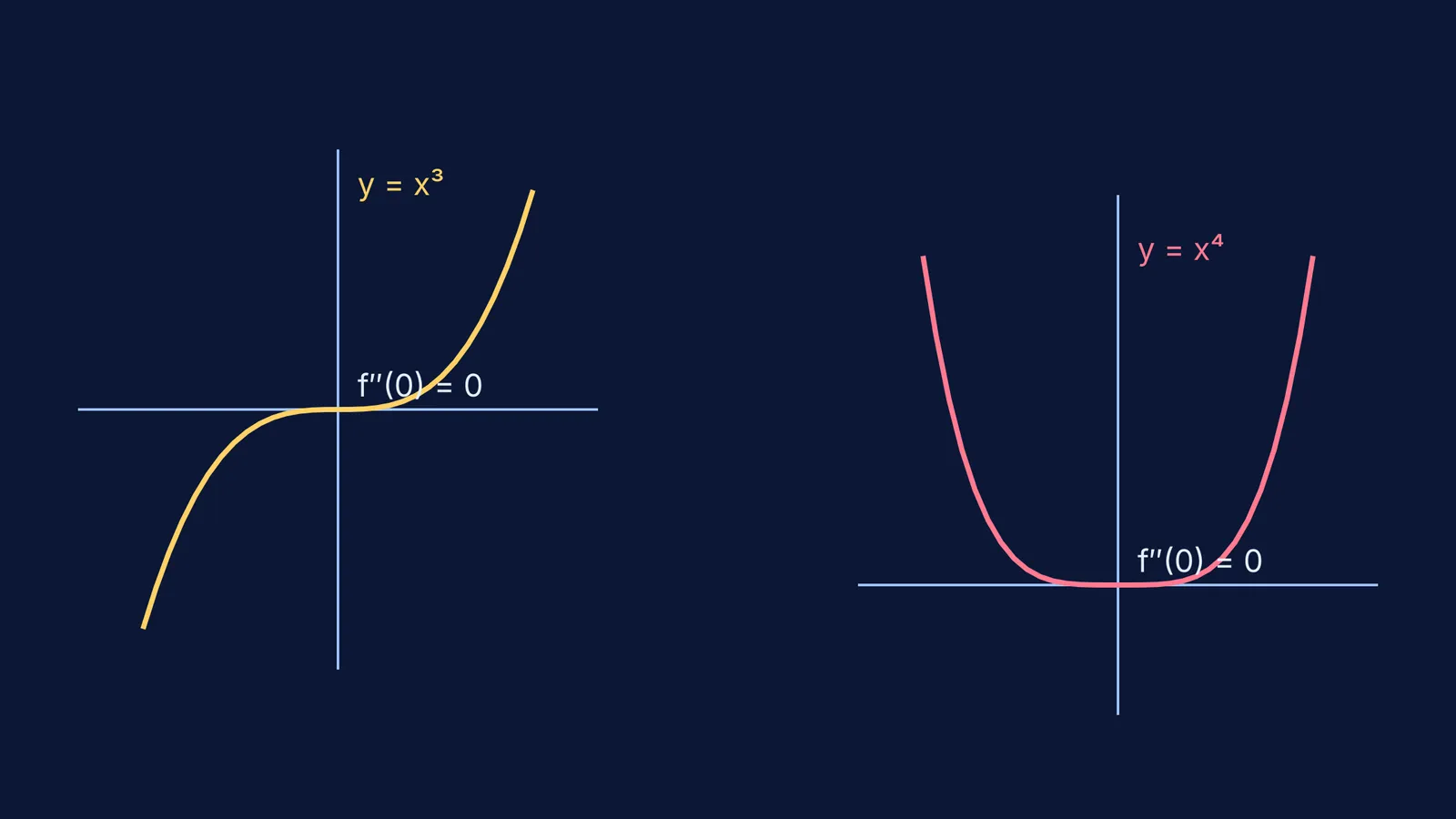
The classic examples of this failure are the functions f(x) = x⁴ and f(x) = x³ at the origin. In both cases, the graphs become perfectly horizontal at x = 0, but their overall shapes are entirely different.
For f(x) = x⁴, the first derivative is 4x³ and the second derivative is 12x². At x = 0, both f′(0) = 0 and f″(0) = 0. The test is inconclusive, yet if you look at the graph of x⁴, it clearly bottoms out at the origin. The point is a local minimum. (If we were testing f(x) = -x⁴, it would similarly fail, but the point would be a local maximum).
For f(x) = x³, the first derivative is 3x² and the second derivative is 6x. At x = 0, again, f′(0) = 0 and f″(0) = 0. But this time, the point is neither a maximum nor a minimum; it is a horizontal inflection point where the curve flattens out before continuing upwards.
Because the test gives the exact same result (0) for a minimum, a maximum, and an inflection point, you cannot trust it.
What to do when the second derivative test fails?
When the test fails, you must fall back on the first derivative test. You go back to checking the sign of f′(x) on either side of the critical point c.
Pick a test value slightly less than c and another slightly greater than c. Choose numbers that are easy to evaluate.
Plug both test values into the first derivative f′(x).
If f′(x) changes from negative to positive, the slope goes from downhill to uphill. The point is a local minimum.
If f′(x) changes from positive to negative, the slope goes from uphill to downhill. The point is a local maximum.
If f′(x) does not change sign (it goes from positive to positive, or negative to negative), the point is neither a maximum nor a minimum.
How does checking the sign change work in practice?
Let us test the function f(x) = x⁴ - 4x³ to see how this fallback works in practice.
First, find the critical points by setting the first derivative to zero: f′(x) = 4x³ - 12x² = 4x²(x - 3)
Setting 4x²(x - 3) = 0 gives critical points at x = 0 and x = 3.
Next, try the second derivative test to save time: f″(x) = 12x² - 24x
At x = 3, f″(3) = 12(3)² - 24(3) = 108 - 72 = 36. Since 36 is positive, the curve is concave up. Therefore, x = 3 is a local minimum.
At x = 0, f″(0) = 12(0)² - 24(0) = 0. The second derivative test fails.
To figure out what is happening at x = 0, we fall back to the first derivative test. We check the sign of f′(x) = 4x²(x - 3) slightly to the left and right of x = 0:
Choose x = -1 (left of 0): f′(-1) = 4(-1)²(-1 - 3) = 4(-4) = -16 (negative).
Choose x = 1 (right of 0): f′(1) = 4(1)²(1 - 3) = 4(-2) = -8 (negative).
Because the first derivative is negative on both sides, the slope does not change sign. The curve is going downhill, flattens out at x = 0, and then continues downhill. Therefore, x = 0 is neither a local maximum nor a local minimum; it is an inflection point.
If you are stuck on these calculations, the Fermi Concept Library contains every concept in physics, chemistry, biology, mathematics and computing, each with its own lesson and its place in the map. It is a great way to confirm what the first derivative test is telling you, especially when checking absolute extrema on a closed interval or dealing with second-order derivative relations. You can also apply these tests to applications of derivatives such as volume and area problems, where classifying the critical point correctly is the final step to the answer.


