

On this page
It is a classic physics puzzle that appears constantly in JEE and NEET exams. You have a beaker of water resting on a weighing scale. You lower a heavy object into the water, suspending it from a spring balance so it never touches the bottom of the beaker.
Does the weighing scale reading change when an object is dipped?
Intuition often says no: the spring balance is holding the object, so its weight shouldn't transfer to the beaker. But the reality is that the reading on the weighing scale increases. It increases by exactly the buoyant force acting on the object, while the spring balance reading decreases by the same amount.
Here is how the physics works, step by step.
Why does the spring balance reading decrease?
When an object is immersed in a fluid, it displaces some of that fluid. Archimedes' principle states that the fluid exerts an upward buoyant force (F_b) on the object equal to the weight of the displaced fluid. OpenStax University Physics confirms that this force acts vertically upwards against gravity.
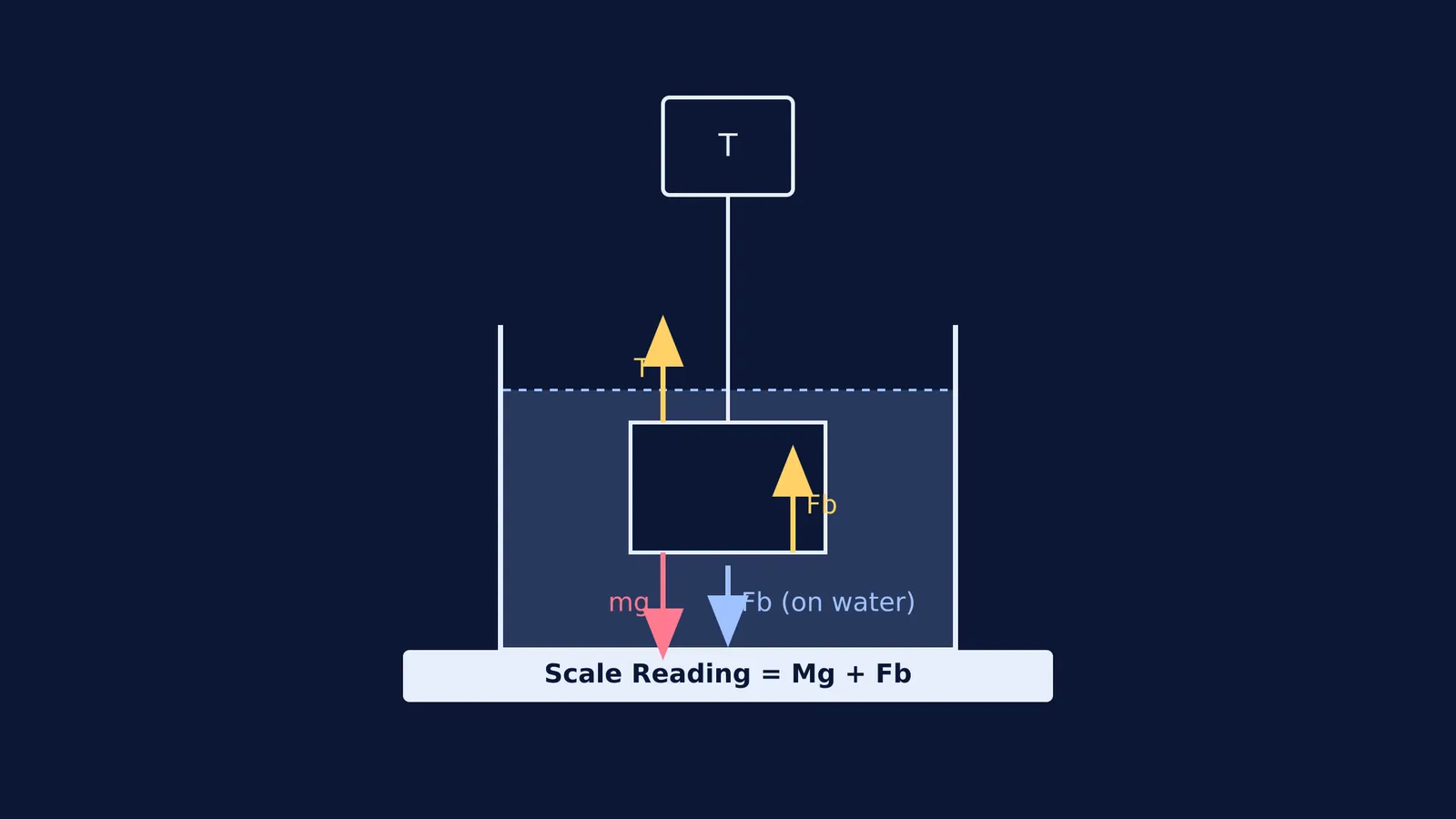
For the object suspended by a string, there are three forces at play:
The object's weight (mg) pulling down.
The tension in the string (T), measured by the spring balance, pulling up.
The buoyant force (F_b) from the water pushing up.
Because the object is stationary, these forces balance out: T + F_b = mg. Rearranging this gives T = mg - F_b. The spring balance reading drops by exactly the buoyant force.
Why does the weighing scale reading increase?
To understand what happens to the beaker, we have to look at the water. If the water pushes the object up with a force of F_b, what does the object do to the water?
This is where Newton's third law of motion comes in. Every action has an equal and opposite reaction. If the water exerts an upward buoyant force on the object, the object must exert an equal downward force on the water.
This downward force is transmitted through the fluid to the bottom of the beaker, and finally to the weighing scale. The scale is now supporting the original weight of the beaker and water (Mg), plus the new downward force from the object (F_b). The normal force (N) provided by the scale becomes N = Mg + F_b.
Even though the object is held externally, its interaction with the water transfers a measurable force to the scale beneath it. You can see similar applications of these principles in our guide to Contact force between blocks pushed together on a smooth floor.
A worked example: a 2 kg block in water
Let's put some numbers to these concepts. Imagine you have a beaker containing 3 kg of water. The beaker itself has a mass of 0.5 kg, so the initial reading on the weighing scale is 3.5 kg, or a weight of 35 N (assuming g = 10 m/s²).
Now, you lower a solid metal block of mass 2 kg and volume 0.0005 m³ into the water, suspending it from a spring balance.
First, we find the buoyant force. The density of water is 1000 kg/m³. F_b = ρVg = 1000 × 0.0005 × 10 = 5 N.
For the spring balance holding the block, the true weight is mg = 20 N. The upward buoyant force is 5 N. Therefore, the tension in the string is: T = mg - F_b = 20 - 5 = 15 N. The spring balance reading decreases from 20 N to 15 N.
For the weighing scale underneath the beaker, the water pushes up on the block with 5 N of force, so the block pushes down on the water with 5 N of force. The original weight of the beaker and water system was 35 N. The new normal force provided by the scale is: N = Mg + F_b = 35 + 5 = 40 N. The weighing scale reading increases from 35 N (or 3.5 kg) to 40 N (or 4.0 kg).
This confirms the sanity check: the total weight of the isolated components is 20 N + 35 N = 55 N. The sum of the two scale readings is 15 N + 40 N = 55 N. The total force in the system remains conserved.
A framework for two-scale buoyancy problems
When you face a problem with multiple scales in an exam, the trick is to isolate the systems. Do not try to solve everything at once.
Find the buoyant force: Calculate F_b = ρVg, where ρ is the density of the fluid and V is the submerged volume of the object.
Isolate the object: Draw a free-body diagram for the object alone. Set Tension = True Weight - F_b.
Isolate the beaker: Draw a free-body diagram for the beaker and liquid. Set Scale Reading = Original Weight + F_b.
Check the total system: As a sanity check, the sum of both scale readings should always equal the total weight of the object, beaker, and fluid combined ((M + m)g).
If you're unsure how to set up the free-body diagram for cases like this, Fermi's AI tutor can build a plan for the session and teach you through it by drawing the figure and checking your understanding as it goes. For more practice on setting up equations for normal forces, you might explore Monkey climbing a rope: tension when it speeds up or slows down or read about Two immiscible liquids in a manometer: finding the unknown density.
If you want to read through similar fundamental ideas, the Fermi Concept Library maps out every concept in physics with its own lesson. By applying Newton's third law consistently, what looks like a trick question becomes a straightforward balancing of forces.


