

On this page
Many students learn to calculate area and perimeter at the exact same time during their schooling, leading to a persistent confusion between the two measurements. If you take 24 square tiles and arrange them into different rectangular shapes, the total number of tiles (the area) stays exactly the same. But the distance around the outside edge (the perimeter) changes drastically depending on how you arrange them.
A 2016 study by researchers Gülçin Tan Şişman and Meral Aksu found that only 5% of sixth-graders could correctly handle spatial measurement tasks involving the complex relationship between area and perimeter. In fact, 62% of the students incorrectly believed that if two shapes are made up of the exact same pieces, their perimeters must be equal.
How do perimeters change for rectangles with an area of 24?
To see why perimeter changes while area stays constant, consider all the rectangles with integer side lengths that have an area of 24. Area is the length multiplied by the width, while perimeter is the total distance around the four sides (2 × length + 2 × width).
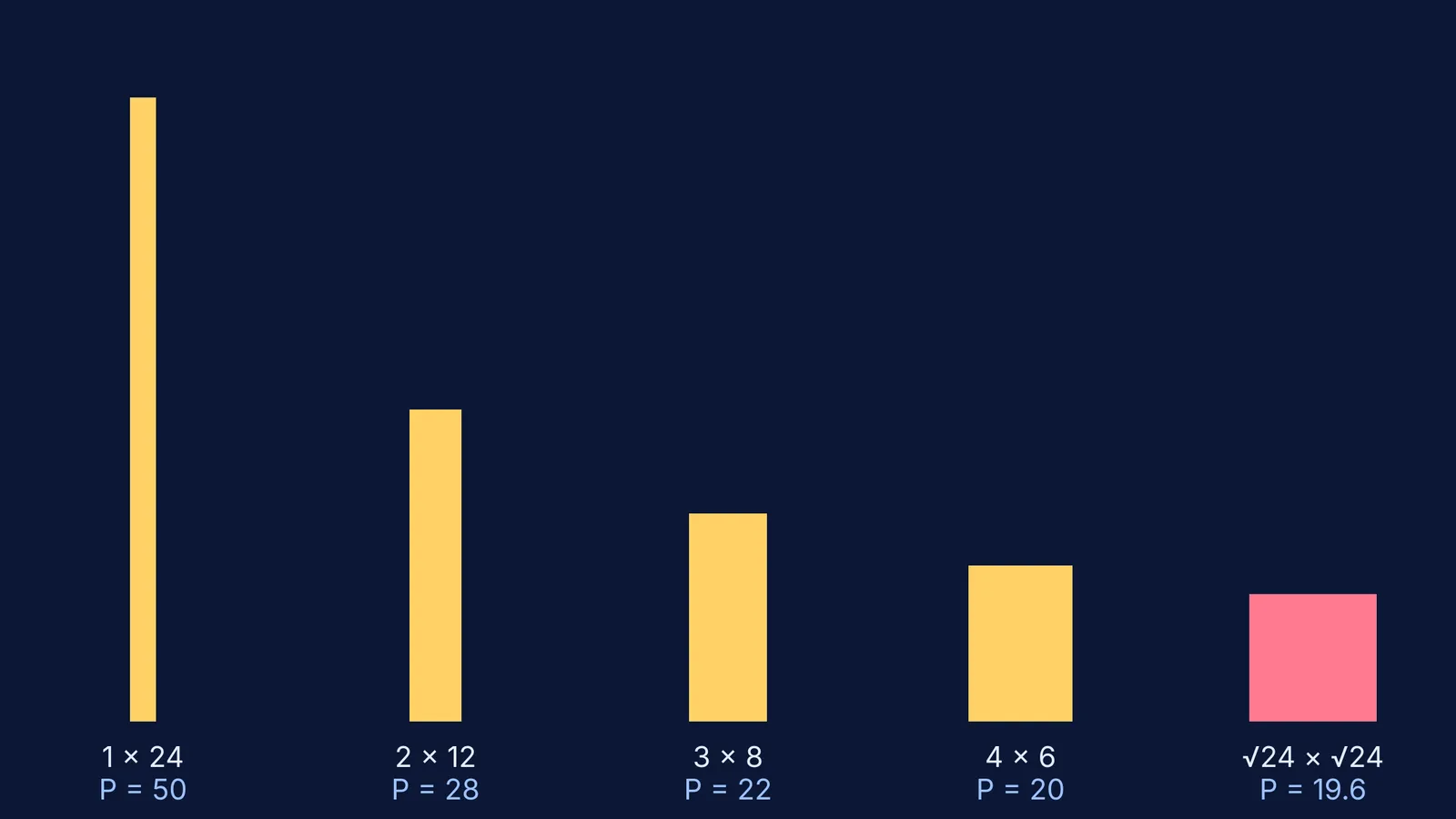
1 × 24 rectangle: Area is 24. Perimeter is 2 × (1 + 24) = 50.
2 × 12 rectangle: Area is 24. Perimeter is 2 × (2 + 12) = 28.
3 × 8 rectangle: Area is 24. Perimeter is 2 × (3 + 8) = 22.
4 × 6 rectangle: Area is 24. Perimeter is 2 × (4 + 6) = 20.
Every one of these geometric figures covers exactly 24 square units of space. Yet the perimeter drops from 50 to 20 as the rectangle becomes less "stretched out" and more structurally compact. This demonstrates that you can dramatically alter a boundary without changing the enclosed space at all.
Why does a square have the least perimeter?
If you are permitted to use decimals or fractions, you can make the rectangle even more compact. The two-dimensional shape that encloses a given area with the absolute minimum perimeter is always a square.
For an area of 24, a square would have side lengths of √24, which is approximately 4.899. Its perimeter is 4 × 4.899 = 19.596, which is slightly less than the 20 of the 4 × 6 rectangle. This is why a square is the most "efficient" rectangle: it covers the most area using the least amount of outer boundary. This principle is not just a mathematical curiosity; it has real-world applications in architecture, packaging, and engineering, where minimising material costs for a specific volume or area is crucial.
If your child struggles with these differences or relies on memorising formulas instead of picturing the shapes, Fermi's AI tutor can teach the concepts step-by-step. The tutor teaches rather than answers: it holds a line of reasoning across a session, draws the figure, and works out what the student knows instead of just printing a calculation. To review the mathematical foundations, the Fermi Concept Library covers every concept in mathematics, physics, chemistry, biology and computing.
How can we avoid the same-area same-perimeter trap?
To help avoid the "same area means same perimeter" trap, encourage learners to look for extreme cases when solving problems.
Long and skinny: A very thin rectangle has a huge perimeter relative to its area. A 0.1 × 240 rectangle still has an area of 24, but its perimeter is a massive 480.2.
Compact and square: A square (or a circle, if we aren't restricted to rectangles) pulls the area into the tightest possible boundary.
When checking geometry work, test whether the answer makes sense by picturing these extremes. You can use this logic to check equations in other areas of maths, much like using the discriminant test to see when a quadratic is always positive. Grasping how properties change independently is a core skill in both geometry and modelling, whether you are solving coordinate geometry problems like drawing a circle through three given points or finding the latus rectum lengths of conic sections.


