

On this page
Cooking myths often borrow a concept from chemistry and stretch it out of proportion. One of the most common kitchen rules is that adding a generous pinch of salt to your pasta pot raises the water's boiling point, allowing the pasta to cook faster at a higher temperature. The science behind this idea—known as boiling point elevation—is a standard topic in high school chemistry. But what happens when we run the numbers on a real pot of water?
It turns out the temperature change is real, but microscopic. Let's work out exactly how much a teaspoon of salt changes the temperature of your boiling water, using the standard formula and colligative properties.
How does boiling point elevation work?
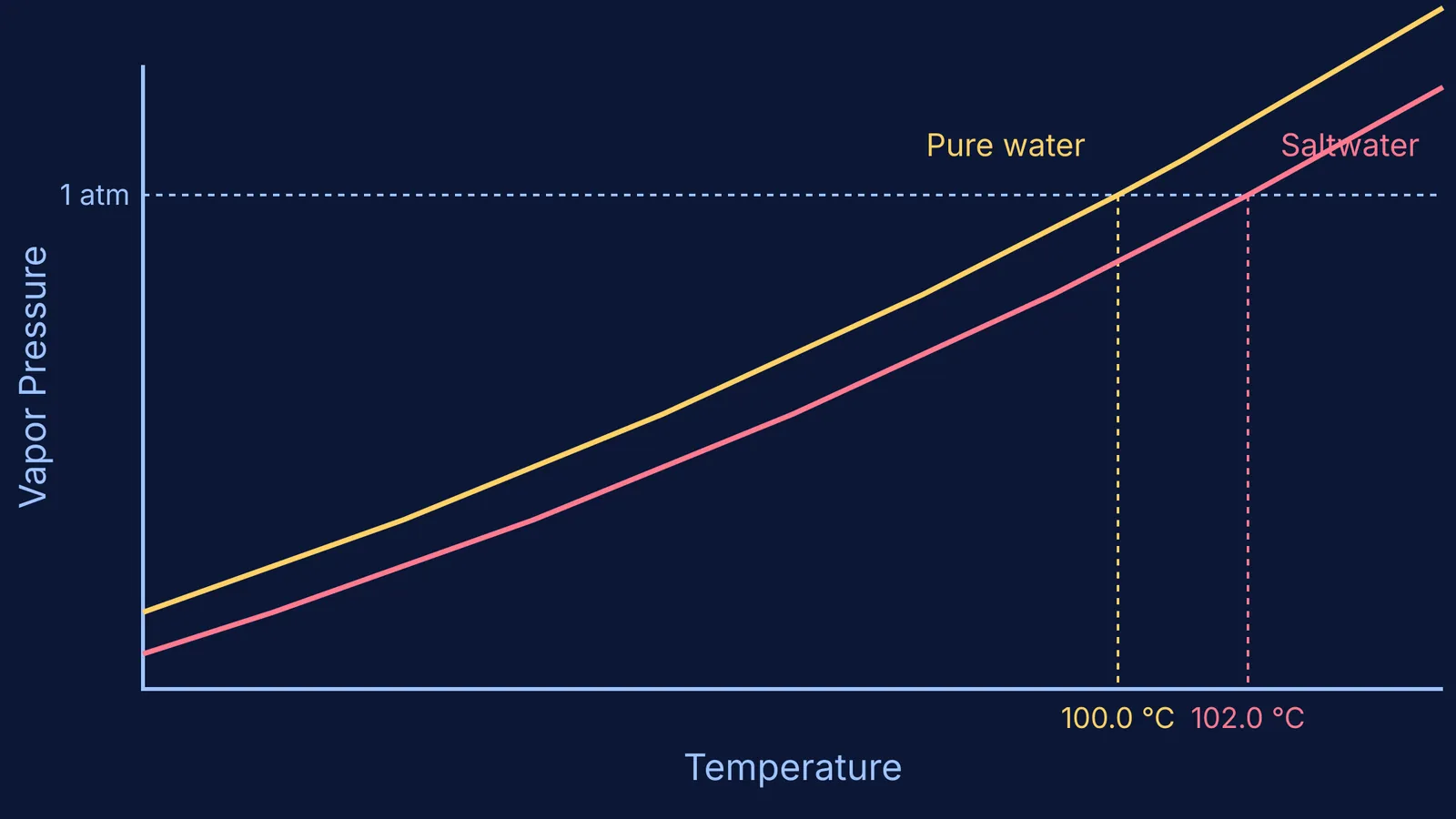
When you heat pure water, it normally boils at 100 °C at sea level. At this specific temperature, the vapor pressure of the liquid equals the atmospheric pressure pushing down on it, which allows bubbles of gas to form within the liquid and escape.
When you dissolve a non-volatile substance like salt into the water, the solute particles physically get in the way of the water molecules at the surface. This lowers the overall vapor pressure of the solvent. To make the solution boil, you now have to heat it to a slightly higher temperature so that its vapor pressure can once again match the atmosphere.
Boiling point elevation is the difference in temperature between the boiling point of a pure solvent and that of a solution. Because it is a colligative property, it depends strictly on the total number of dissolved particles rather than their chemical identity. Just like finding molar mass from osmotic pressure, the severity of the effect scales with the concentration of particles in the liquid.
If you are working through physical chemistry questions on solutions, you can explore the underlying thermodynamics in the Fermi Concept Library, where every concept in physics, chemistry, biology, mathematics and computing has its own lesson and its place in the map.
Does adding salt to water make it boil at a higher temperature?
Yes, but by an incredibly small margin for the amounts typically used in cooking. We can calculate the exact temperature increase using the boiling point elevation formula: ΔT = i × Kb × m.
Let's break down the variables for a standard pot of salted water:
Kb (the molal boiling-point elevation constant): The molal boiling-point elevation constant for water is 0.512 °C/m.
i (the van 't Hoff factor): Table salt is sodium chloride (NaCl), which dissociates into two ions (Na⁺ and Cl⁻) in water, meaning the van 't Hoff factor is 2.
m (molality): This represents the moles of solute per kilogram of solvent. Working with molality avoids the volume changes that occur with temperature, though it requires careful tracking of masses, much like mixing and diluting solutions.
According to the USDA FoodData Central database, one US teaspoon of table salt weighs 6.1 grams. The molar mass of sodium chloride is 58.44 g/mol.
If you dissolve that single teaspoon of salt (6.1 grams) into one litre of water, which conveniently weighs exactly one kilogram:
Moles of salt = 6.1 g / 58.44 g/mol = 0.104 moles.
Molality (m) = 0.104 moles / 1 kg = 0.104 m.
Temperature change (ΔT) = 2 × 0.512 °C/m × 0.104 m = 0.107 °C.
A teaspoon of salt in a litre of water raises the boiling point by roughly one-tenth of a degree Celsius. Even if you heavily salt a larger 4-litre pot with a full tablespoon of salt, the boiling point only increases by about 0.08 °C.
Worked example: How much salt for a real difference?
What if you actually wanted to raise the boiling point by a full 2.0 °C to cook your pasta noticeably faster? Let's rearrange the formula to find the mass of salt required for 1 kg of water.
Set ΔT = 2.0 °C.
2.0 = 2 × 0.512 × m.
m = 2.0 / 1.024 = 1.95 mol/kg.
Moles of NaCl needed = 1.95 moles.
Mass = 1.95 moles × 58.44 g/mol = 114 grams of salt.
You would need to dump more than 114 grams of salt—nearly 19 teaspoons—into a single litre of water just to raise the boiling point by two degrees. The resulting pasta would be inedibly salty, resembling water from the Dead Sea more than a seasoned broth.
If you ever get stuck rearranging variables or solving colligative property equations like this for your exams, you can walk through the steps in the Fermi Problem Library, where a step-by-step solver explains the reasoning rather than printing an answer.
Why do we salt pasta water?
If adding salt does not cook the pasta faster, why is it an almost universal rule of cooking? The answer is purely for flavour and culinary structure.
Dried pasta is highly absorbent. As it rehydrates and cooks in the boiling water, it draws the liquid inside its starch matrix. Salting the water heavily ensures that you are seasoning the pasta from the inside out, rather than just coating the surface with salt later when you add the sauce.
So, keep salting your water generously. Just know that you are doing it entirely for taste, not to bend the laws of thermodynamics.


