

On this page
In Class 10 chemistry, understanding how salts are related helps you predict their properties. Rather than memorising many individual compounds, common salts are grouped into families based on their shared radicals (ions).
What is a family of salts?
A family of salts is defined by a common ion. A salt is an ionic compound formed by the neutralisation of an acid and a base. The positive ion comes from the base, and the negative ion comes from the acid. If two salts have the same positive ion (cation) or the same negative ion (anion), they are said to belong to the same family of salts (BYJU'S).
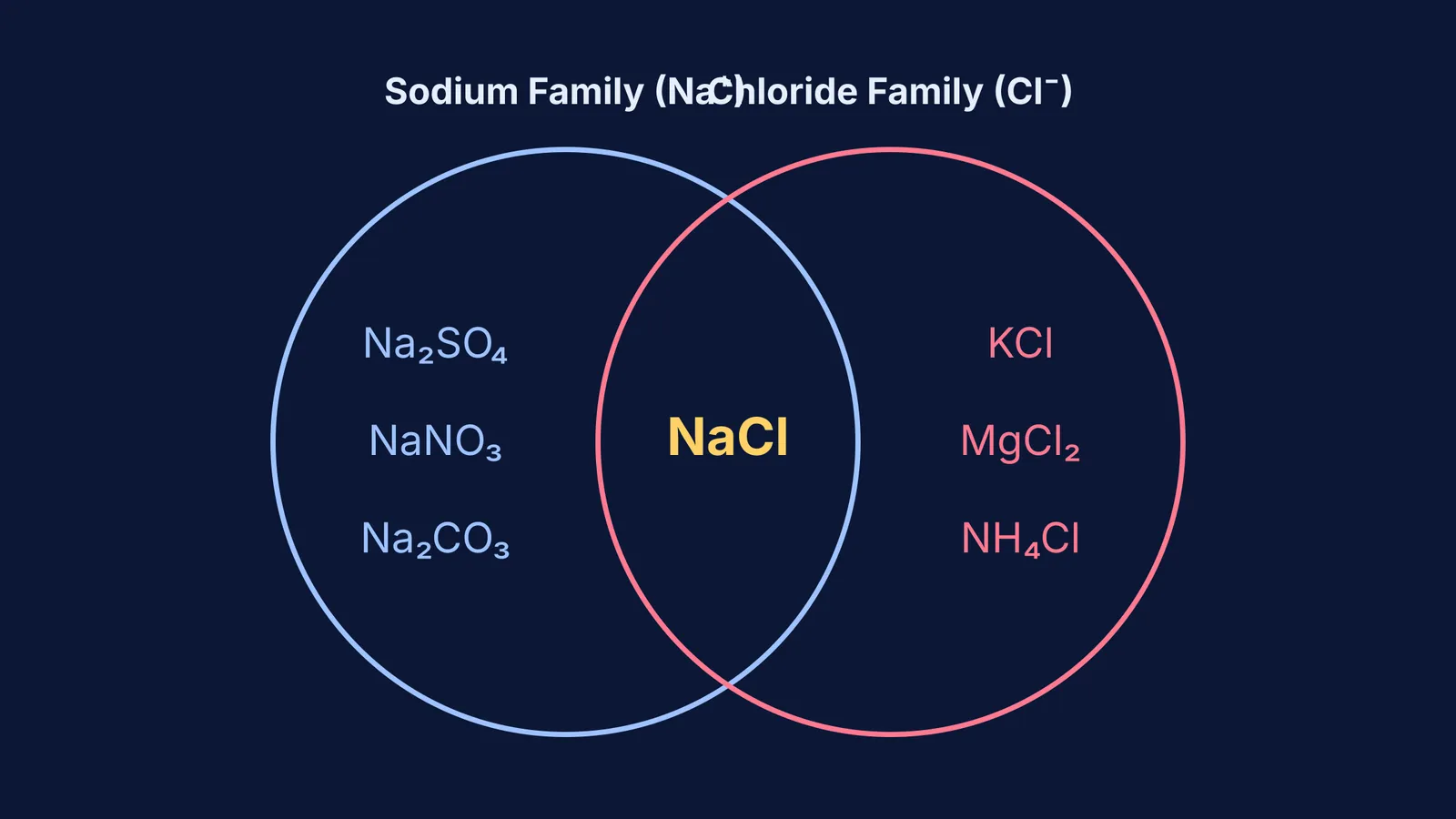
For example, look at sodium chloride (NaCl). It is made of a positive sodium ion (Na⁺) and a negative chloride ion (Cl⁻).
Because it has a Na⁺ ion, it belongs to the sodium family, alongside sodium sulphate (Na₂SO₄) and sodium nitrate (NaNO₃).
Because it has a Cl⁻ ion, it also belongs to the chloride family, alongside potassium chloride (KCl) and magnesium chloride (MgCl₂).
Consider another example: potassium sulphate (K₂SO₄). It is formed from a potassium ion (K⁺) and a sulphate ion (SO₄²⁻). It belongs to the potassium family of salts (along with potassium chloride and potassium nitrate) and the sulphate family of salts (along with magnesium sulphate and copper sulphate).
How does the family affect the pH of a salt?
Salts are not always neutral. The pH of a salt solution depends on the strength of the parent acid and parent base that formed it.
Neutral salts (pH = 7): Formed from a strong acid and a strong base. The chloride family salt NaCl is neutral because it comes from strong hydrochloric acid (HCl) and strong sodium hydroxide (NaOH).
Acidic salts (pH < 7): Formed from a strong acid and a weak base. For example, ammonium chloride (NH₄Cl) is acidic.
Basic salts (pH > 7): Formed from a weak acid and a strong base. Sodium carbonate (Na₂CO₃) is basic because it comes from weak carbonic acid (H₂CO₃) and strong sodium hydroxide.
If you find yourself memorising acid and base reactions, the Fermi Concept Library can help. It shows you the map of chemistry concepts so you can see why strong and weak acids behave differently.
Sodium vs potassium salts: Why does the body care?
Chemistry groups sodium and potassium together because they are both alkali metals that form +1 ions. However, in biology, they are strictly separated.
The cells in the human body maintain a sharp divide between the sodium family and the potassium family of ions. The body uses energy to operate the Na⁺/K⁺-ATPase pump, which constantly moves three sodium ions out of the cell for every two potassium ions it pulls in (NCBI StatPearls).
This means sodium ions are kept at a higher concentration outside the cell, while potassium ions are concentrated inside. This difference in concentration is what creates the electrical potential that allows nerve cells to fire and muscles to contract.
A framework for classifying salts
When you encounter a new salt in Class 10, ask three questions:
What is the positive ion? (This names its metal family).
What is the negative ion? (This names its non-metal family).
Were its parent acid and base strong or weak? (This predicts its pH).
To master this chapter, try creating a simple table in your notebook. List common positive ions (Na⁺, K⁺, Mg²⁺, Ca²⁺, NH₄⁺) down the left side, and negative ions (Cl⁻, SO₄²⁻, NO₃⁻, CO₃²⁻) across the top. Filling in the grid will give you the chemical formulas for dozens of salts, helping you instantly recognise which families they belong to.
If you want to practice more Class 10 topics, you can read our guides on electron dot structures of covalent molecules or naming carbon compounds in Class 10.


