

On this page
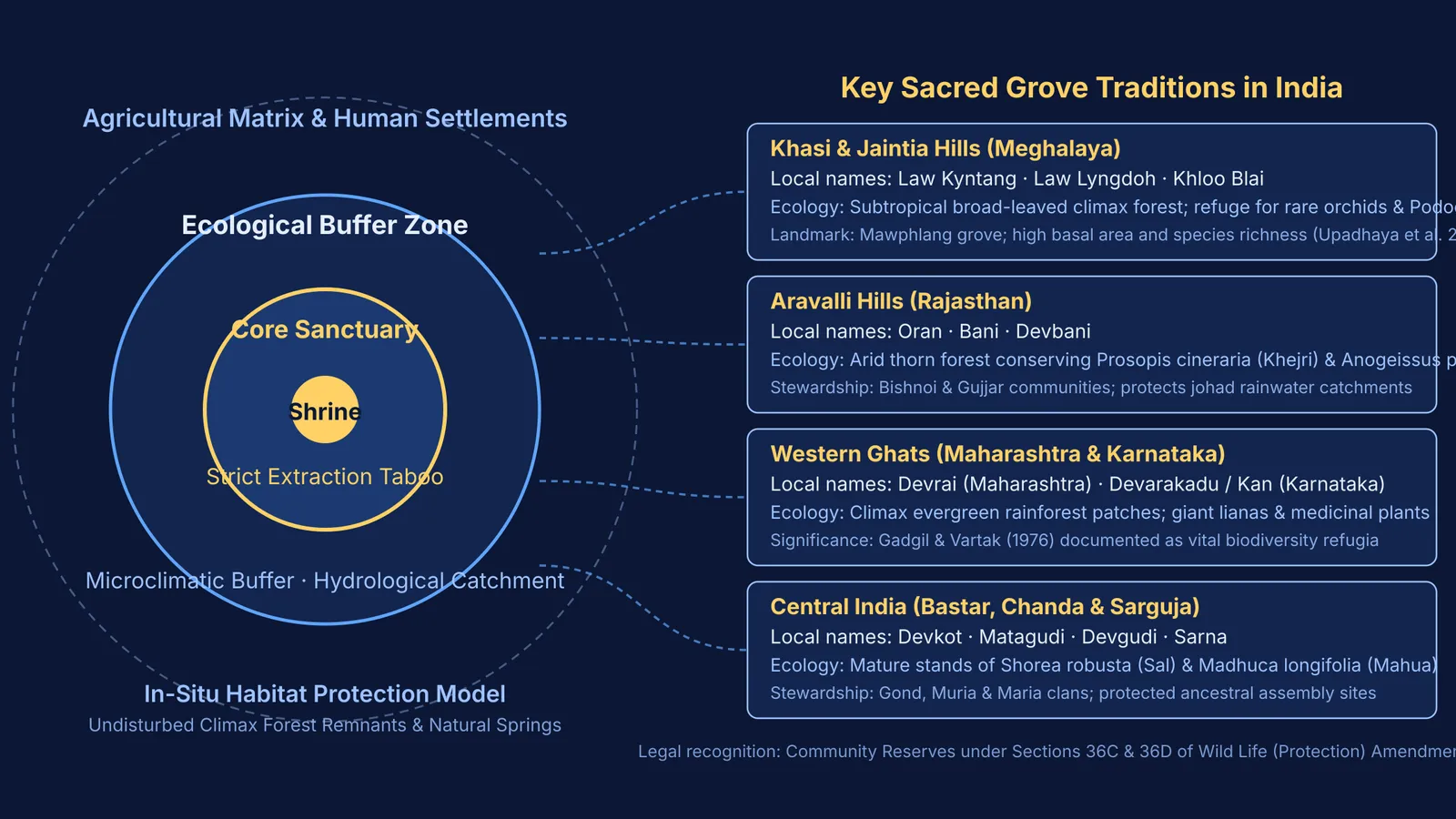
Sacred groves are patches of primeval or near-natural forest dedicated to local deities, ancestral spirits, or village guardians, protected entirely through customary religious taboos and social norms. In these tracts, customary rules prohibit hunting, logging, burning, and often even gathering dry fallen firewood. According to a nationwide review by Sharma and Kumar (2021), sacred groves function as vital community-managed ecological refugia, conserving biodiversity and fragile soil resources in landscapes heavily modified by human settlement.
Unlike state-managed wildlife sanctuaries, sacred groves rely primarily on community self-regulation rather than policing. In their extensive survey across southern and northeastern India, Ormsby and Bhagwat (2010) note that an estimated 100,000 or more sacred forests exist across India, forming a dense network of micro-reserves that sustain genetic diversity. Because the surrounding landscape is frequently cleared for agriculture or urban infrastructure, these groves often represent the only surviving remnant of the region's climax vegetation.
Which sacred groves in India are key examples?
India's sacred groves span distinct biogeographic provinces, from high-rainfall northeastern hills to arid western ridges:
Khasi and Jaintia Hills of Meghalaya: Locally known as Law Kyntang or Law Lyngdoh in Khasi and Khloo Blai in Jaintia, these montane forests are safeguarded by indigenous clans through the veneration of deities such as Labasa. The famed Mawphlang sacred grove near Shillong represents one of the best-preserved examples. Research by Upadhaya et al. (2003) in the Jaintia Hills demonstrated that these groves maintain high tree density and species richness, preserving rare endemic flora, epiphytic orchids, and native gymnosperms such as *Podocarpus neriifolia*.
Aravalli Hills of Rajasthan: In the arid and semi-arid terrain of Rajasthan, sacred groves are maintained as Orans, Banis, or Devbanis. Communities such as the Bishnois and Gujjars protect keystone desert trees including *Prosopis cineraria* (Khejri) and *Anogeissus pendula* (Dhok). These groves surround seasonal rainwater storage ponds (*johads*), preventing siltation and ensuring groundwater recharge.
Western Ghats of Maharashtra and Karnataka: Across the Western Ghats biodiversity hotspot, sacred groves are called Devrai in Maharashtra and Devarakadu or Kans in Karnataka. In their landmark study published in *Economic Botany*, Gadgil and Vartak (1976) documented that Devrais preserved climax evergreen rain forest patches containing ancient lianas and medicinal plants that had vanished from surrounding logging concessions.
Bastar and Sarguja areas of Central India: In the tribal heartlands of Bastar and northern Chhattisgarh, groves are revered as Devkot, Matagudi, Devgudi, or Sarna. Managed by Gond, Muria, and Maria communities, they shield climax stands of *Shorea robusta* (Sal) and *Madhuca longifolia* (Mahua), serving as sacred sites for community festivals and ancestral assemblies.
How do sacred groves protect regional biodiversity?
Sacred groves deliver disproportionately large ecosystem services relative to their physical acreage. By maintaining multi-tiered tree canopies, dense leaf litter, and undisturbed soil crusts, they create stable microclimates with higher relative humidity and lower ground temperatures than surrounding farmland. This microhabitat supports specialized decomposers, mycorrhizal fungi, insect pollinators, and avian species that cannot persist in monoculture crop fields.
They also function as hydrological buffers. Dense root networks enhance soil permeability and prevent runoff during monsoon downpours, replenishing perennial natural springs and keeping local streams flowing during dry months.
To provide formal legal recognition without undermining indigenous management, Parliament passed the Wild Life (Protection) Amendment Act of 2002. Sections 36C and 36D introduced Community Reserves, enabling state forest departments to legally register community-owned or privately protected lands while leaving daily governance to local management committees.
If you are exploring how microclimates, habitat fragmentation, and ecological refugia influence species survival, the Fermi Concept Library covers every concept in biology, each with its own lesson and its place in the map.
How are sacred groves tested in NEET biology?
In the NCERT Class 12 Biology curriculum (Chapter on Biodiversity and Conservation), sacred groves feature prominently as a core question topic. Students frequently encounter direct recall questions and assertion-reason items evaluating conservation classification.
When revising for the examination, use this systematic checklist:
Classify the conservation category: Always classify sacred groves as in-situ conservation because organisms are protected within their natural evolutionary habitat. Do not confuse them with ex-situ measures like cryopreservation, botanical gardens, pollen banks, or zoological parks.
Memorise the four official NCERT examples: Keep the textbook list exact: Khasi and Jaintia Hills in Meghalaya, Aravalli Hills of Rajasthan, Western Ghats regions of Karnataka and Maharashtra, and Sarguja, Chanda, and Bastar areas of central India. Questions regularly test these four regional pairs in match-the-list questions in NEET.
Recall the Meghalaya plant refuge fact: NCERT specifically notes that in Meghalaya, sacred groves are the last refuges for a large number of rare and threatened plants. This exact statement frequently appears as the correct alternative in single-choice questions.
Verify the line-by-line textbook wording: Because NEET biology tests literal phrasings, review our guide on using NCERT lines for NEET biology and review broader ecological numericals in biodiversity and conservation key facts.
When working through ecology and conservation questions, Fermi's AI tutor works out what you already know and builds a plan for the session, noticing where you get stuck and checking your understanding step by step.


