

On this page
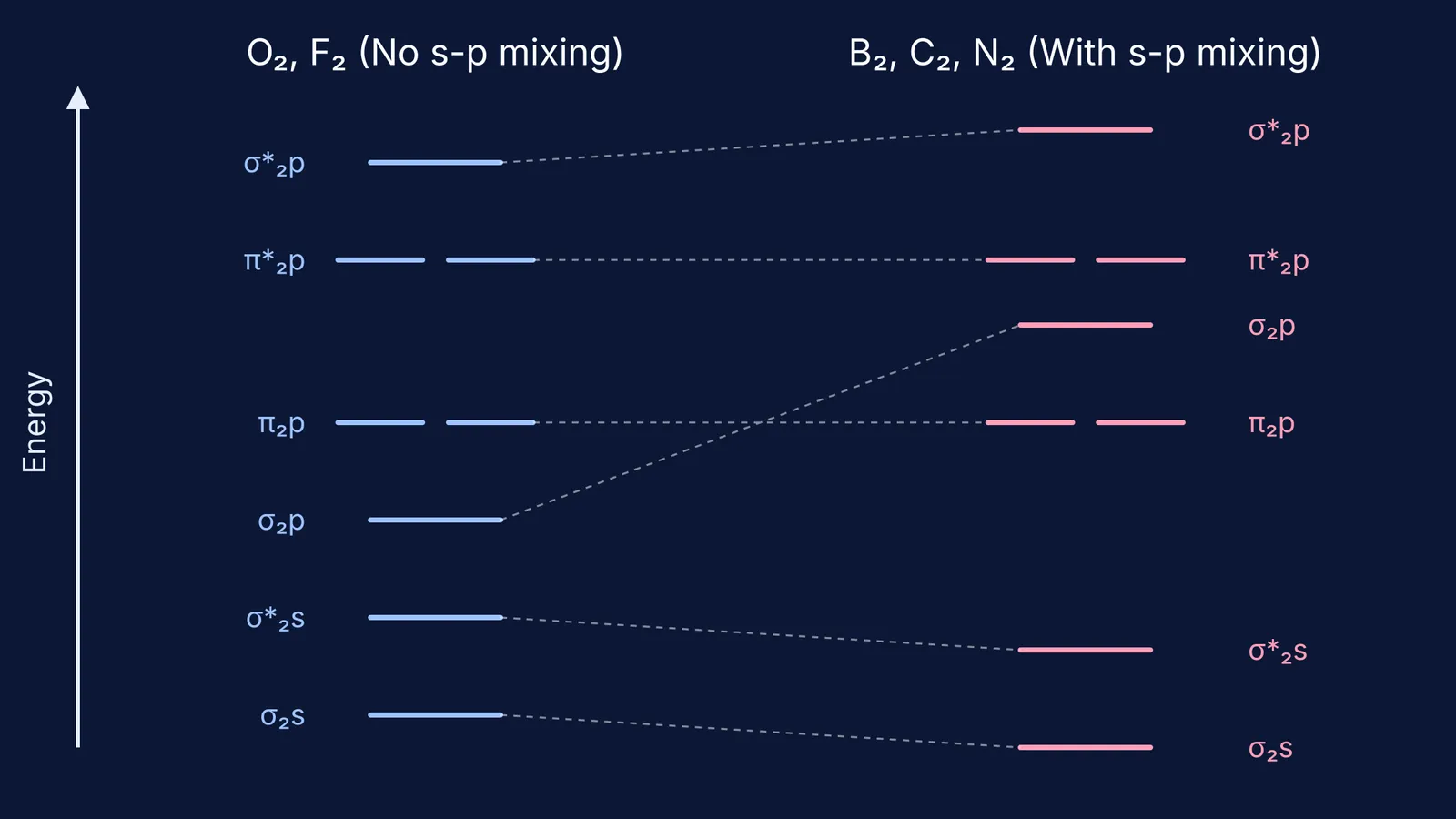
If you draw the molecular orbital (MO) diagram for oxygen (O₂), you place the σ₂p orbital below the π₂p orbitals. But if you do the same for nitrogen (N₂), boron (B₂), or carbon (C₂), the order flips: the π₂p orbitals sit below the σ₂p orbital.
This flipped order is not a random exception. It happens because of s-p mixing, a quantum mechanical interaction first understood by pioneers like Robert Mulliken that forces orbitals to repel each other. Understanding why this happens is the key to explaining the stability of nitrogen gas and why liquid oxygen sticks to a magnet.
What is s-p mixing in molecular orbitals?
When atomic orbitals combine to form molecular orbitals, they must be close in energy and have the same symmetry. In the second period of the periodic table, both the 2s and the 2p (specifically 2p along the bond axis) atomic orbitals form σ (sigma) molecular orbitals.
Because they share this cylindrical symmetry, the σ₂s and σ₂p molecular orbitals can interact with one another. When two orbitals of the same symmetry interact, they "repel" each other in energy. The lower-energy orbital (the σ₂s) is pushed even lower, while the higher-energy orbital (the σ₂p) is pushed higher. We call this s-p mixing.
For this mixing to be noticeable, the original 2s and 2p atomic orbitals must be close in energy. If the energy gap between them is too large, the orbitals ignore each other, and no mixing occurs.
Why does the energy order change for B₂, C₂ and N₂?
As you move from left to right across the second period, the effective nuclear charge increases. This stronger positive charge pulls all electrons closer, but it stabilises the 2s orbital much more steeply than the 2p orbitals, widening the energy gap between them.
For the lighter elements, this gap is small enough for strong s-p mixing to occur. According to data from LibreTexts Chemistry/05%3A_Molecular_Orbitals/5.02%3A_Homonuclear_Diatomic_Molecules/5.2.02%3A_Orbital_Mixing), the 2p–2s energy gap is 5.7 eV in boron, 8.8 eV in carbon, and 12.4 eV in nitrogen. Because these gaps are relatively small, the σ₂s and σ₂p orbitals strongly repel each other. This repulsion is so intense that the σ₂p orbital is pushed up past the π₂p orbitals.
As a result, the energy order for B₂, C₂, and N₂ becomes: σ₁s < σ*₁s < σ₂s < σ*₂s < π₂p < σ₂p < π*₂p < σ*₂p
Why don't O₂ and F₂ undergo s-p mixing?
By the time you reach oxygen and fluorine, the nucleus has significantly more protons. The 2s electrons, which spend more time close to the nucleus, are pulled inward tightly.
The energy gap between the 2s and 2p orbitals in oxygen widens to 16.5 eV. At this distance, the 2s and 2p orbitals are too far apart in energy to interact. Without this repulsion, the σ₂p orbital remains in its natural position below the π₂p orbitals.
Therefore, for O₂ and F₂, the energy order is standard: σ₁s < σ*₁s < σ₂s < σ*₂s < σ₂p < π₂p < π*₂p < σ*₂p
If you are struggling to remember these energy rules during your revision, the Fermi Concept Library maps out every core idea in chemistry. Furthermore, Fermi's AI tutor can work out what you already know and build a plan for the session, so you sit down to a clear next step instead of staring at a blank page.
How does s-p mixing explain the paramagnetism of B₂?
The reversed energy order changes how we fill electrons into the molecular orbitals, which directly predicts the magnetic properties of the molecule. We can see this clearly in diatomic boron (B₂).
Boron has a total of 10 electrons (or 6 valence electrons). We fill them from the lowest energy orbital up. If we used the standard order (without mixing), the last two electrons would pair up in the lowest-lying σ₂p orbital. This would mean all electrons are paired, and B₂ would be diamagnetic.
However, because of s-p mixing, the π₂p orbitals are actually lower than the σ₂p orbital. The two equal-energy π₂p orbitals must each take one electron before any pairing occurs, following Hund's rule. These two unpaired electrons make B₂ paramagnetic, a fact that matches experimental observations perfectly.
You can read more about how this connects to the molecular orbital theory of other elements, or see how similar concepts apply to the sigma and pi bonds in carbon chemistry.
Checklist: Predicting the magnetism of a diatomic molecule
When tackling exam problems, you can find the magnetic properties and bond order systematically:
Count the total number of electrons in the molecule.
Choose the correct energy order. If the total is 14 or fewer (like B₂, C₂, N₂), use the mixed order where π₂p comes before σ₂p. If the total is 15 or more (like O₂, F₂), use the standard order where σ₂p comes first.
Fill the orbitals one electron at a time, starting from the lowest energy.
When you reach equal-energy orbitals (like the two π₂p orbitals), place one electron in each before pairing them up.
Check for unpaired electrons. If any exist, the molecule is paramagnetic. If all are paired, it is diamagnetic.


