

On this page
When you buy groceries or plan a journey, you rarely need an exact number. Instead, you need an estimate—a quick calculation that is close enough to the real answer to be useful. In Class 6, learning to estimate builds your number sense and gives you a powerful way to check your maths homework before handing it in.
Estimation is the process of finding an approximate value of a quantity to make calculations quicker and easier. The most common way to estimate is by rounding off numbers to the nearest ten, hundred or thousand.
How to round off to the nearest ten, hundred or thousand?
Rounding off makes numbers easier to work with. To round a number, you look at the digit just to the right of the place value you want to round to.
Here are the standard rules:
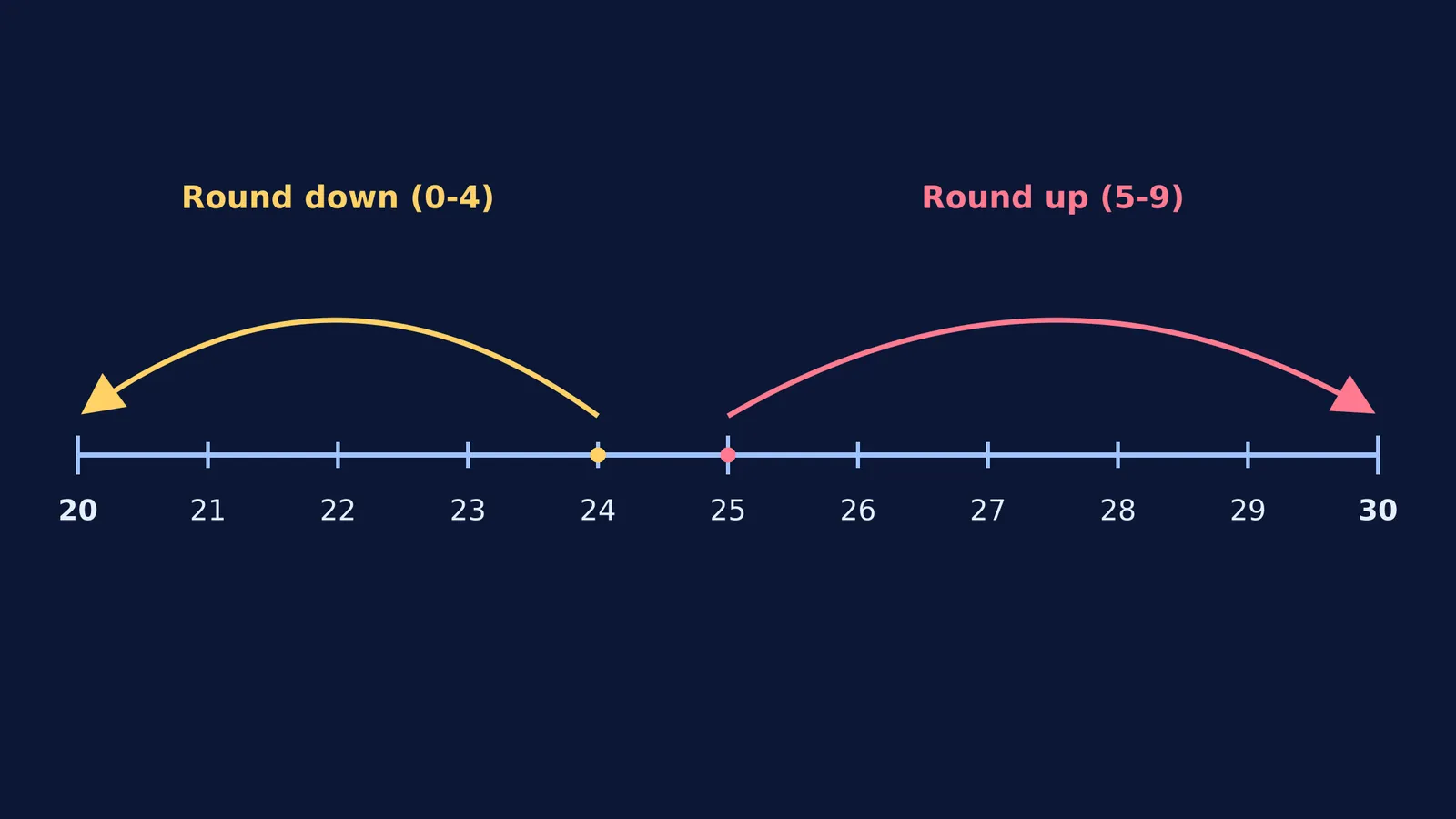
Round down (0 to 4): If the digit to the right is 0, 1, 2, 3, or 4, keep the target digit the same and turn everything after it into zeros. For instance, 24 rounded to the nearest ten is 20.
Round up (5 to 9): If the digit is 5, 6, 7, 8, or 9, increase the target digit by 1 and turn everything after it into zeros. For instance, 26 rounded to the nearest ten is 30. By convention, exactly halfway points like 25 are always rounded up to 30.
This works for any place value. If you are rounding 489 to the nearest hundred, you check the tens digit (8). Because 8 is five or more, 489 rounds up to 500. If you are rounding 2,401 to the nearest thousand, you check the hundreds digit (4). Because 4 is less than five, 2,401 rounds down to 2,000.
If you struggle to remember how place values work, you can revisit the basics in A story of numbers in Class 8 Ganita Prakash: how numerals grew, or look ahead to larger astronomical numbers in Beyond Earth in Class 6 Curiosity: stars, planets and the night sky.
What is the general rule for estimation?
When you need to add, subtract or multiply two large numbers, rounding them first makes the arithmetic much faster. The standard guideline used in schools is known as the general rule.
The general rule states that you should round off each number to its greatest place value before performing the calculation.
Let us look at a few examples:
Estimating a sum: To estimate 5,290 + 17,986.
Round 5,290 to the nearest thousand: 5,000.
Round 17,986 to the nearest thousand: 18,000.
The estimated sum is 5,000 + 18,000 = 23,000.
Estimating a product: To estimate 5,673 × 436.
Round 5,673 to the nearest thousand: 6,000.
Round 436 to the nearest hundred: 400.
The estimated product is 6,000 × 400 = 2,400,000.
Estimation is particularly useful when checking your work in an exam. If you multiply 5,673 by 436 on paper and your answer is somewhere around 24,000, your estimate of 2,400,000 immediately warns you that you have misplaced some zeros.
If you are practising your arithmetic and keep making errors in your working, the Fermi Problem Library has worked problems with a step-by-step solver that explains the reasoning rather than just printing an answer. This helps you spot exactly where your method went wrong without leaving you stuck.
Why do we use estimation in everyday life?
Estimation is not just a classroom exercise. It is a practical skill you will use constantly.
Speed: When you are at a shop comparing prices, you do not have time to do long addition in your head. Rounding numbers lets you quickly add up the bill.
Checking: As seen above, an estimate acts as a safety net. If a calculated answer is far from your estimate, you know you need to redo the sum.
Scale: Sometimes exact numbers are impossible to find. If a news report says a stadium held 49,871 people, it is much easier to communicate that "about 50,000 people" attended.
To build a solid foundation, make estimation a habit. Once you master the rounding rules and the general rule for operations, you will have a reliable way to navigate numbers both in maths class and in the real world. For hands-on maths practice, such as using a compass and ruler, you can also explore Playing with Constructions, Class 6: compass skills step by step.


