

On this page
If you are given the matrix A = [cos θ, sin θ; -sin θ, cos θ], you might be asked to find its nth power, Aⁿ. The answer is surprisingly neat: you just multiply the angle by n to get [cos nθ, sin nθ; -sin nθ, cos nθ].
This is a common matrix problem in Class 12 mathematics and entrance exams. We will prove it using mathematical induction, but first, let us see why the maths works out this way.
What does the matrix cos θ sin θ do?
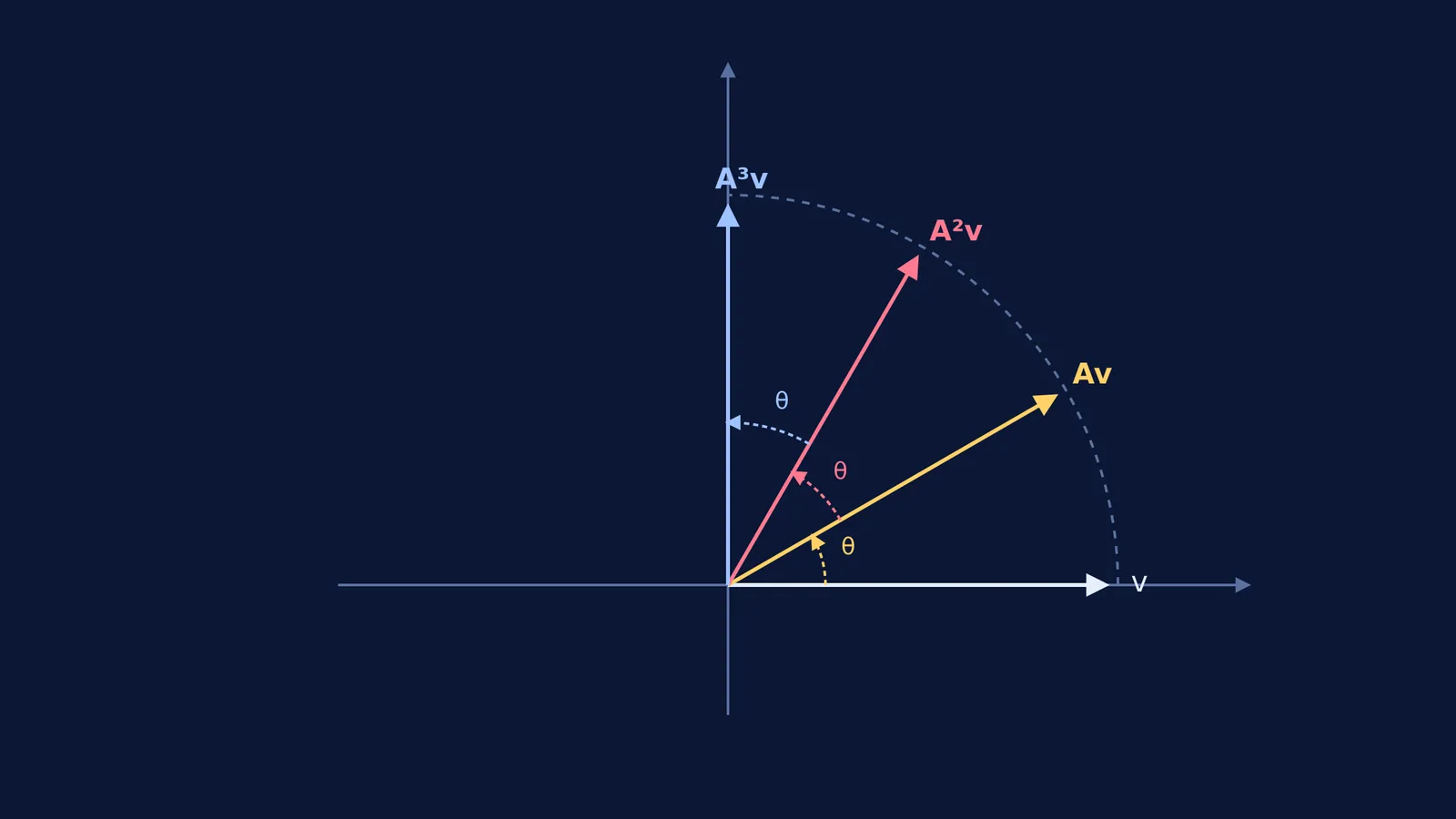
A matrix filled with sines and cosines is a rotation matrix. When you multiply a coordinate vector by this matrix, the vector rotates around the origin by an angle θ.
If you apply the matrix a second time, which is A², you rotate the vector by θ and then by θ again, making the total rotation 2θ. If you raise it to the power n (Aⁿ), the total rotation becomes nθ. This geometric reality is why the formula works, but exams require you to prove it algebraically. If you want to see how this connects to other matrix rules, you can review the Adjoint and inverse of a matrix: the properties JEE tests.
How do you prove the matrix power n by induction?
We use the Principle of Mathematical Induction to prove that Aⁿ = [cos nθ, sin nθ; -sin nθ, cos nθ] for all natural numbers n. The proof starts with a base case and builds up to an induction step [[1]](https://en.wikipedia.org/wiki/Mathematical_induction).
Step 1: The base case For n = 1, the formula gives: A¹ = [cos θ, sin θ; -sin θ, cos θ] This matches the original matrix A exactly, making the base case true.
Step 2: The induction step We assume the formula is true for some integer k. This is our induction hypothesis: Aᵏ = [cos kθ, sin kθ; -sin kθ, cos kθ]
Now, we prove it is true for n = k + 1 by multiplying Aᵏ by A: Aᵏ⁺¹ = Aᵏ × A Aᵏ⁺¹ = [cos kθ, sin kθ; -sin kθ, cos kθ] × [cos θ, sin θ; -sin θ, cos θ]
Using standard matrix multiplication, we get these components: Top-left: (cos kθ cos θ) − (sin kθ sin θ) Top-right: (cos kθ sin θ) + (sin kθ cos θ) Bottom-left: −(sin kθ cos θ + cos kθ sin θ) Bottom-right: (cos kθ cos θ) − (sin kθ sin θ)
Now, we apply the trigonometric angle addition formulas.
Substituting these identities into our matrix gives: Aᵏ⁺¹ = [cos(k+1)θ, sin(k+1)θ; -sin(k+1)θ, cos(k+1)θ]
Since the statement holds for k + 1, it is true for all natural numbers n by induction. If you want to practise more matrix patterns, try Finding Aⁿ for a matrix by spotting the pattern.
What happens if the matrix has a negative sign in the other corner?
Sometimes, exams flip the negative sign to test your understanding. Instead of A = [cos θ, sin θ; -sin θ, cos θ], they might give you B = [cos θ, -sin θ; sin θ, cos θ].
This simply changes the direction of the rotation. The first matrix rotates clockwise, while the second rotates counter-clockwise. The induction proof works in the exact same way. When you multiply Bᵏ by B, you use the same trigonometric identities, but the negative signs appear on the top-right instead of the bottom-left. The final result is still Bⁿ = [cos nθ, -sin nθ; sin nθ, cos nθ].
Is there a faster way than induction?
While exams often require induction, you can also prove this rule using complex numbers. A two-dimensional rotation matrix behaves like a complex number on the unit circle. The matrix [cos θ, sin θ; -sin θ, cos θ] maps directly to cos θ + i sin θ.
According to De Moivre's theorem, when you raise a complex number to the power n, the angle multiplies by n: (cos θ + i sin θ)ⁿ = cos nθ + i sin nθ. Because rotation matrices follow the same algebraic rules as complex numbers, the matrix power must result in [cos nθ, sin nθ; -sin nθ, cos nθ]. This is a great way to verify your answer quickly during a multiple-choice exam, even if you still write out the full induction proof for long-answer sections.
Why use spaced repetition to learn proofs?
Long proofs require you to remember several steps and trigonometric identities at once. If you struggle to recall the angle addition formulas during a test, you should space out your practice. In 1939, H.F. Spitzer demonstrated the effectiveness of spaced repetition by testing it on over 3,600 sixth-grade students in Iowa [[2]](https://en.wikipedia.org/wiki/Spaced_repetition). Reviewing the proof the next day, then the next week, and then the next month locks it into your long-term memory.
If you get stuck on a step, Fermi's AI tutor can work out what you already know and build a plan for the session, guiding you through the algebraic steps without just giving you the answer. You can also explore the Fermi Concept Library to strengthen your grasp of the underlying trigonometric identities before tackling the matrix multiplication.


