

On this page
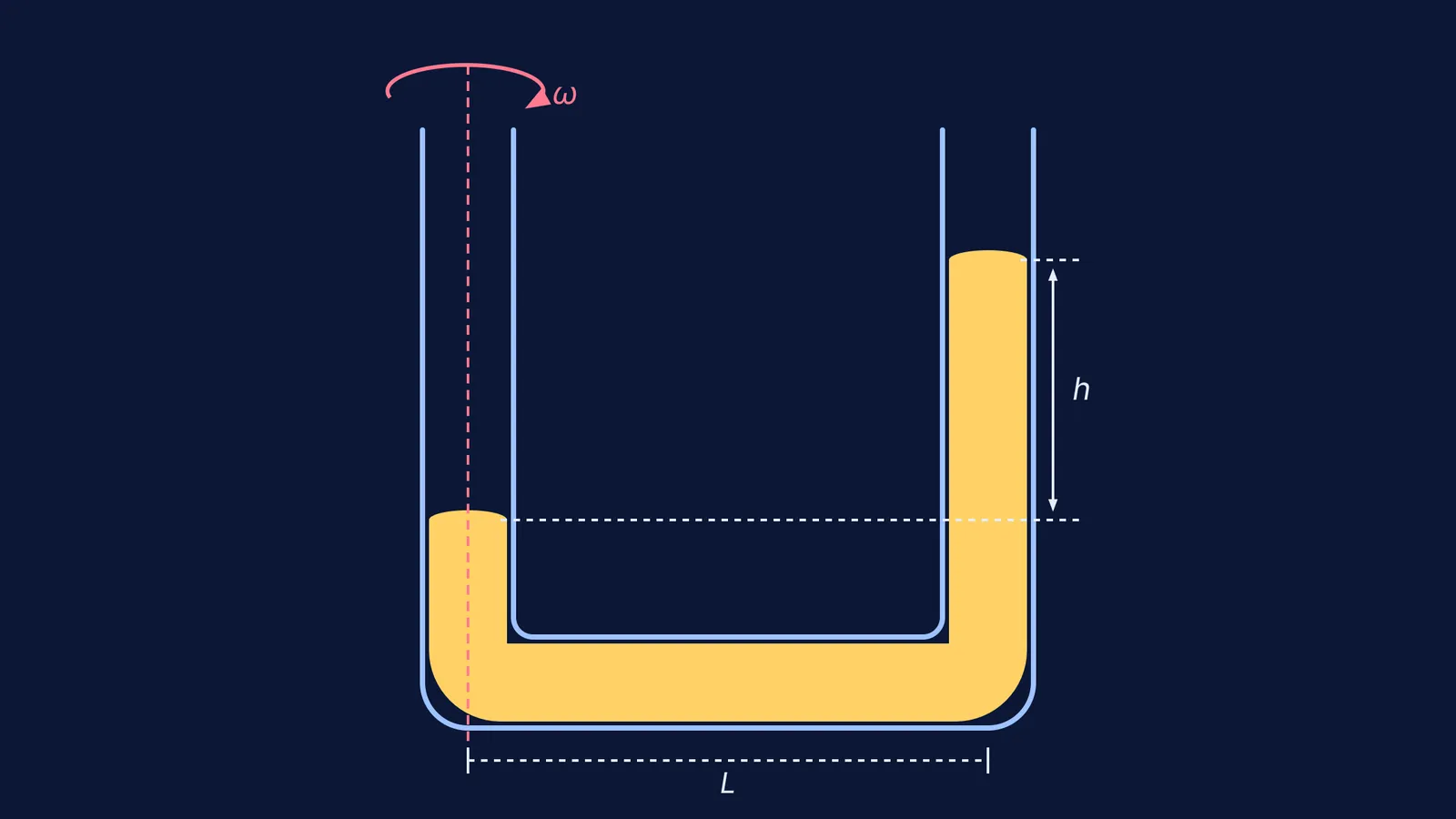
When you spin a U-tube containing a liquid around one of its vertical arms, the liquid does not stay level. The liquid in the arm further from the axis rises, while the liquid in the arm acting as the axis falls. This effect gives you a neat way to calculate the rotational speed from the difference in heights.
Imagine sitting in a car that takes a sharp turn. You feel yourself pushed against the door, away from the centre of the curve. This is the centrifugal effect, and liquids experience it just like we do. In a rotating frame of reference, the liquid experiences a centrifugal force directed perpendicularly away from the axis of rotation (Wikipedia, "Centrifugal force"). This force pushes the liquid in the horizontal base of the tube toward the outer arm, creating a pressure gradient. The faster you spin the tube, the harder the liquid is pushed outward.
This simple setup can lead to surprisingly complex physics. A classic 1990 paper in the American Journal of Physics by Bruce Denardo and colleagues explored the rich dynamics of rotating U-tubes. They confirmed that the equilibrium liquid heights shift predictably as the rotational frequency changes, and even discovered instances where the liquid levels jump abruptly—a phenomenon known as hysteresis—when the axis of rotation is placed between the two arms (Denardo et al., 1990).
Why does the liquid level change?
The change happens because the rotation creates a horizontal pressure difference. To maintain equilibrium, the liquid must adjust its height to create an equal and opposite hydrostatic pressure difference, relying on the same hydrostatic principles you use when solving for two immiscible liquids in a manometer. The liquid rises in the outer arm until its extra weight perfectly balances the outward centrifugal push.
How do you derive the height difference in a U-tube?
To find the exact height difference, you have to look at the forces acting on the liquid in the horizontal base of the tube. We balance the outward pressure caused by rotation against the downward hydrostatic pressure of the liquid columns.
Let's set up the problem. Imagine a U-tube with a horizontal base of length L. It contains a liquid of uniform density ρ and rotates with a constant angular velocity ω about its left arm.
Calculate the centrifugal pressure gradient: Think of a tiny slice of liquid in the horizontal base, sitting at a distance r from the axis of rotation. The centrifugal force on this tiny mass creates a small outward pressure increase, which we can write as dP = ρω²r dr.
Integrate across the whole base: To find the total pressure difference between the inner arm and the outer arm, we integrate this small pressure increase from the axis (r = 0) to the outer arm (r = L). This gives the total pressure difference along the base: ΔP = ∫ ρω²r dr = ½ρω²L².
Equate it to the hydrostatic pressure: This extra pressure is pushing the liquid up the outer arm. The liquid will stop rising when the extra weight of the taller column creates an equal and opposite pressure. If the difference in height between the two arms is h, the hydrostatic pressure difference is ΔP = ρgh.
Solve for the height difference: Since the system is in equilibrium, the centrifugal pressure equals the hydrostatic pressure. Equating the two expressions for ΔP gives ρgh = ½ρω²L². Dividing both sides by ρg simplifies the formula to h = ω²L² / 2g.
Does the liquid's density matter?
If you look closely at the final formula, h = ω²L² / 2g, the density ρ of the liquid is nowhere to be seen. It cancels out perfectly during the derivation. This means the height difference h is entirely independent of the fluid you use.
Whether the U-tube is filled with tap water, cooking oil, or heavy liquid mercury, the levels will split by the exact same height difference as long as the rotation speed and the tube's geometry remain the same. The heavier liquid experiences a stronger centrifugal push, but it also exerts a stronger hydrostatic downward pressure, and the two effects balance each other out exactly—much like how pressure scales with depth in Pascal's law in hydraulic machines.
How do you use the formula in a problem?
Let's test this formula with a typical physics problem. Suppose you have a U-tube where the two vertical arms are separated by a horizontal distance of 30 cm (so L = 0.3 m). You rotate the entire tube around its left arm at a steady angular velocity of 4 rad/s. Taking the acceleration due to gravity g as 9.8 m/s², we want to find the height difference between the liquid levels in the two arms.
Start by plugging the given values into our derived formula:
h = (4² × 0.3²) / (2 × 9.8)
Calculate the squares first:
h = (16 × 0.09) / 19.6
Multiply the terms in the numerator:
h = 1.44 / 19.6
Divide to find the final height:
h ≈ 0.073 m
Converting this back to a more practical unit, the liquid in the outer arm will stand roughly 7.3 cm higher than the liquid in the inner arm.
If you are struggling to picture why the pressure builds up in rotating frames, or how to set up the integral for a different axis of rotation, the Fermi Concept Library contains every concept in physics, chemistry, biology, mathematics and computing, each with its own lesson. Seeing the forces drawn out step-by-step makes setting up the equations much easier.


