

On this page
When a mass is suspended by a string, the only forces acting on it are gravity pulling down and the string pulling up. But if you push or pull that mass to the side, the string no longer hangs straight down. It sags at an angle to balance your sideways pull against the weight of the mass.
To find the relationship between the horizontal force, the angle of the string, and the new tension, you have to break the forces into their horizontal and vertical components. Here is how the physics works.
How much force is needed to pull a hanging mass sideways?
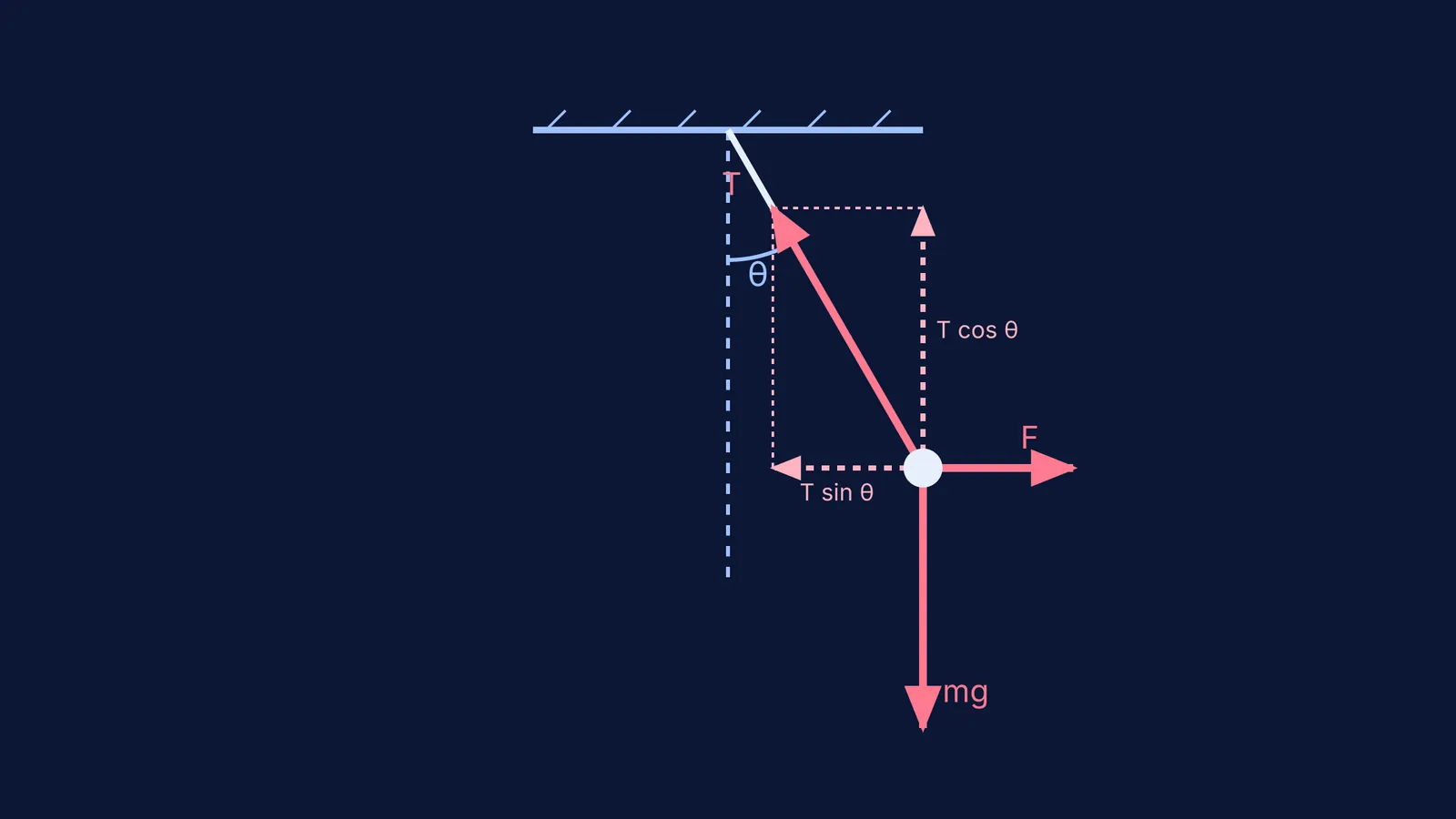
Imagine a mass m hanging from a ceiling. If you apply a horizontal force F to the mass, it swings out and comes to a stop at an angle θ from the vertical.
Because the mass is at rest, it is in a state of static equilibrium, meaning the vector sum of all external forces acting on it must be zero. The string pulls on the mass with a tension force T directed along the string. To apply the equilibrium condition, we split this tension into two perpendicular parts:
A vertical component pulling upwards: T cos θ
A horizontal component pulling backwards: T sin θ
For the mass to stay still, the forces in each direction must cancel out exactly. Vertically, the upward pull of the string must balance the weight of the mass (mg): T cos θ = mg
Horizontally, the string's backwards pull must balance your applied force (F): T sin θ = F
If you divide the horizontal equation by the vertical equation, the tension T cancels out: (T sin θ) / (T cos θ) = F / (mg) tan θ = F / (mg)
This result tells you exactly how much horizontal force is needed to hold the mass at any angle. The geometry of this tan θ ratio is very similar to finding the angle of repose and angle of friction on an inclined plane. If you want the string to hang at 45° (tan 45° = 1), your horizontal pull must exactly equal the weight of the mass.
What is the tension in the rope when pulled horizontally?
Tension is the pulling force transmitted axially along the string). Before you pulled the mass, the string only had to support the object's weight, so the tension was simply mg.
Once the mass is pulled sideways, the string must do two jobs: it still supports the full weight vertically, and it now also resists your horizontal pull. Because these two perpendicular requirements add together like the sides of a right-angled triangle, the new tension is the hypotenuse.
Using Pythagoras' theorem on the horizontal and vertical components: T² = (T cos θ)² + (T sin θ)² T² = (mg)² + F² T = √(F² + m²g²)
The tension in the string is always greater than the weight alone. The harder you pull, the tighter the string becomes. If you pull with a force equal to the weight (F = mg), the tension becomes √(m²g² + m²g²) = mg√2.
This static tension is fundamentally different from dynamic systems where the mass is moving. For example, a monkey climbing a rope changes the tension by accelerating upwards or downwards. Similarly, a swinging mass requires computing the simple pendulum string tension at any angle by factoring in centripetal force rather than just static equilibrium.
If you find setting up these force balances difficult, Fermi Concept Library contains lessons on Newton's laws and vector resolution that map out exactly how components work.
How do you solve horizontal force problems step by step?
A typical problem might ask: *A 2 kg mass hangs from a string. What horizontal force is required to hold it at an angle of 30° to the vertical, and what is the new tension?* (Take g = 9.8 m/s²).
Find the weight: First, calculate the downward gravitational force acting on the mass.
mg = 2 × 9.8 = 19.6 N.
Apply the angle condition: You know the relationship between the applied force, the weight, and the angle is tan θ = F / mg.
Solve for the force: Rearrange the formula to make F the subject.
F = mg tan θ F = 19.6 × tan 30° F = 19.6 × 0.577 = 11.3 N
Calculate the new tension: You can use either the vertical balance equation (T = mg / cos θ) or the Pythagorean sum (T = √(F² + m²g²)).
Using the vertical balance equation: T = 19.6 / cos 30° T = 19.6 / 0.866 = 22.6 N
The required horizontal force is 11.3 N, and the tension in the string grows to 22.6 N. Notice that the tension is greater than the 19.6 N weight, confirming that pulling the mass sideways increases the strain on the rope.
If you encounter trickier variations, Fermi's AI tutor can teach you how to set up the new free-body diagram as it draws the figure with you on the screen.


