

On this page
When a quadratic problem mentions that the two roots differ by 1, or by any fixed quantity k, many students instinctively write β = α + 1 and substitute this into the relations for the sum and product of roots. While this substitution will lead to an answer, it forces you to manipulate unwieldy rational fractions under tight exam pressure.
A much faster, structural approach relies on an elementary property of polynomials: even though the difference (α − β) is not symmetric, its square (α − β)² is completely symmetric. Squaring the difference allows you to express the root-spacing condition directly in terms of the coefficients a, b, and c using Vieta's formulas, producing a direct relation with the quadratic discriminant.
What is the condition when quadratic roots differ by 1?
Consider the standard quadratic equation ax² + bx + c = 0 with real coefficients and a ≠ 0, as defined in the CBSE Class 10 Mathematics curriculum. Let its roots be α and β.
According to Vieta's formulas, the sum and product of the roots depend only on the coefficients:
Sum of roots: α + β = −b / a
Product of roots: αβ = c / a
If the roots differ by 1, their absolute difference is |α − β| = 1. Squaring both sides yields:
(α − β)² = 1
Using the algebraic expansion (α − β)² = (α + β)² − 4αβ, substitute the sum and product:
(−b / a)² − 4(c / a) = 1
b² / a² − 4c / a = 1
Multiply through by a² (valid because a ≠ 0):
b² − 4ac = a²
This is the exact condition. Notice that the left side is simply the discriminant D = b² − 4ac, which governs root properties on Wolfram MathWorld. The relation can be restated as D = a², or b² = a² + 4ac.
For any monic quadratic equation where the leading coefficient is a = 1 (such as x² + bx + c = 0), this condition simplifies directly to:
b² − 4c = 1
How does the identity (α − β)² = (α + β)² − 4αβ work?
Why can you not express the raw difference α − β directly in terms of the coefficients? As French mathematician François Viète recognized in the late sixteenth century, documented by the MacTutor History of Mathematics archive, polynomial coefficients relate exclusively to elementary symmetric polynomials of the roots.
The quantity α − β is antisymmetric: swapping α and β flips its sign from (α − β) to −(α − β). Because the coefficients of a polynomial cannot tell which root is α and which is β, no rational combination of coefficients can produce α − β directly without a square root sign.
Squaring the difference restores symmetry: (β − α)² = (α − β)². Expanding both binomials confirms how they align:
(α + β)² = α² + 2αβ + β²
(α − β)² = α² − 2αβ + β²
Subtracting the second equation from the first yields (α + β)² − (α − β)² = 4αβ. Rearranging terms gives the fundamental identity (α − β)² = (α + β)² − 4αβ. This transformation is a cornerstone when evaluating symmetric functions of roots.
Because (α + β)² − 4αβ = (b² − 4ac) / a² = D / a², taking the square root reveals that the absolute difference between the roots of any quadratic equation is:
|α − β| = √D / |a|
Why is substituting β = α + 1 a trap in timed exams?
Students frequently attempt to solve root difference problems by writing β = α + 1. Substituting this into the sum gives:
α + (α + 1) = −b / a, which simplifies to 2α = −b / a − 1, giving α = −(b + a) / (2a)
Next, one must substitute this expression for α into the product relation α(α + 1) = c / a:
[−(b + a) / (2a)] · [(a − b) / (2a)] = c / a
−(a² − b²) / (4a²) = c / a
(b² − a²) / (4a²) = c / a, giving b² − a² = 4ac, or b² − 4ac = a²
Although this substitution yields the same result, it requires several additional algebraic steps and introduces nested minus signs where arithmetic errors commonly occur. When practicing polynomial relations, the Fermi Problem Library provides worked problems with a step-by-step solver that explains the reasoning rather than printing an answer, helping students master structural identities instead of brute-force elimination.
How do you solve exam problems with a general difference k?
If the problem states that the roots differ by a real constant k, so that |α − β| = k, squaring both sides yields:
(α − β)² = k²
Substituting (α − β)² = D / a² gives the general formula:
b² − 4ac = k²a²
Worked Example 1: Finding an unknown linear coefficient
Problem: The roots of x² − px + 12 = 0 differ by 1. Find all possible values of p.
Identify the coefficients: a = 1, b = −p, c = 12.
The difference is k = 1.
Apply the condition b² − 4ac = k²a²:
(−p)² − 4(1)(12) = (1)²(1)² p² − 48 = 1 p² = 49 p = ±7
Verification: For p = 7, the equation x² − 7x + 12 = 0 factors into (x − 3)(x − 4) = 0 with roots 3 and 4, which differ by 1. For p = −7, x² + 7x + 12 = 0 factors into (x + 3)(x + 4) = 0 with roots −3 and −4, which also differ by 1.
Worked Example 2: Non-monic equation
Problem: For what value of m do the roots of 2x² − mx + 3 = 0 differ by 2?
Here a = 2, b = −m, c = 3, and k = 2.
Apply b² − 4ac = k²a²:
(−m)² − 4(2)(3) = (2)² · (2)² m² − 24 = 4 × 4 = 16 m² = 40, so m = ±2√10
This method is equally effective in advanced questions involving common roots, such as when two quadratics share a root.
How can you test the condition geometrically?
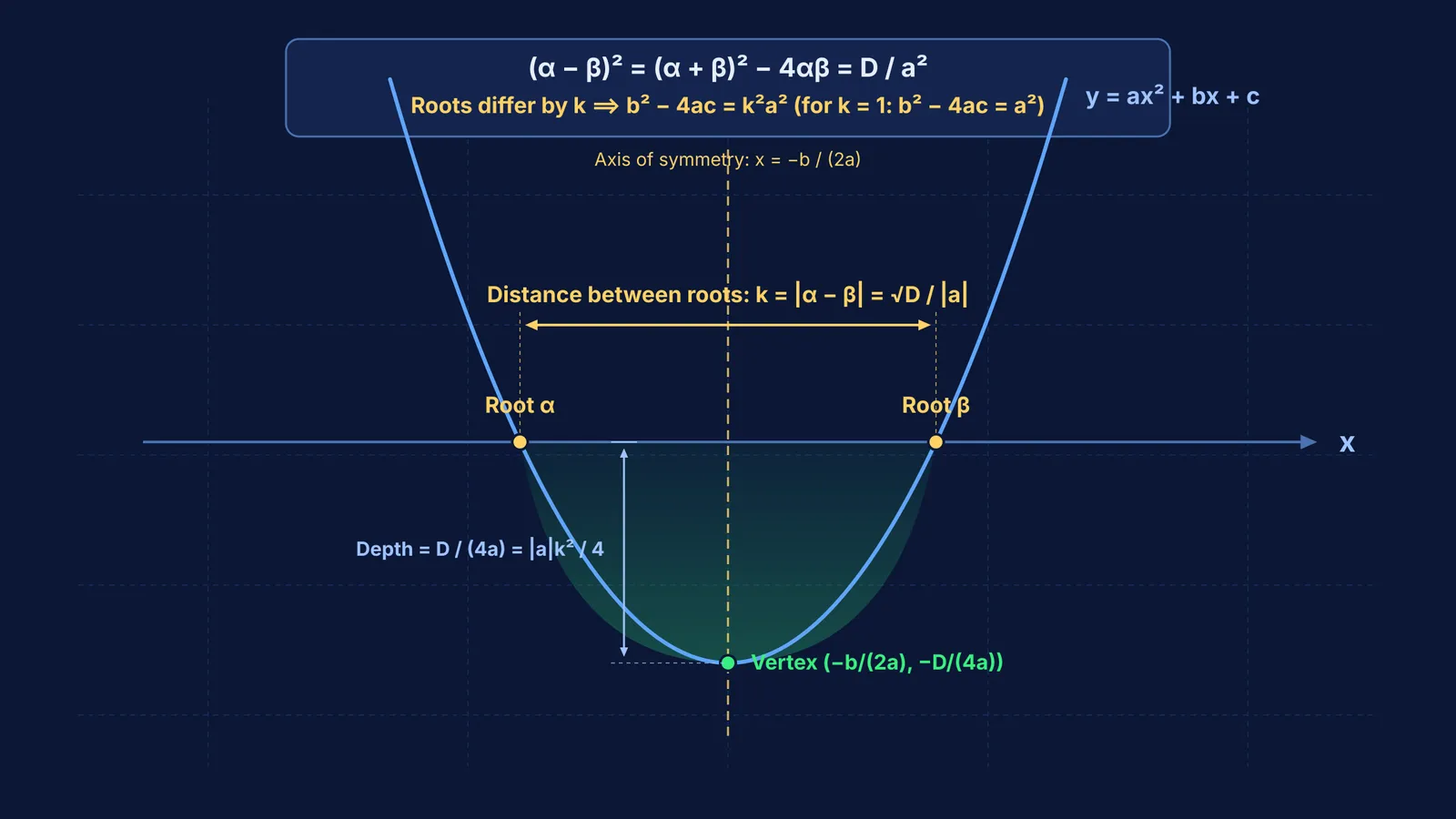
Geometrically, the equation y = ax² + bx + c represents a parabola whose x-intercepts are the roots α and β. The horizontal distance between these intercepts is precisely |α − β| = k = √D / |a|.
The vertex of the parabola lies halfway between the roots at x = −b / (2a). Evaluating the function at the vertex gives the vertical depth of the turning point:
y_vertex = −D / (4a)
Because D = k²a², the depth of the vertex below the horizontal axis is:
|y_vertex| = |a|k² / 4
This demonstrates that whenever the distance between the roots is fixed, the depth of the vertex depends solely on the leading coefficient a. This geometric perspective is closely tied to the discriminant test for quadratic signs.
To build confidence across algebraic manipulations and coordinate geometry, the Fermi Concept Library covers every concept in physics, chemistry, biology, mathematics and computing, each with its own lesson and its place in the map. When you sit down to practice, Fermi's AI tutor can work out what you already know and build a plan for the session, so you sit down to a clear next step.


