

On this page
Why does the centre of mass fall straight down?
When a uniform rod stands upright or tilted on a frictionless floor and begins to tip, many students picture it pivoting around its bottom end. They imagine the centre of mass swinging along a circular arc, much like a pendulum. But Newton's laws dictate an entirely different motion.
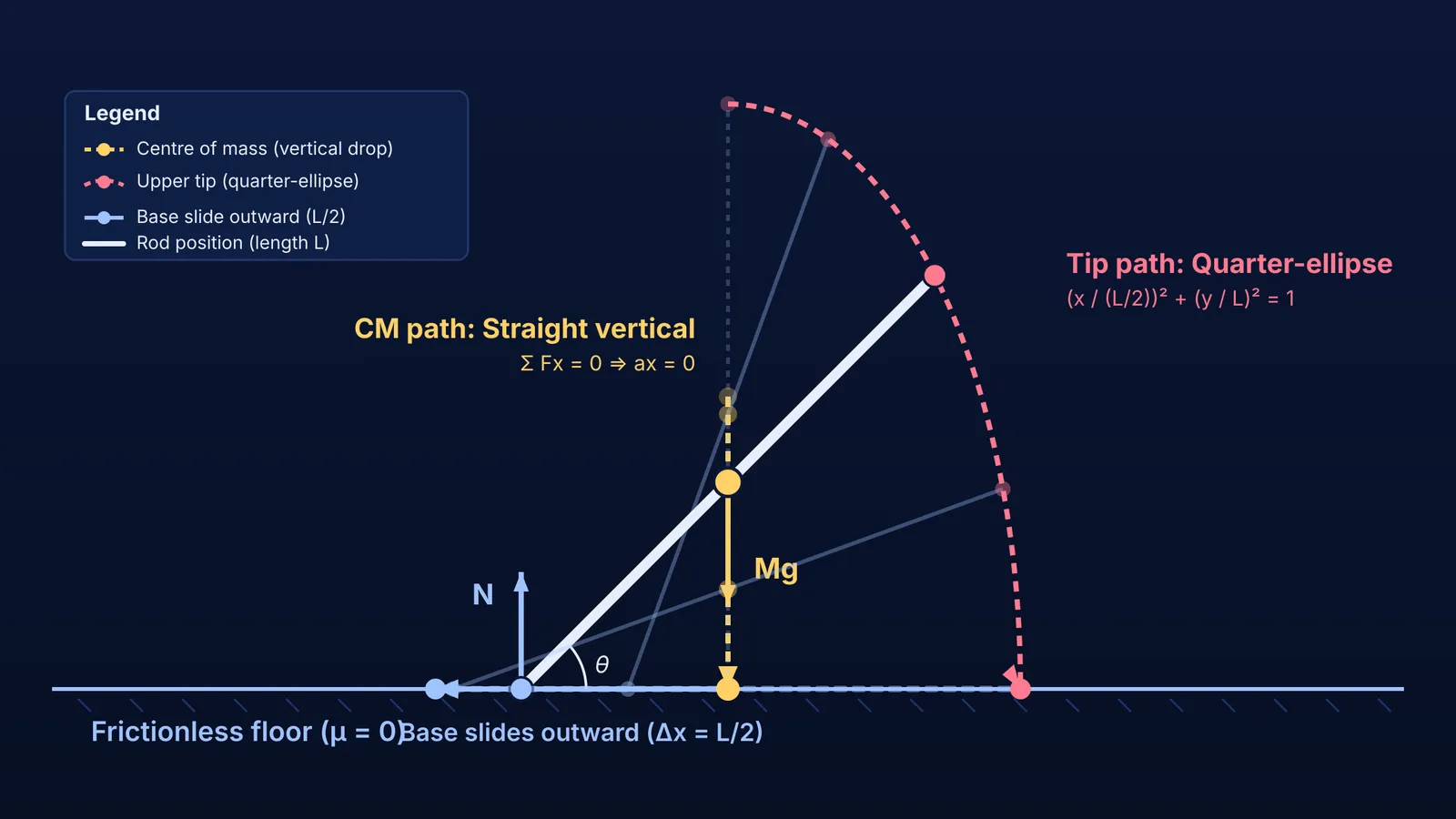
To find the trajectory, consider the external forces acting on the rod. Gravity pulls downward at the centre of mass with force M g, while the floor exerts an upward normal contact force N at the base. Because the floor is frictionless, no horizontal contact force can exist. There is no friction, and air resistance is neglected.
Applying Newton's second law for a system of particles (Σ F_ext = M a_cm), the net horizontal force is:
Σ F_x = M a_cm_x = 0
Because horizontal force is zero at every instant, the horizontal acceleration of the centre of mass is zero: a_cm_x = 0. Released from rest with zero initial horizontal velocity, it maintains v_cm_x = 0 throughout the fall. The horizontal coordinate of the centre of mass cannot change, remaining strictly constant.
As physicist Rod Cross demonstrated using video analysis of low-friction falling rods (Cross, 2021), the centre of mass drops along a vertical straight line. Because the upward normal force opposes gravity (M g − N = M a_cm_y), its downward acceleration is strictly less than free-fall acceleration g.
What path do the ends and other points trace?
If the centre of mass drops straight down, what happens to the rest of the rod? As the rod tilts, it rotates about its descending centre of mass. This produces distinct geometric trajectories for each point along the rod (Cross, 2021).
Let the uniform rod have length L and tilt at angle θ to the floor. Setting the vertical fall line of the centre of mass at x = 0, its position is (0, (L/2) sin θ). Because the base touches the floor at distance L/2 from the midpoint, its horizontal coordinate is:
x_base = −(L/2) cos θ
As the rod falls from vertical (θ = 90°) to flat (θ = 0°), cos θ increases from 0 to 1, sliding the base outward along the floor in a straight horizontal line by distance L/2.
Meanwhile, the top tip has coordinates x_tip = (L/2) cos θ and y_tip = L sin θ. Dividing each coordinate by its amplitude and squaring yields:
(x_tip / (L/2))² + (y_tip / L)² = cos² θ + sin² θ = 1
The top end traces a quarter-ellipse with horizontal semi-minor axis L/2 and vertical semi-major axis L. Every point between the centre of mass and the ends traces an ellipse whose width depends on its distance from the centre.
For ideas that are easier to see than to read, the Fermi Simulation Lab provides interactive simulations where students can trace each trajectory, watching the vertical drop of the centre of mass and the elliptical arc of the tip unfold side by side.
How does a frictionless floor differ from a hinged pivot?
The most frequent exam mistake is confusing a smooth floor with a hinged rod falling from a fixed pivot.
In a hinged system, the pivot is fixed. The hinge provides a horizontal reaction force that prevents slipping. Because this horizontal force is non-zero, horizontal momentum is not conserved, and the centre of mass rotates along a circular arc of radius L/2: x² + y² = (L/2)². On a frictionless floor, no hinge exists. The floor cannot exert a sideways grip, so the base slides freely outward.
This distinction is essential when analyzing the centre of gravity vs centre of mass during rotation. Because the sliding contact point accelerates horizontally, it is a non-inertial reference point.
As Vitor Oliveira established in the *American Journal of Physics* (Oliveira, 2016), real friction causes rods to pivot without slipping at steep angles before slipping outward or inward. Only at zero friction does the centre of mass fall in an undisturbed vertical line.
What is the rod's angular velocity at flat impact?
Consider a uniform rod of mass M and length L released from rest near vertical (θ_0 = 90°) on a frictionless floor. What is its angular velocity ω when it strikes the floor flat at θ = 0°? Because the upward normal contact force acts vertically while the contact point moves horizontally, N does no work, and total mechanical energy is conserved (Cross, 2021).
The potential energy lost as the centre of mass falls by L/2 is ΔU = M g L / 2.
Total kinetic energy combines translational motion of the centre of mass and rotation about it: K = (1/2) M v_cm² + (1/2) I_cm ω². With I_cm = (1/12) M L² and vertical velocity v_cm = (L/2) ω cos θ, this simplifies to:
K = (1/2) M ((L/2) ω cos θ)² + (1/24) M L² ω² = (1/24) M L² ω² (1 + 3 cos² θ)
At flat impact (θ = 0°, cos 0° = 1), equating kinetic energy to potential energy gives:
(4/24) M L² ω² = M g L / 2 ⇒ ω = √(3 g / L)
At that moment, the downward speed of the centre of mass is v_cm = (1/2) √(3 g L). The Fermi Problem Library offers worked problems with a step-by-step solver that explains the reasoning rather than printing an answer, letting students verify the physical principles behind each step.
How can you avoid common exam traps?
When tackling rigid-body questions in physics exams, follow this checklist:
Check for horizontal forces: If the floor is frictionless and no hinge touches the body, Σ F_x = 0. Released from rest, the centre of mass falls straight down.
Choose the right reference point: The sliding base accelerates horizontally, making it non-inertial. If you calculate motion from the sliding base frame, you must include pseudo forces in non-inertial frames, or simply take torques about the centre of mass to avoid fictitious forces entirely.
Distinguish individual point paths: Only the centre of mass moves vertically. The base slides along the floor, while the tip and intermediate points trace ellipses.
If you are unsure where to begin on a mechanics problem, Fermi's AI tutor can work out what you already know and build a plan for the session, guiding you through Newton's laws for systems of particles step by step.


