

On this page
When you first learn Newton's law of gravitation, you deal with point masses or perfect spheres. The maths is straightforward because all the mass can be treated as if it sits at a single central point. But what happens when the mass is spread out into an irregular shape or a line?
Finding the gravitational force of a uniform rod on a point mass is a classic problem that bridges the gap between basic physics and calculus. It forces you to abandon the simple plug-and-chug approach and think about how extended objects interact. Mastering this setup is the essential first step before tackling more complex shapes like solid disks, rings or spherical shells.
Instead of a single formula, you have to cut the rod into infinitely many tiny slices, find the force from each one, and add them up. Here is how to set up the integral, perform the calculation, and understand what the final result tells you.
How do you set up the integral for a uniform rod?
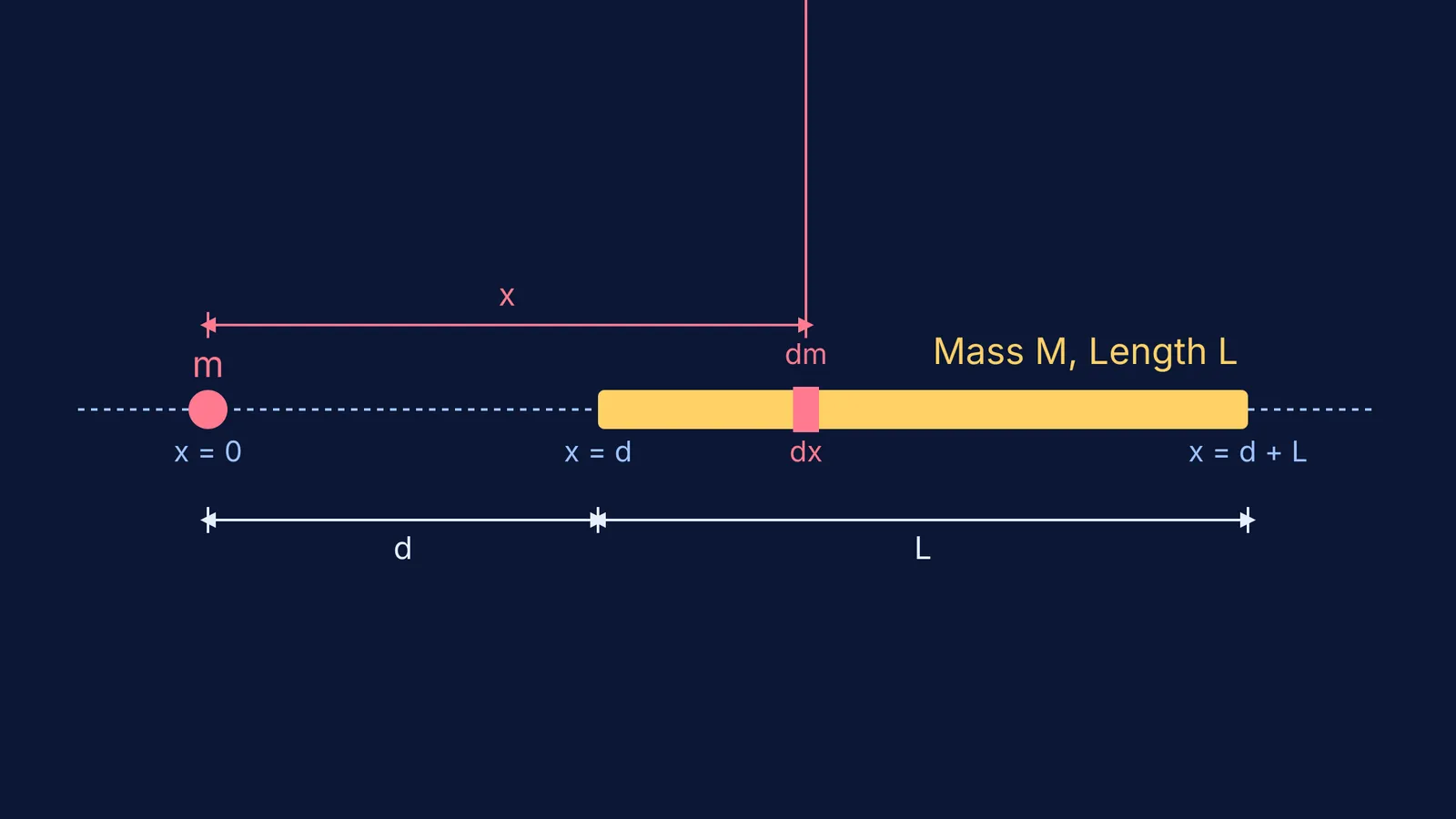
To solve this, place your point mass m at the origin of a coordinate system (x = 0). Imagine the uniform rod lies along the x-axis. The closest end of the rod is at a distance d from the mass, so the rod stretches from x = d to x = d + L, where L is the length of the rod.
Because the rod is uniform, its mass M is spread evenly along its length. Its linear mass density (mass per unit length) is a constant value: λ = M / L
Pick an arbitrary tiny slice of the rod at a distance x from the point mass. Let this slice have an infinitesimally small length dx. The mass of this tiny slice is its density multiplied by its length: dm = λ × dx = (M / L) dx
According to Newton's law, this thin slice pulls on the point mass m with a tiny, differential gravitational force dF. Because both masses are on the x-axis, the force points directly along the axis toward the rod: dF = Gm(dm) / x²
Substituting our expression for dm, we get the force from just this one slice in terms of x and dx: dF = GmM / (L x²) dx
What is the gravitational force of a rod on a point mass?
To find the total magnitude of the force, you must integrate (add up) the forces from every slice along the entire length of the rod. The rod starts at x = d and ends at x = d + L, so these become the limits of your integration.
F = ∫ [from d to d + L] GmM / (L x²) dx
Because G, m, M and L are all constants, you can pull them completely outside the integral sign. This leaves you with the simple task of integrating 1/x² with respect to x:
F = (GmM / L) ∫ [from d to d + L] x⁻² dx
The integral of x⁻² is simply −1/x. Evaluating this result at the upper and lower limits gives:
F = (GmM / L) [ (−1 / (d + L)) − (−1 / d) ]
F = (GmM / L) [ 1/d − 1/(d + L) ]
To tidy this expression up, combine the two fractions inside the brackets by finding a common denominator: 1/d − 1/(d + L) = (d + L − d) / (d(d + L)) = L / (d(d + L))
Substitute this simplified fraction back into the force equation. The length L cancels out of the numerator and denominator beautifully. The total gravitational force exerted by the rod is:
F = GMm / (d(d + L))
How does the formula change at a large distance?
A good way to check any derived formula in physics is to look at its extreme limits. What if you move the point mass very far away from the rod? Does the physics still hold up?
If the distance d is much greater than the rod's length L (d ≫ L), then adding L to d hardly changes anything at all. You can safely approximate d + L ≈ d.
Substitute this approximation into the denominator of our final result: d(d + L) ≈ d(d) = d²
The force becomes: F ≈ GMm / d²
From far away, the rod's length stops mattering entirely. The equation shows that it behaves exactly like a single point mass of mass M located at a distance d, perfectly recovering the standard form of Newton's law of gravitation.
Practice this and similar problems
Continuous mass distributions appear frequently across both mechanics and electromagnetism. The exact same calculus and integration method applies to finding the electric field of a finite charged rod or solving centre of mass problems for non-uniform beams.
If you find yourself stuck on how to choose the right element dx or where to set your integration limits, the Fermi Problem Library has worked problems with a step-by-step solver that explains the reasoning rather than printing an answer. For a broader review of the physics and to practice similar derivations, the Fermi Concept Library maps out gravitation and shows exactly how each mathematical rule connects to the real world.


