

On this page
When a conducting rod slides down vertical rails in a magnetic field, it does not accelerate forever. It reaches a steady, maximum speed called the terminal velocity. This setup is a classic electromagnetic induction problem, elegantly combining Newtonian mechanics, motional EMF, and the conservation of energy into a single system.
Understanding how a falling rod converts its gravitational potential energy into electrical current is fundamental to how electromagnetic braking works.
Why does a falling rod reach a terminal velocity?
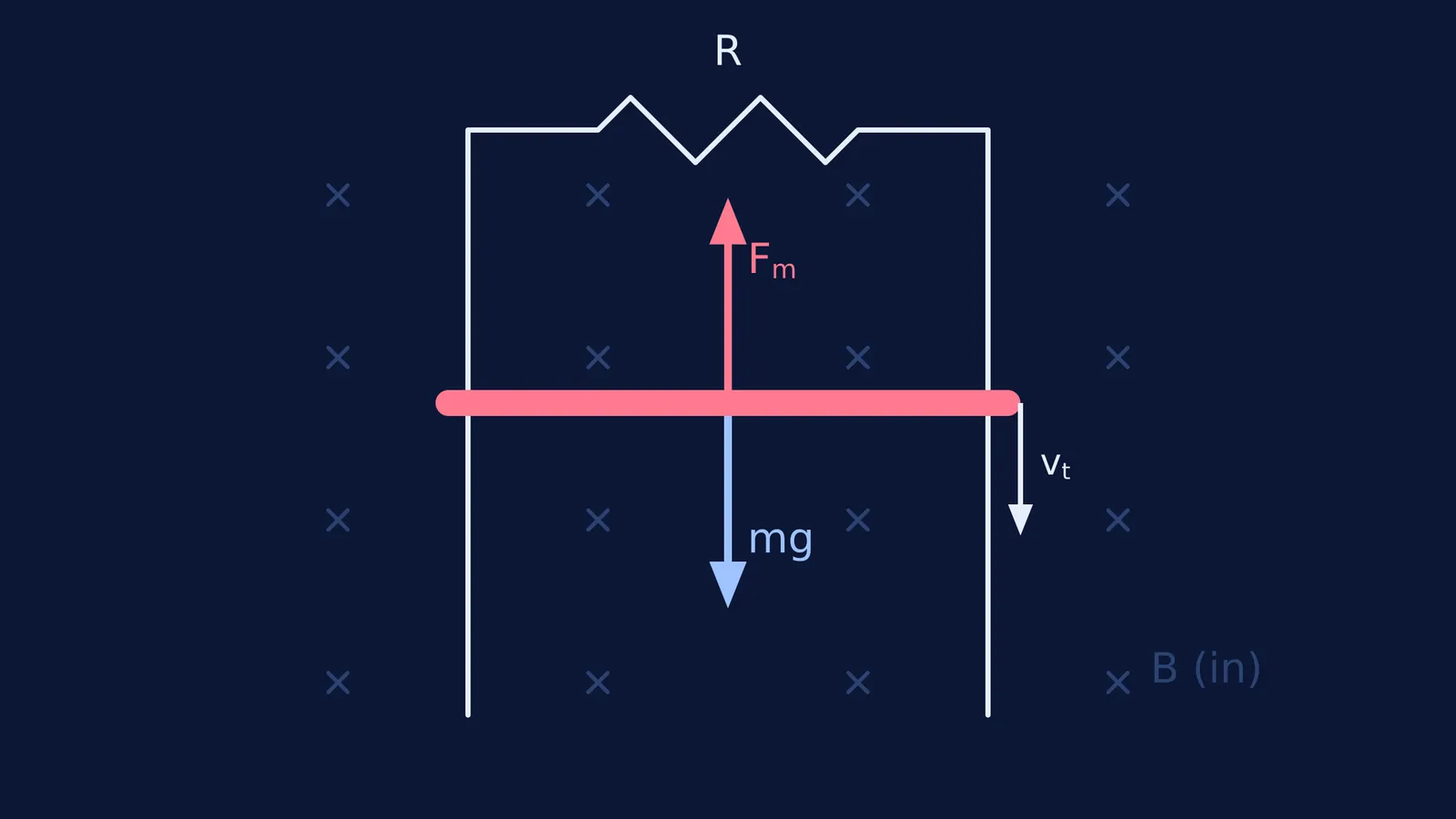
When a metal rod falls, gravity pulls it down. If there is a uniform magnetic field pointing into the page and the vertical rails are connected by a resistor, the falling rod cuts through the magnetic field lines. This change in magnetic flux induces an electromotive force (EMF) across the rod.
According to Faraday's law, the magnitude of this motional EMF is ε = Blv, where B is the magnetic field strength, l is the rod's length between the rails, and v is its downward speed. This EMF drives an induced current I = Blv/R through the closed circuit, where R is the total resistance.
By Lenz's law, this induced current creates a magnetic force that opposes the downward motion. Using the right-hand rule, the induced magnetic force (F_m) points straight up. The magnitude is F_m = IlB, which becomes F_m = B² l² v / R when substituting the current.
Because this magnetic braking force grows directly with speed v, it eventually equals the rod's constant downward weight (mg). At this point, the net force is zero, and the rod falls at a steady terminal speed.
How to derive the terminal velocity of a falling rod?
To find the formula for terminal velocity (v_t), we set the net force to zero. The upward magnetic force equals the downward gravitational force:
B² l² v_t / R = mg
Rearranging this equation isolates the terminal velocity:
v_t = mgR / (B² l²)
This derivation, found in University Physics Volume 2, reveals important relationships:
Mass (m): A heavier rod has a higher terminal speed because gravity pulls it harder.
Resistance (R): Higher resistance means less current, creating a weaker braking force.
Magnetic field (B) and length (l): A stronger field or longer rod dramatically increases the braking force, causing the rod to fall much slower.
If you are stuck on setting up motional EMF equations, the Fermi Problem Library has worked problems with a step-by-step solver that explains the reasoning rather than printing an answer, so you can see how to apply Faraday's and Lenz's laws.
What happens to the energy?
A common question asks to prove energy is conserved at terminal velocity. Since the rod falls at a constant speed, its kinetic energy is no longer changing. However, it steadily loses gravitational potential energy. Where does that energy go?
It turns into heat. The rod's mechanical power lost to gravity is P_mech = mgv_t.
Meanwhile, the electrical energy dissipated as heat in the resistor is Joule heating, P_elec = I² R. Substituting I = Blv_t/R gives P_elec = (B² l² / R) × v_t². Substituting the v_t formula into one v_t term yields: P_elec = (B² l² / R) × (mgR / B² l²) × v_t = mgv_t.
The mechanical power lost exactly matches the electrical power dissipated as heat. The system continuously converts gravitational potential energy into electrical, then thermal energy. If you find these conversions hard to picture, the Fermi Simulation Lab has interactive simulations for the ideas that are easier to see than to read, letting you watch the energy shift. For a different look at charges in fields, see our guide on the helical path of a charge in a magnetic field.
How to solve a terminal velocity problem?
Suppose a conducting rod has a mass of 0.50 kg and a length of 1.0 m. It slides down vertical rails connected by a 1.0 Ω resistor (review the resistance of a tapered conductor for other resistance setups). Using the concepts from University Physics Volume 2, let the uniform magnetic field be 0.50 T, pointing into the page, and g = 9.8 m/s².
Identify values: m = 0.50 kg, l = 1.0 m, R = 1.0 Ω, B = 0.50 T.
Use the formula: v_t = mgR / (B² l²).
Plug in numbers: v_t = (0.50 × 9.8 × 1.0) / (0.50² × 1.0²).
Calculate denominator: 0.50² = 0.25.
Calculate numerator: 0.50 × 9.8 × 1.0 = 4.9.
Divide: v_t = 4.9 / 0.25 = 19.6 m/s.
The rod will accelerate until it reaches 19.6 m/s, then fall at a constant speed.


