

On this page
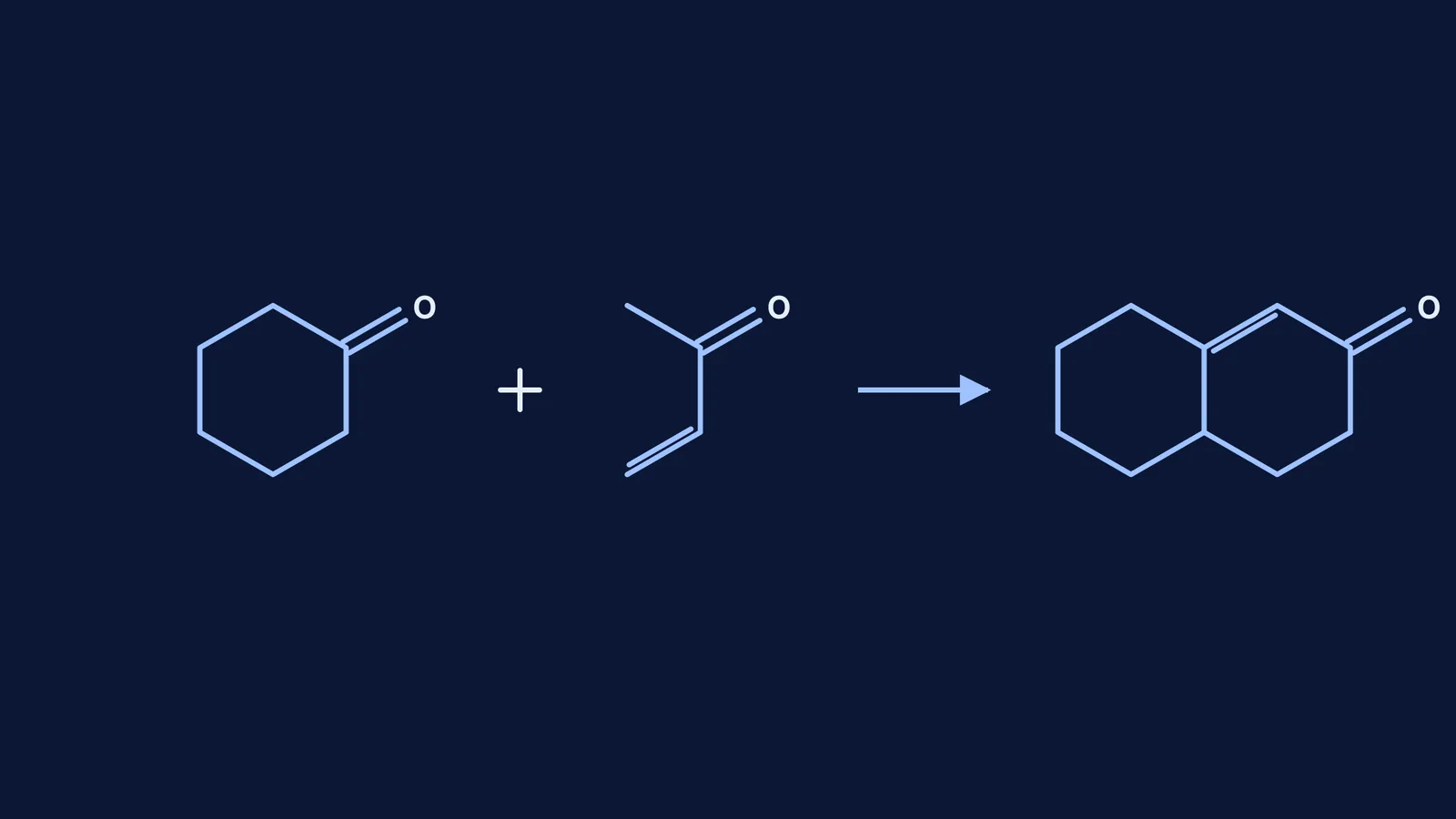
Discovered in 1935 by Sir Robert Robinson and William Rapson, the Robinson annulation is a cornerstone of organic synthesis. It fuses a new six-membered ring onto an existing structure, creating an α,β-unsaturated cyclic ketone (an enone).
This reaction is famous for its elegance: it strings two fundamental carbon-carbon bond-forming steps—a Michael addition and an intramolecular aldol condensation—into a single sequence. From synthesizing early steroids like cortisone to assembling the frameworks of modern antibiotics, this tandem mechanism remains a masterclass in building complex, three-dimensional molecules from simple, flat parts.
What is the Robinson annulation mechanism?
The reaction requires two starting materials: an enolizable, nucleophilic ketone (the Michael donor) and an α,β-unsaturated ketone, typically methyl vinyl ketone (the Michael acceptor). When heated in the presence of a base like sodium ethoxide or potassium hydroxide, these reactants undergo a two-part cascade that builds the new ring.
Step 1: The Michael addition The reaction begins when the base removes a proton from the α-carbon of the starting ketone. This forms a reactive, negatively charged enolate. Because the enolate is a strong nucleophile, it attacks the terminal, electron-poor carbon of the α,β-unsaturated ketone in a process known as 1,4-conjugate addition (or Michael addition). The product of this first phase is a 1,5-dicarbonyl intermediate, essentially adding a four-carbon chain that temporarily hangs off the original ring like a tail.
Step 2: The intramolecular aldol condensation With the 1,5-dicarbonyl intermediate formed, the base strikes again. It deprotonates the terminal methyl group of the newly added side chain to form a second enolate. Because the molecule is now flexible, this new enolate swings around and attacks the original ketone's carbonyl carbon from within the same molecule. This intramolecular aldol addition closes the ring, forming a cyclic β-hydroxy ketone.
Finally, a dehydration step occurs. Driven by the heat of the reaction, the intermediate loses a molecule of water. This forms a carbon-carbon double bond that is conjugated with the new ketone, yielding a highly stable, six-membered enone fused to the starting structure.
Where do students go wrong with Michael plus aldol?
Because the Robinson annulation combines two distinct mechanisms, the most common mistakes happen in the transition between them. Students often deprotonate the wrong carbon during the aldol step. A 1,5-dicarbonyl compound has multiple acidic α-protons, meaning it can form several different enolates.
If you deprotonate the wrong carbon, the resulting intramolecular attack might form a strained four-membered ring or a highly unstable bridged system instead of the desired six-membered product. Thermodynamic stability dictates that the six-membered ring is the major product, but drawing the incorrect pathway is a frequent trap in organic chemistry exams.
If you are stuck mapping out which carbon attacks which, the Fermi Concept Library has a lesson for every concept in chemistry and its place in the map. If you lose track of the numbering while closing the ring, Fermi's AI tutor notices where you are stuck and holds a line of reasoning with you. It checks your understanding of the aldol phase and confirms your numbering before moving on to the final dehydration step.
How do you synthesize the Wieland-Miescher ketone?
One of the most famous applications of this reaction is the synthesis of the Wieland-Miescher ketone, a crucial bicyclic building block used in steroid chemistry since the mid-20th century.
Reactants: The synthesis begins with 2-methylcyclohexane-1,3-dione and methyl vinyl ketone (MVK).
Michael phase: The highly acidic proton located exactly between the two carbonyls of the dione is removed. The resulting, highly stabilized enolate attacks the MVK, attaching a 3-oxobutyl chain directly to the ring.
Aldol phase: The terminal methyl group on the newly attached MVK chain is deprotonated. The chain folds back, and the enolate attacks one of the original carbonyl groups, closing a new six-membered ring.
Dehydration: Water is eliminated, creating an enone structure.
The final result is a bicyclic structure consisting of two fused six-membered rings. Mastering this exact sequence will give you a solid foundation for grasping other multi-step reactions, such as Fischer esterification and the Reimer-Tiemann and Kolbe reactions of phenol. It trains you to track electrons, follow the numbering of carbon atoms through complex rearrangements, and confidently spot the most stable product in a competitive chemical environment—skills that are just as vital when working through complex carbocation rearrangements.


