

On this page
In today’s cells, there is a strict and universal division of labour. DNA is the master archive that stores genetic information, while proteins are the dynamic molecular machines that carry out chemical reactions and build cellular structures. But this creates a classic chicken-and-egg paradox for the origin of life: you need proteins to read and copy DNA, but you need DNA to provide the instructions for building proteins. Which one came first?
The RNA world hypothesis offers an elegant solution: neither. It proposes that life began with RNA, a versatile molecule that simultaneously acted as the genetic archive and the catalyst for chemical reactions.
What is the RNA world hypothesis?
The idea that RNA might have been the very first biomolecule was suggested by scientists in the 1960s, but the term "RNA world" was famously coined by physicist and molecular biologist Walter Gilbert in a 1986 *Nature* paper. Gilbert envisioned a primordial stage of evolution where RNA molecules replicated themselves and drove the chemistry of early life entirely without the help of proteins or DNA.
In this early world, RNA strands would have acted as templates to copy themselves. For this scenario to be physically possible, however, RNA had to be capable of catalysing its own replication and driving other chemical reactions. Until the 1980s, biologists believed that only proteins could act as biological catalysts.
How can RNA act as a catalyst?
While DNA normally forms a rigid, predictable double helix designed to protect its interior bases, RNA is typically synthesised as a single strand. This single strand is free to fold back on itself, forming complex three-dimensional shapes driven by base pairing within the same molecule. Much like a folded protein enzyme, these intricate RNA structures can bind to other molecules and lower the activation energy required to make them react.
In the early 1980s, researchers finally discovered the first RNA enzymes, which they named ribozymes. This breakthrough proved that RNA is not just a passive messenger, earning Thomas Cech and Sidney Altman the 1989 Nobel Prize in Chemistry.
The most compelling evidence for the RNA world still sits inside your cells today. The ribosome, the massive molecular factory that translates genetic code into proteins in every living organism, is at its core a giant ribozyme. Its catalytic heart—the part that actually joins amino acids together—is made entirely of RNA, an evolutionary relic from a time before protein enzymes existed.
Why did DNA take over information storage?
If RNA can store information and drive chemistry, why did life ever bother to evolve DNA? The answer comes down to chemical stability and the physical limits of building a large genome.
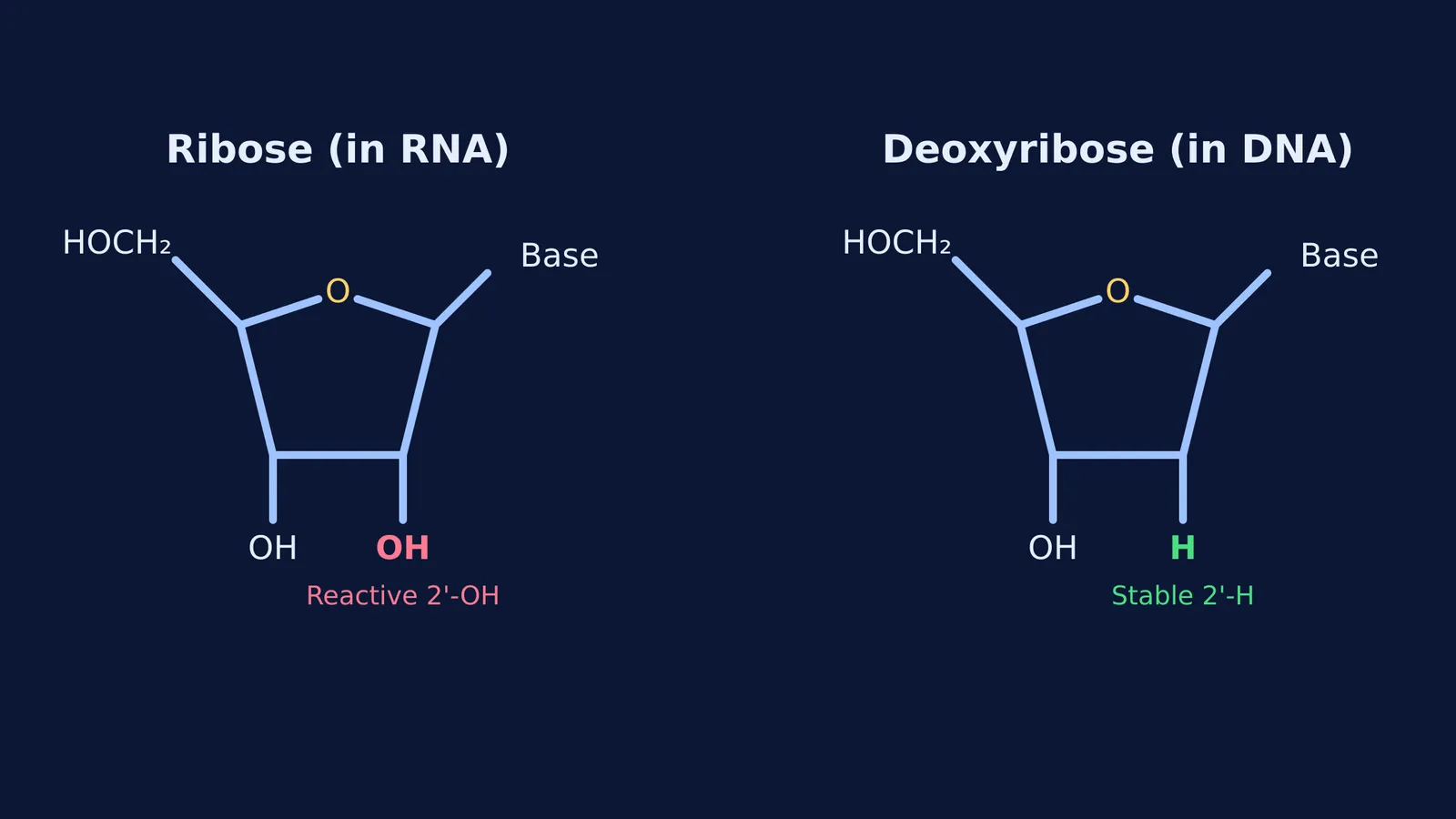
Look closely at the chemical structure of nucleosides and nucleotides. The "R" in RNA stands for ribonucleic acid, meaning its backbone contains the sugar ribose. Ribose has a hydroxyl group (-OH) attached to its 2' carbon. In water, this reactive 2'-OH group can easily attack the adjacent phosphate bond, snipping the RNA strand in half through a process called alkaline hydrolysis.
DNA uses a different sugar: deoxyribose. As the name suggests, it is missing that specific oxygen atom, replacing the 2'-OH with a simple, unreactive hydrogen (-H) atom. Without that reactive oxygen nearby, DNA is vastly less prone to hydrolysis. This minor structural difference makes DNA a much safer, more durable molecule for long-term information storage, allowing organisms to maintain genomes containing billions of base pairs without them constantly falling apart.
The transition to the modern cell
Over millions of years of evolution, the RNA world handed over its dual responsibilities.
Proteins, which are built from a broad toolkit of amino acids, offered far more chemical variety than RNA's nucleotide bases. They eventually took over the role of catalysts. Meanwhile, DNA, with its highly stable deoxyribose backbone, became the permanent archive.
RNA was demoted to the role of a busy middleman. Today, it serves primarily as messenger RNA, carrying temporary working copies of the DNA archive to the ribosome, and undergoing complex RNA processing and splicing before it can be used. Because it degrades quickly, RNA is perfect for short-term tasks where a cell needs to send a message and then clear it away.
Understanding this evolutionary logic is one of the most effective ways to master molecular biology. Instead of memorising the differences between DNA and RNA by rote, knowing *why* they differ makes the facts stick. If you are looking to build this kind of first-principles understanding, the Fermi Concept Library holds every concept in physics, chemistry, biology, mathematics and computing, each with its own lesson and its place in the map.
When answering exam questions on nucleic acid stability, use this checklist to structure your reasoning:
The 2'-OH group: Present in RNA, absent in DNA. This makes RNA susceptible to autohydrolysis.
Reactivity vs Stability: RNA's reactivity suits its role as a temporary, easily degraded messenger. DNA's stability suits its role as a permanent archive.
Thymine vs Uracil: DNA uses thymine, which is chemically more stable than RNA's uracil, further protecting the genetic code from accidental mutations.


