

On this page
In the ICSE Class 10 physics syllabus, understanding household circuits is a major milestone. One of the most common exam topics is the shift from the traditional tree system to the modern ring main system.
Knowing how these systems differ not only secures marks but also explains why the electrical sockets in your house are wired the way they are, and why certain safety features exist.
What is the tree system of wiring?
In older homes, electricity was distributed using a tree system. The main power lines—acting like the thick trunk of a tree—ran directly from the distribution board through the centre of the house. From this central trunk, separate sub-circuits or branches were taken out into individual rooms or routed to specific high-power appliances.
All appliances were connected in parallel across these branches. However, this layout had severe limitations. Running separate cables to every branch required a massive amount of thick wire, making it incredibly expensive and resource-intensive to install. Furthermore, if the fuse on a specific branch blew due to a fault, every single appliance on that branch lost power instantly. Adding a new socket years later was also a messy and disruptive job, as it often meant running a new cable all the way back to the main distribution board rather than simply extending a local wire.
What is a ring main system in household wiring?
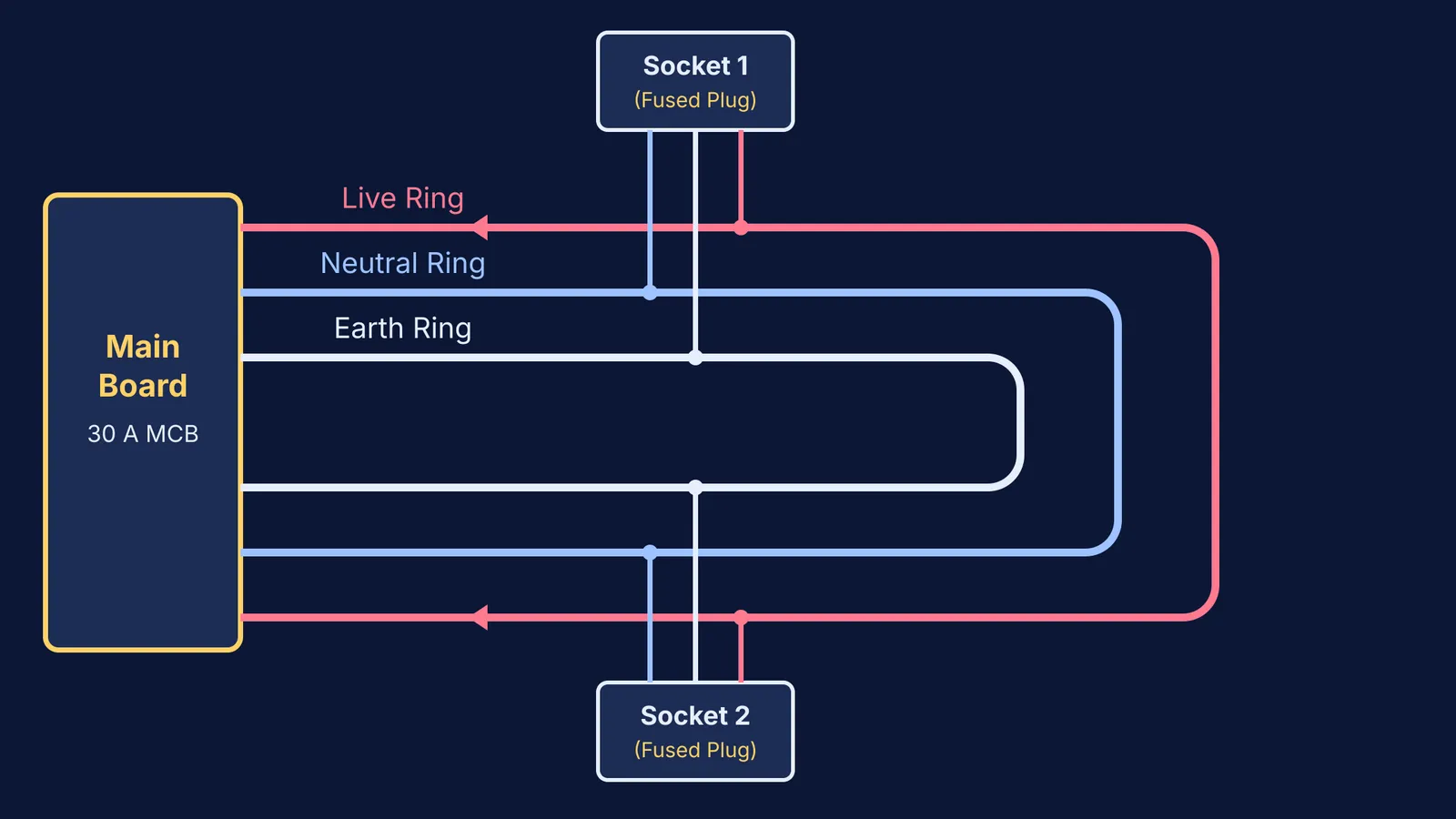
Today, the ring main system is the standard approach for domestic wiring. Instead of branching out and stopping at the final socket, the three main cables—Live, Neutral, and Earth—start at the consumer unit (the main distribution board), travel in a continuous loop through the rooms, and return to the exact same terminals at the board.
Every socket on that floor or section of the house taps into this continuous ring. Because the appliances are still connected in parallel, they all receive the standard mains supply without a significant voltage drop. The continuous loop means that current from the main board splits and travels in two opposite directions around the ring to reach any given socket. If you are struggling to picture how voltage stays constant across parallel circuits, the Fermi Concept Library is built for exactly this. Fermi's AI tutor holds a line of reasoning across a session, notices where a student is stuck, and decides whether to explain, ask or show; it draws the figure on a board and checks your understanding as it goes.
Why is the ring system preferred over the tree system?
The ICSE syllabus frequently asks students to compare the two methods. The ring main system offers three overwhelming advantages that make the tree system obsolete:
Lower cost from thinner wires: Because the current can travel from the consumer unit to any socket via two different paths (the two sides of the ring), the cables do not need to carry the full load alone. This means thinner cables can safely be used. In fact, when the ring circuit was originally developed after World War II, it was designed specifically to reduce copper requirements by approximately 25% (Wikipedia).
Independent operation: In a tree system, a blown branch fuse darkens a whole room. In a ring system, a fault in one device only blows that specific appliance's local fuse, leaving the rest of the house completely unaffected.
Easy expansion: Adding a new socket simply requires breaking into the existing ring in the wall and wiring the new socket in, rather than running a fresh cable all the way back to the main board.
Where do fuses and MCBs sit in a ring circuit?
Safety devices are placed strategically in a ring system to prevent overheating and fires.
At the main distribution board, the entire ring is protected by a high-capacity Miniature Circuit Breaker (MCB) or a main fuse. This is typically rated at 30 A or 32 A (Wikipedia), which is high enough to handle multiple heavy appliances—like a heater and a microwave—running at the same time.
However, 30 A is far too high to protect the thin flexible cord of a table lamp or a phone charger. If a fault occurs in the lamp, a huge current could melt its thin cord long before the 30 A main breaker ever trips. To solve this critical safety gap, every appliance in a ring system uses a fused plug. The plug itself contains a small, local fuse (usually up to 13 A) connected tightly to the live wire. This ensures that the appliance's own cord is protected independently.
If a toaster short-circuits, its local 13 A fuse blows immediately. The toaster stops, but the 30 A main MCB stays on, and the television plugged into the same ring keeps working without interruption. When working through past papers to test these concepts, the Fermi Problem Library provides a step-by-step solver that explains the reasoning rather than just printing an answer, helping you spot the exact rule you missed.
How do you draw Class 10 circuit diagrams?
When drawing or analysing household circuits in your exams, check these key practical points:
Are all switches and local fuses connected exclusively to the Live (red or brown) wire?
Is every socket connected in parallel across the Live and Neutral wires?
Does the Earth wire safely connect to the top pin of the three-pin sockets?
Does the overall ring complete its loop back to the main distribution board?
Getting these details right proves you understand not just the theory, but the practical safety behind Magnetic effects of current in Class 10: fields, rules and home wiring and Electricity in Class 10: Ohm's law, resistors and electric power.


