

On this page
In geometry, finding a missing angle in a triangle is a standard skill that relies on a single overarching rule. According to the foundational principles of Euclidean geometry, the sum of a triangle's interior angles is exactly 180 degrees. Whether you are working with an acute, obtuse, or right triangle, this total remains constant.
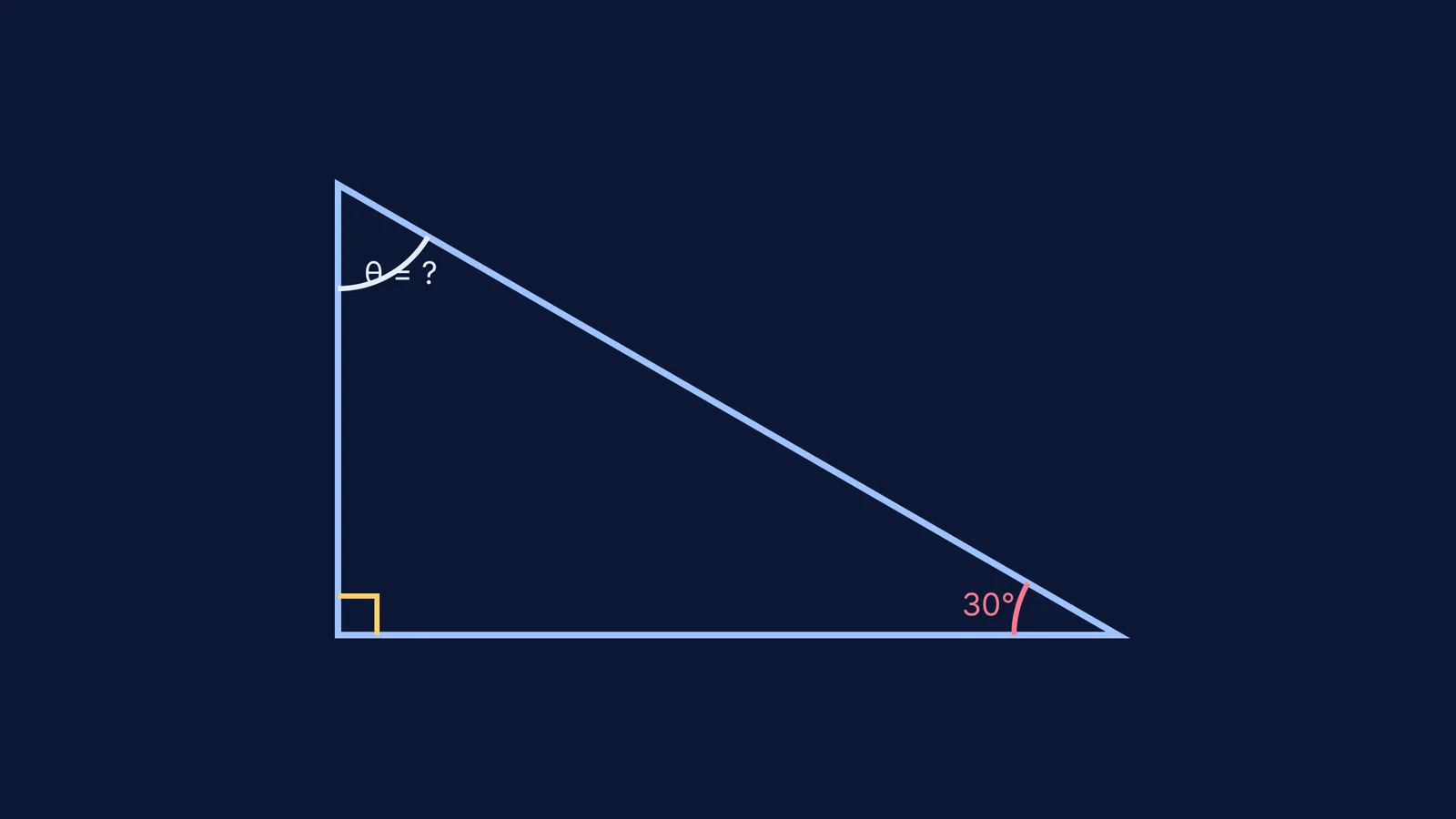
When dealing specifically with a right-angled triangle, calculating the missing angle becomes even more straightforward because one of the angles is already known.
How do you find a missing angle in a right-angled triangle?
Every right triangle contains one angle that measures exactly 90 degrees. Since the total angle sum is 180 degrees, the remaining two non-right angles (the acute angles) must add up to the remaining 90 degrees. In a right triangle, the two non-right angles are always complementary, meaning their sum is exactly 90 degrees.
If you are given one acute angle, finding the missing angle requires a single subtraction:
Identify the given acute angle (for example, 35°).
Subtract it from 90° (90° − 35° = 55°).
The missing angle is 55°.
This shortcut removes the need to constantly subtract from 180°, speeding up your working time during exams.
What about isosceles right triangles?
An isosceles triangle has two sides of equal length, which means the angles opposite those sides are also equal. An isosceles right triangle has exact angle measurements of 90°, 45°, and 45°.
If a problem mentions that a triangle is both a right triangle and isosceles, you immediately know all three angles without needing any extra numerical values. This shape represents half of a square divided along its diagonal and is a staple in geometry problems because its predictable angles simplify calculations.
How do you solve angles in ratio problems?
Sometimes, instead of giving you an angle's exact measurement, a problem will give you the ratio between the two acute angles.
For instance, a question might state that the acute angles of a right triangle are in a 1:2 ratio. Because the acute angles must add to 90°, you can set up a simple algebraic equation using a variable, such as *x*.
Let the first angle be *x* and the second angle be 2*x*.
Add them together: *x* + 2*x* = 90°.
Combine the terms: 3*x* = 90°.
Divide by 3: *x* = 30°.
This means the angles are 30° and 60°. In a 30-60-90 special right triangle, the sides are in the ratio 1:√3:2, and the angles are exactly 30°, 60°, and 90°.
A step-by-step framework for exam questions
When you encounter a missing angle problem in your homework or on a test, follow this mental checklist:
Identify the triangle type: Is it a right triangle? If so, lock in the 90° angle immediately.
Check for "isosceles": If the problem states the two legs are equal, your missing angles are automatically 45°.
Use the 90° rule: For any right triangle, subtract the known acute angle from 90° to find the missing one.
Set up ratio equations: If given a ratio (like 2:3), equate the sum of the ratio parts (2*x* + 3*x*) to 90°.
If you find yourself getting stuck when the algebra gets complicated, the Fermi Problem Library has worked problems with a step-by-step solver that explains the reasoning rather than printing an answer. Fermi's AI tutor works out what you already know and builds a plan for the session, so you can practice these logical deductions without hitting a wall.
Once you are comfortable with basic triangle properties, you can extend these ideas to coordinate geometry by learning to find the Area of a triangle using determinants, and the collinearity test, or discover how to construct a Circle through three given points: finding its centre and radius.


