

On this page
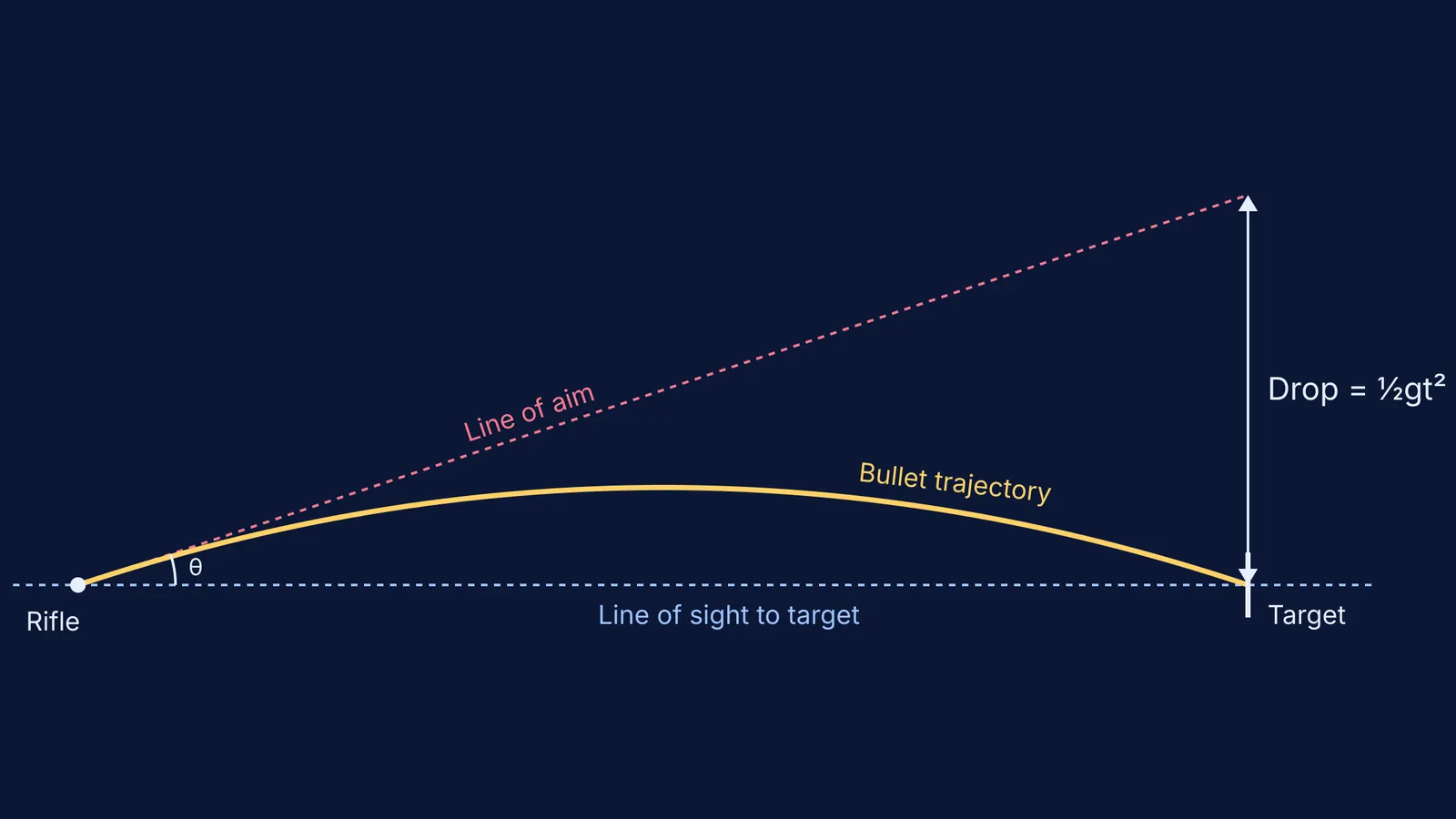
To hit a distant target, you must aim your rifle higher than the target by the exact distance the bullet will drop due to gravity during its flight. Because horizontal and vertical motions are independent, a bullet fired horizontally falls at the same downward acceleration of 9.8 m/s² as a bullet dropped from rest.
Why does a bullet drop?
The physics of a fired bullet is exactly the physics of any projectile. The bullet's high horizontal speed gets it to the target, but its vertical motion is governed entirely by gravity.
If we ignore air resistance, the vertical distance h a bullet falls is given by the standard kinematic formula for falling objects: h = ½gt²
Here, t is the time of flight. This time depends on the horizontal distance d to the target and the bullet's average horizontal velocity u. Because the time of flight is t = d/u, the bullet drop becomes proportional to the square of the distance.
This squared relationship is why long-range shooting requires precise mathematical adjustments. A small error in estimating the distance results in an exponentially larger error in predicting the bullet drop.
How much higher do you need to aim?
Let's put some numbers to the formula to see this in practice. A standard .308 Winchester rifle cartridge fires a bullet with a muzzle velocity of roughly 800 to 860 metres per second.
If you are shooting at a target 400 metres away, and we assume an average velocity of 800 m/s:
Time of flight: t = 400 / 800 = 0.5 seconds.
Bullet drop: h = ½ × 9.8 × (0.5)² = 4.9 × 0.25 ≈ 1.22 metres.
This means the bullet falls 1.22 metres during the half-second it spends in the air. To compensate, the line of aim extending from your rifle sights must point exactly 1.22 metres above the target. By tilting the barrel up by this amount, the bullet is launched on an upward curve—described by the Equation of trajectory of a projectile: finding u and θ from it—that arcs perfectly into the bullseye.
Shooters compensate for this drop either by using the markings on their scope's reticle (known as a "hold-over") or by physically adjusting the elevation dials on the scope, which tilts the optics so the centre of the crosshairs remains on the target while the barrel points higher.
What happens when shooting uphill or downhill?
A common misconception is that you should aim higher for uphill targets and lower for downhill targets. In reality, the physics dictates that you must aim lower for both uphill and downhill shots compared to the direct line-of-sight distance.
Gravity only acts perpendicular to the true horizontal plane. Therefore, the bullet drop is determined strictly by the horizontal distance to the target, not the slant distance up or down the hill. Because the horizontal distance is always shorter than the slant distance, the bullet spends less time being pulled perpendicularly away from its path than it would if the target were at the same distance on level ground.
For example, if a target is 400 metres away but at a steep 45-degree uphill angle, the horizontal distance is only about 283 metres. If you aim as if it were 400 metres away on level ground, you will overshoot the target because the bullet will not drop as much as you expected.
Does the mass of the bullet matter?
In the fundamental physics equations, you might notice that the mass of the projectile does not appear in the drop formula h = ½gt². In a vacuum, a heavy bullet and a light bullet fired horizontally at the same speed will drop exactly the same amount over the same distance.
However, in the real world of external ballistics, mass does matter, but indirectly. A heavier bullet often has a better ballistic coefficient, meaning it is more aerodynamic and less affected by air resistance. It retains its velocity better than a lighter bullet of the same shape. Because it stays faster over a long distance, its time of flight is shorter, giving gravity less time to pull it down. Thus, heavier, streamlined bullets generally exhibit a "flatter" trajectory at extreme ranges.
Students working on mechanics problems often see this principle in action. Whether it is a bullet, a thrown ball, or a Horizontal projectile from a cliff: time, range and impact speed, the independence of horizontal and vertical motion always holds true.
If you are practising projectile problems and keep losing track of the kinematic equations, the Fermi Problem Library has worked problems with a step-by-step solver that explains the reasoning rather than printing an answer. And if you need to build your intuition for how velocity and gravity shape a trajectory, you can explore every concept in physics, each with its own lesson and its place in the map, in the Fermi Concept Library.


