

On this page
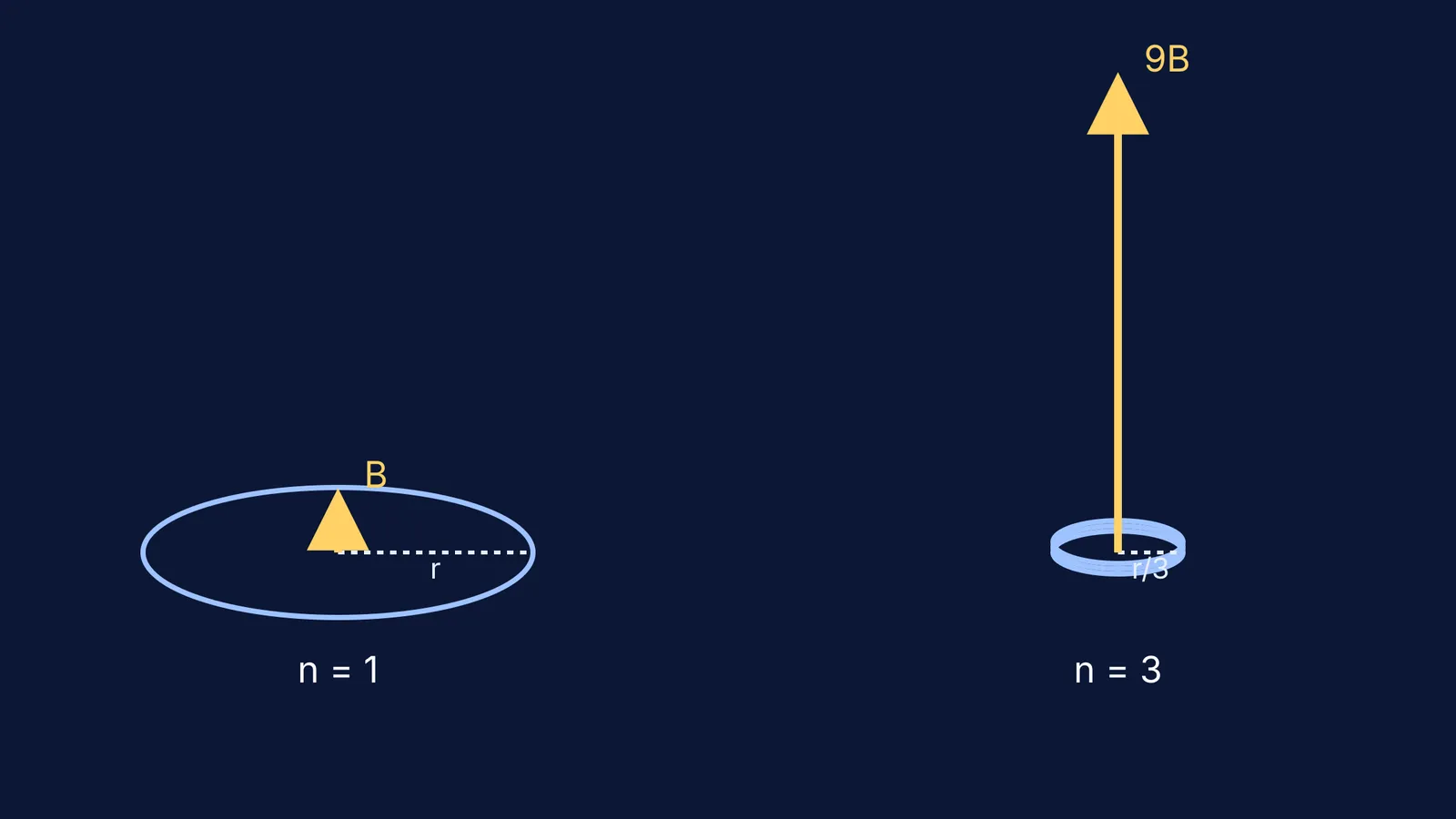
It is one of the most common traps in physics. A question tells you that a long, straight wire is bent into a single circular loop, producing a magnetic field B at its centre. The exact same wire is then completely rewound into a tighter coil of n turns, and you are asked to calculate the new magnetic field at the centre.
Many students intuitively guess that n turns mean n times the magnetic field. They choose nB and lose marks. Here is why the correct answer is n²B, and how the maths behind it works.
What is the formula for the magnetic field at the centre?
The magnetic field B at the centre of a circular current loop of radius r carrying a current I is given by B = μ₀I/2r (1).
If you have a coil with n turns of that exact same radius, the fields from each individual turn add up directly. The new formula simply becomes B = nμ₀I/2r. This is exactly why it is so tempting to wrongly assume the field simply scales by n.
Why does the new radius shrink to r/n?
Imagine a straight wire of total length L. If you bend it into a single loop, the circumference of that loop equals the wire's length: L = 2πr₁
So the radius of the single loop is r₁ = L/2π.
Now, take that exact same wire of length L and wrap it into a tight coil of n turns. The total length is still L, but it is now shared evenly across n smaller circumferences: L = n × 2πrₙ
Solving for the new radius rₙ gives: rₙ = L / (2πn)
If we substitute the original radius r₁ into this equation, we get rₙ = r₁/n. In other words, to get a greater number of turns out of the same length of wire, your new coil must be correspondingly smaller.
How do the two factors combine?
Now we calculate the new magnetic field, Bₙ. We use the field formula for n turns, but we must use the new, smaller radius rₙ:
Bₙ = nμ₀I / (2rₙ)
Substitute rₙ = r₁/n into the equation: Bₙ = nμ₀I / (2 × (r₁/n))
The n in the denominator of the denominator mathematically flips up to the numerator: Bₙ = n² × (μ₀I / 2r₁)
The part in the brackets is exactly our original magnetic field, B₁. Therefore: Bₙ = n²B₁
The field at the centre rises by a factor of n² because you are making two physical changes at once. You are increasing the total number of turns (which multiplies the initial field by n), and you are bringing those turns much closer to the centre by shrinking the radius (which multiplies the field by another factor of n). If you rewind a single loop into multiple turns, the field does not merely scale linearly; it becomes quadratically stronger.
This inverse relationship between the number of turns and the radius is the crucial key to solving the problem. The same fundamental principle applies to any closed shape made from a fixed continuous length of wire. Whether you are dealing with circular loops, square loops, or other regular polygons, rewinding the wire into n turns will always decrease the side length or radius by a factor of n, leading to the exact same n² dependence for the magnetic field at the centre.
A framework for "same wire" problems
When you see a physics problem about reshaping an object without changing its fundamental material, always write down the conserved quantity first.
Identify what stays constant. For a reshaped wire, it is the total length L (and therefore volume and mass). For a stretched wire, volume is constant but length changes.
Write the old and new geometry. Express the new dimensions directly in terms of the old ones. Here, L = 2πr₁ = n × 2πrₙ, giving rₙ = r₁/n.
Substitute into the final formula. Replace the old variables in the field or resistance formula with your new expressions.
If you struggle with these multi-step derivations, you are not alone. When a student gets stuck on a proportionality question, the Fermi Problem Library does not just print the final answer. Fermi's AI tutor works out where the gap is—whether it is remembering the Biot-Savart law or visualising the conserved length—and helps you build the substitution step by step. You can also explore the geometry of current loops as magnetic dipoles or trace the helical path of a charge to see how fields affect motion.


