

On this page
A relation is defined simply as a set of ordered pairs (OpenStax). In mathematics, it is the most basic way to describe how two groups of objects connect to one another. Each pair links an input to an output. The set of all first components (the inputs) makes up the domain, and the set of all second components (the outputs) forms the range.
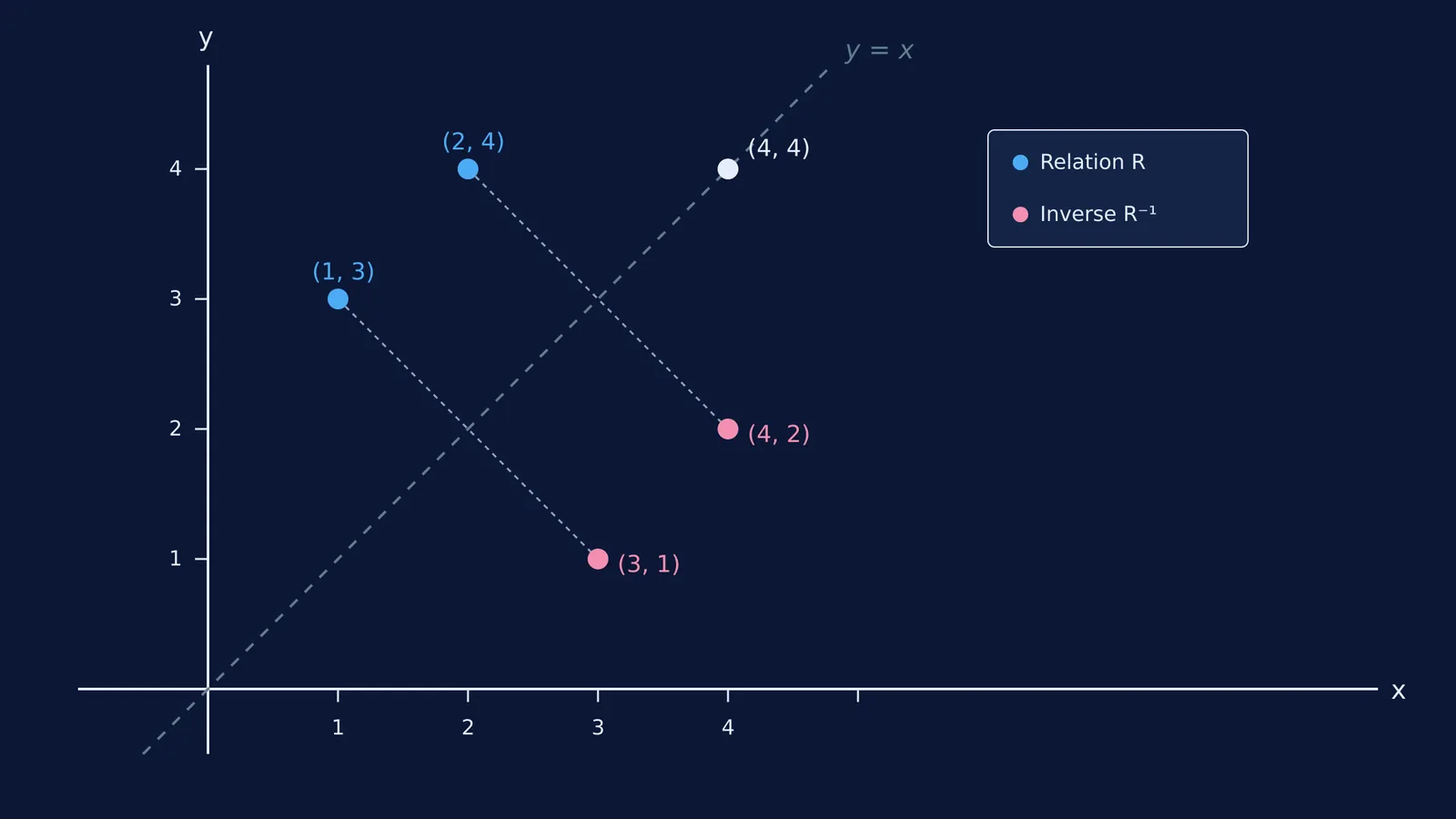
For example, take a relation R made of three distinct points on a graph: {(1, 3), (2, 4), (4, 4)}. The domain is the set of all unique x-values, which gives us {1, 2, 4}. The range is the set of all unique y-values, which gives us {3, 4}. Notice that the range is smaller than the domain because the output 4 is repeated.
The Fermi Concept Library holds every concept in mathematics, each with its own lesson and its place in the map, so you can see how sets, relations and functions build on each other across your syllabus.
How to find the inverse of a relation?
To find the inverse of a relation, you simply interchange the components of each ordered pair. If a relation contains the pair (a, b), its inverse will automatically contain the pair (b, a) (OpenStax).
For the discrete example R = {(1, 3), (2, 4), (4, 4)}, you just flip every coordinate. The inverse relation, written mathematically as R⁻¹, is {(3, 1), (4, 2), (4, 4)}.
If you are working with an algebraic equation instead of a list of points—like y = 3x - 5—you find the inverse relation by literally swapping x and y in the formula to get x = 3y - 5. From there, you use algebra to solve for y, isolating the new output variable.
When graphed on a coordinate plane, swapping the coordinates like this perfectly reflects the original relation across the diagonal line y = x. You can read more about how this visual geometry works in our guide to finding and reflecting the inverse of a function.
Why do domain and range swap in an inverse relation?
Because every (x, y) point is transformed into (y, x), all the x-values of the original relation become the y-values of the inverse. Likewise, the original y-values become the new x-values. This means the original range becomes the new domain.
Using our previous example, the inverse relation R⁻¹ has a domain of {3, 4} and a range of {1, 2, 4}. The two sets have exactly traded places. The inputs that used to feed into the relation are now the outputs it produces. If you are preparing for entrance exams, keeping track of these sets and knowing when they are allowed to swap is critical; see our breakdown of finding domain, range and composite functions.
Why might the inverse of a function not be a function?
A function is a special, strict type of relation where every single input has exactly one output. For an inverse relation to also qualify as a function, the original function must be "one-to-one"—meaning each output also comes from exactly one unique input (OpenStax).
If multiple inputs in the original function give the exact same output, the inverse will map that single output back to multiple different inputs. Look closely at our relation R: the inputs 2 and 4 both gave an output of 4. In the inverse relation R⁻¹, the single input 4 now maps to both 2 and 4.
This causes the inverse relation to fail the vertical line test, meaning the "inverse" is not a function at all. To fix this problem for standard equations like the parabola y = x², mathematicians restrict the domain of the original function (for instance, only allowing x ≥ 0) so that it becomes one-to-one before taking the inverse. You can learn how to check for this property in our article on testing for one-one and onto functions.
How do you check if an inverse is a function?
Let us test this rule with a practical algebraic problem. Suppose you are asked to find the inverse of the quadratic function f(x) = x² - 4 and determine if the result is a function.
Identify the original function: We start with f(x) = x² - 4, which draws a U-shaped parabola.
Find test ordered pairs: Pick a positive and a negative input. The function contains the points (-3, 5) because (-3)² - 4 = 5, and it contains (3, 5) because 3² - 4 = 5.
Build the inverse relation: By swapping the coordinates, the inverse relation must contain the points (5, -3) and (5, 3).
Evaluate the result: Because the single input 5 now gives two completely different outputs (-3 and 3), the inverse relation fails the definition of a function.
If you struggle to spot whether a function is one-to-one before finding its inverse, the Fermi Problem Library has worked problems with a step-by-step solver that explains the reasoning rather than printing an answer. And if you are unsure where your understanding is breaking down during graph transformations, Fermi's AI tutor can work out what you already know and build a plan for the session, so you sit down to a clear next step.


