

On this page
What is a reversible process in physics?
A thermodynamic process is reversible if it can be turned back along the exact same path so that both the system and surroundings return to their initial states with no trace left in the universe. The NCERT Class 11 Physics textbook identifies two mandatory conditions:
The process must be quasi-static, proceeding through equilibrium states at an infinitesimal rate.
The system must experience zero dissipative forces, meaning no energy is lost to friction, viscosity, or electrical resistance.
In 1865, Rudolf Clausius showed in *Annalen der Physik* that ∮ dQ/T = 0 for any reversible cycle, meaning a reversible path generates zero net entropy in the universe (ΔS_univ = 0). When mapping how state variables link mechanical work to thermal equilibrium, the Fermi Concept Library places each concept in physics and chemistry within its dedicated lesson and wider topic map.
Why are real processes irreversible?
Every spontaneous macroscopic process is irreversible. When mechanical work occurs in real systems, dissipative effects degrade directed energy into random thermal motion. As demonstrated by Rudolf Clausius in 1865, converting work to heat through friction is an uncompensated transformation: work can fully convert to heat, but that heat cannot spontaneously turn back into work without external intervention.
Irreversibility also stems from finite driving gradients. Whenever heat transfers across a finite temperature difference ΔT, or a gas expands rapidly into an unbalanced low-pressure zone, the system tumbles through non-equilibrium states with turbulent pressure variations. In the extreme case of the free expansion of an ideal gas, a gas rushes into a vacuum without pushing an external boundary; while no work is done and internal energy remains constant, entropy increases spontaneously, preventing the gas from returning to its original volume on its own.
Is every quasi-static process reversible?
A common exam mistake is assuming that quasi-static processes are automatically reversible. As physicist Mohammad Samiullah explained in the *American Journal of Physics* in 2007, all reversible processes are quasi-static, but not all quasi-static processes are reversible.
Consider a gas in a cylinder with a piston subject to friction against the walls. Removing sand grains one by one expands the gas infinitely slowly with uniform pressure and temperature throughout—a textbook quasi-static path. However, friction continuously converts mechanical work into heat dissipated into the surroundings. If you slowly add the grains back, the piston compresses the gas, but friction generates fresh heat rather than absorbing it. The gas returns to its initial state, but the surroundings remain permanently heated. Because the surroundings are altered, the process is irreversible.
What are key examples of reversible and irreversible processes?
The NCERT Class 11 Physics curriculum groups thermodynamic paths into two categories:
Ideal reversible processes: Infinitely slow, frictionless isothermal expansion of an ideal gas; elastic deformation of a spring within its elastic limit without internal hysteresis; and an electrochemical cell operated against an opposing potentiometer voltage differing by an infinitesimal EMF dE.
Real irreversible processes: A block sliding across a rough table where kinetic energy dissipates as heat; spontaneous heat flow between bodies at 350 K and 300 K; sudden expansion of gas following a membrane puncture; diffusion of ink in water; and electrical heating in a resistor of resistance R at rate I²R.
In cyclic heat engines, net work over a completed cycle equals the enclosed loop area on an indicator diagram, as shown in our guide on net work in a cyclic process. A reversible cycle achieves the maximum theoretical efficiency between two temperatures.
How do you calculate work in reversible versus irreversible expansion?
To see why reversibility matters in standard NCERT Class 11 Physics problems, consider 1.00 mole of ideal gas at temperature T = 300 K expanding isothermally from initial volume V_i = 10.0 L (0.0100 m³) to final volume V_f = 20.0 L (0.0200 m³), with gas constant R = 8.314 J/(mol·K).
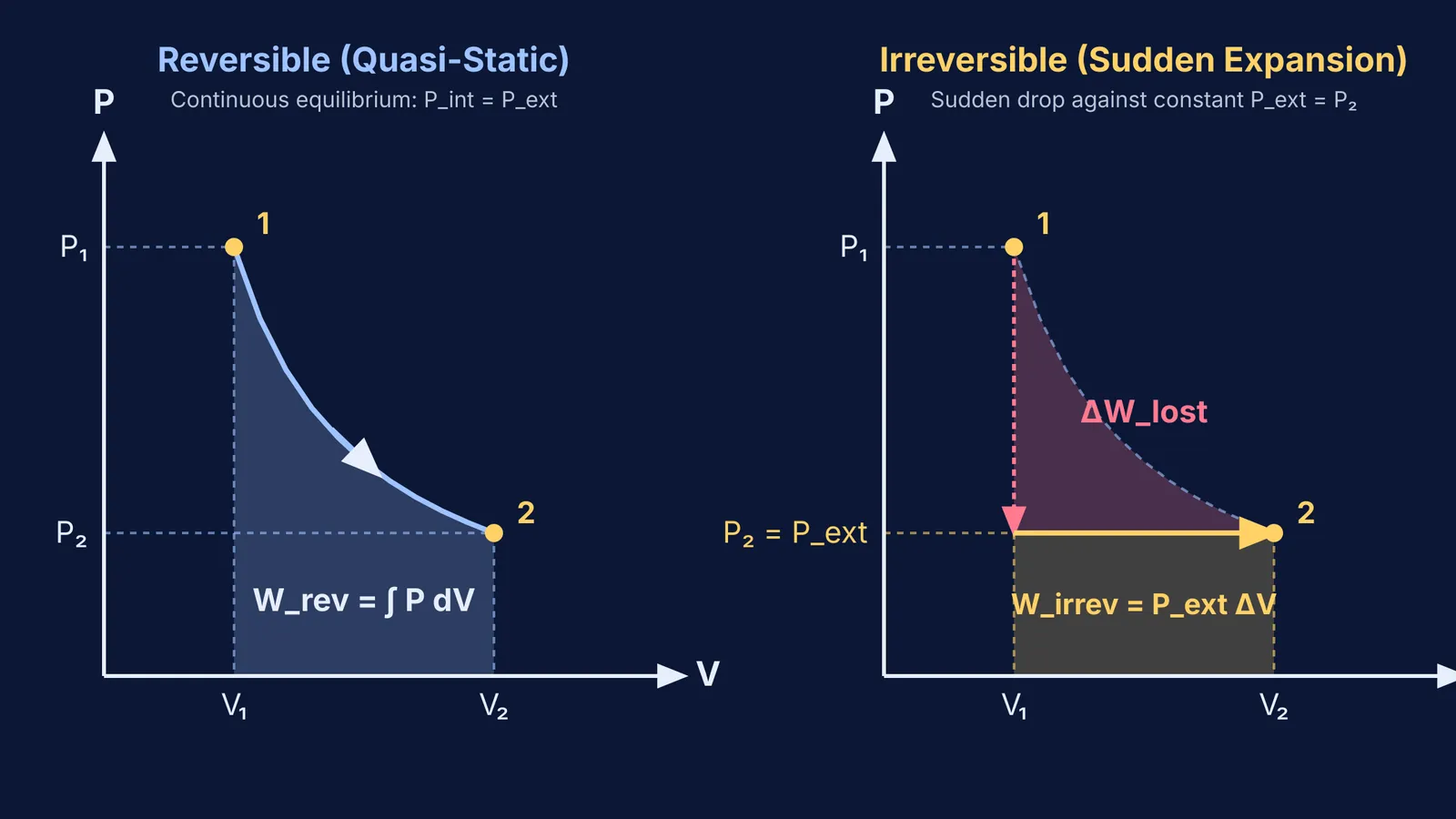
In a reversible isothermal expansion, internal pressure continuously balances external pressure (P = nRT/V):
W_rev = ∫ P dV = n R T ln(V_f / V_i) = 1.00 mol × 8.314 J/(mol·K) × 300 K × ln(2.00) ≈ 1729 J
Now consider a sudden, single-step irreversible expansion against a constant external pressure equal to the final gas pressure P_ext = P_f = 124,710 Pa. As outlined in our analysis of work in irreversible expansion, the work done is:
W_irrev = P_ext (V_f − V_i) = 124,710 Pa × 0.0100 m³ = 1247 J
The reversible path delivers 482 J more work (1729 J − 1247 J = 482 J) because the gas pushes against a smoothly decreasing pressure rather than dropping abruptly. In a 2009 study in the *European Journal of Physics*, Joaquim Anacleto and colleagues showed that dividing an expansion into N discrete stages reduces entropy generation steadily toward zero as N approaches infinity.
If you struggle to evaluate boundary conditions or set up work integrals, the Fermi Problem Library provides worked problems with a step-by-step solver that explains the reasoning rather than printing an answer.


