

On this page
When a p-n junction diode is connected in reverse bias, the applied voltage widens the depletion layer and raises the internal potential barrier. This barrier blocks majority carriers—electrons on the n-side and holes on the p-side—from crossing the junction. However, an ammeter still detects a tiny backwards current. This is the reverse saturation current.
This leakage current is caused entirely by minority charge carriers (Shockley, 1949). In a p-type semiconductor, there are stray electrons; in an n-type semiconductor, there are stray holes. When these minority carriers diffuse near the depletion zone, the strong electric field sweeps them across the junction. Because the background population of minority carriers at room temperature is minute, the resulting current is tiny. Tracing how this barrier develops connects directly to our guide on the p-n junction diode: reading forward and reverse bias curves.
Why does reverse saturation current increase with temperature?
Minority carriers in a doped semiconductor are not supplied by dopant atoms. Instead, they are generated thermally. Above absolute zero, random vibrations in the crystal lattice carry enough energy to break covalent bonds. Each broken bond frees an electron and leaves behind a hole, creating an electron-hole pair.
As temperature rises, lattice atoms vibrate more vigorously, accelerating thermal generation. The intrinsic carrier concentration grows exponentially with temperature according to the relation nᵢ² = N_c N_v exp(−E_g / kT), where E_g is the bandgap energy and k is the Boltzmann constant. By the law of mass action, the minority electron concentration in p-type material is n_p = nᵢ² / N_A, and the minority hole concentration in n-type material is p_n = nᵢ² / N_D. Because reverse saturation current is directly proportional to minority carrier density, it rises steeply as the diode heats up.
Why does reverse saturation current double for every 10 °C?
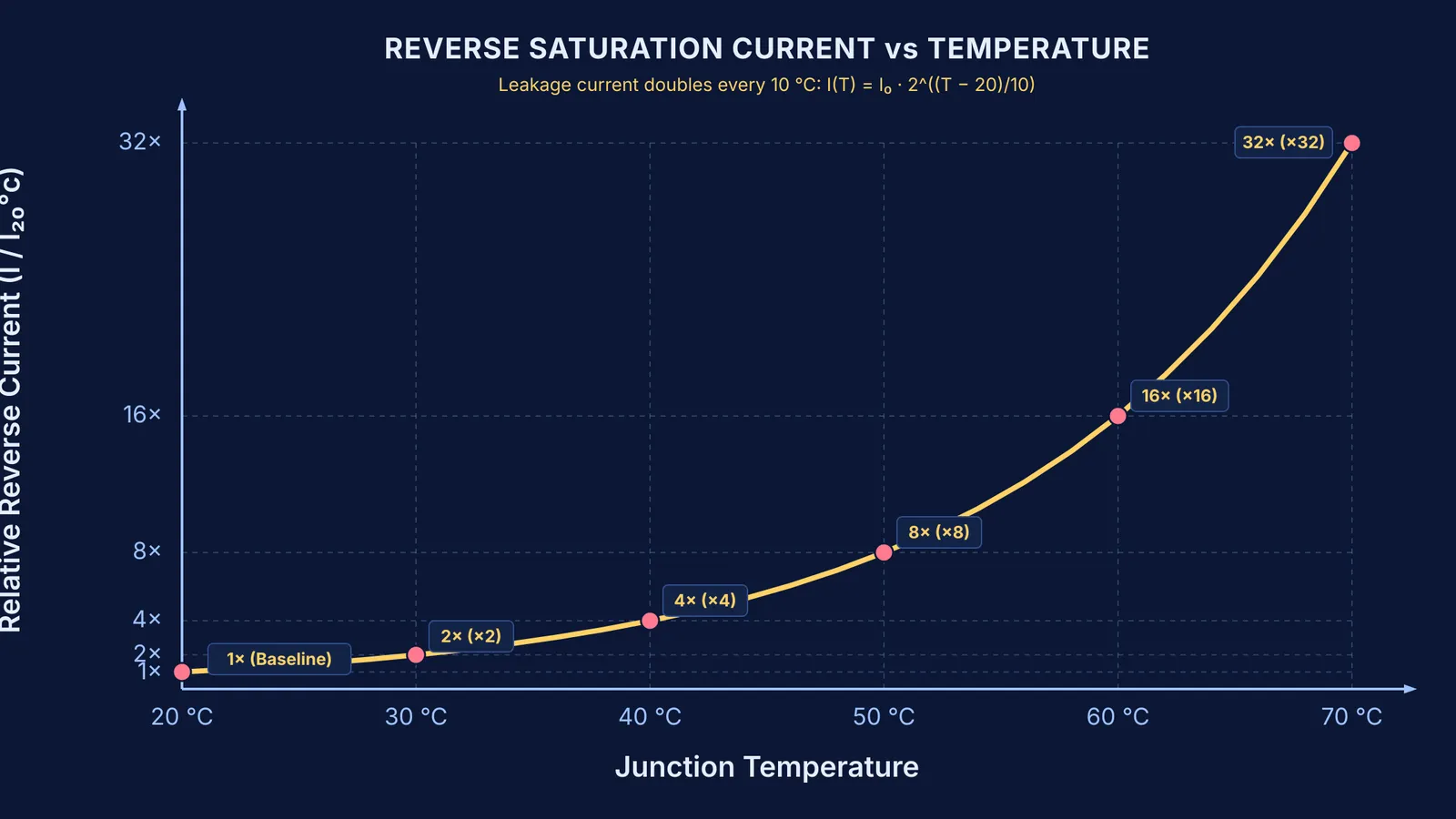
The exponential dependence of carrier generation leads to a reliable rule of thumb. In semiconductor electronics, the reverse saturation current approximately doubles for every 10 °C (or 10 K) rise in temperature (Li et al., 2020). Mathematically, doubling every 10 °C corresponds to an increase of roughly 7% per degree Celsius, because (1.072)¹⁰ ≈ 2.0.
If a diode has reverse saturation current I₁ at temperature T₁, its current I₂ at temperature T₂ is given by:
I₂ = I₁ × 2^((T₂ − T₁) / 10)
This sensitivity makes thermal management vital. If a circuit overheats, increased leakage current generates additional internal heat. This extra heat further increases leakage, sparking a regenerative cycle known as thermal runaway that can destroy the component.
Why is reverse saturation current higher in germanium than silicon?
While the doubling rule applies to both materials, their baseline leakage currents differ markedly. At 300 K, germanium has an energy bandgap of about 0.67 eV, compared to 1.12 eV for silicon. Because germanium requires less energy to free valence electrons, thermal vibrations break covalent bonds far more frequently.
As a result, the room-temperature intrinsic carrier concentration in germanium is roughly 1,000 times higher than in silicon. Furthermore, Sah, Noyce, and Shockley (1957) showed that silicon leakage at room temperature is dominated by space-charge generation in the depletion layer, keeping current in the nanoampere or picoampere range. Germanium leakage is dominated by diffusion, typically reaching 1 to 10 microamperes. With much higher baseline leakage, germanium is far more vulnerable to thermal runaway, which is why silicon replaced it in modern circuits. You can review these doping dynamics in our guide on n-type and p-type semiconductors: carrier concentration problems.
How does the Shockley diode equation account for temperature?
The full relationship between current, voltage, and temperature is described by the Shockley diode equation, formulated by Shockley (1949). While thermal voltage V_T = kT / q increases linearly with temperature, reverse saturation current I_S increases exponentially, dominating the diode's thermal response.
This rapid rise in I_S has an important consequence in forward bias. At a constant forward current, the forward voltage drop across a silicon diode decreases by approximately 2 mV for every 1 °C rise in temperature. Engineers use this predictable shift to construct integrated temperature sensors.
How do you calculate the change in reverse saturation current?
Standard electronics problems frequently test this doubling behavior (Li et al., 2020). Consider a typical calculation:
Problem: A silicon diode has a reverse saturation current of 5 nA at 20 °C. What is its reverse saturation current at 60 °C?
Find the temperature rise: ΔT = 60 °C − 20 °C = 40 °C.
Count the 10 °C intervals: 40 / 10 = 4 steps.
Determine the multiplier: 2⁴ = 16.
Calculate final current: 5 nA × 16 = 80 nA.
Although 80 nA is still small, it is sixteen times larger than the room-temperature baseline.
Where can you practice diode temperature problems?
Memorising the doubling formula helps in quick calculations, but understanding that heat generates the minority carriers gives you real intuition. In voltage regulators, checking leakage limits is essential, as shown in Zener diode regulator problems: choosing the series resistor.
For students mastering semiconductor physics, the Fermi Concept Library covers every concept in physics, chemistry, biology, mathematics and computing, each with its own lesson and its place in the map. When working through circuit numericals, the Fermi Problem Library provides worked problems with a step-by-step solver that explains the reasoning rather than printing an answer.


