

On this page
It is one of the most common pitfalls in secondary-school mathematics: finding the original value of something after it has gone up in price. If a shop adds Goods and Services Tax to an item, or your boss gives you a pay rise, how do you find the base amount from the final figure?
Most people instinctively reach for subtraction. They calculate the percentage of the new, final price and take it away. But because the original percentage was applied to a smaller starting number, subtracting that same percentage from the larger final number takes away too much.
When you need to reverse a mathematical increase, you must undo the original multiplication by dividing.
How do you find the original price after a percentage increase?
To work backwards from a final amount, mathematics curricula teach the multiplier method mmerevise.co.uk. A percentage increase is just a multiplication by a decimal.
An increase of 10% means that you are paying 110% of the original amount. As a decimal multiplier, 110% is written as 1.10. The forward calculation is simple: Original Amount × 1.10 = New Amount
To reverse the process and find the original amount, you move the multiplier to the other side of the equation by dividing: Original Amount = New Amount ÷ 1.10
Consider a pay-rise example. If your salary is raised by 10% to £44,000, it is tempting to subtract 10% of £44,000 (which is £4,400) to get £39,600. However, if your original salary was £39,600, a 10% increase would only add £3,960, leaving you with £43,560—not £44,000.
The correct calculation is £44,000 ÷ 1.10, which reveals your original salary was exactly £40,000.
If you are unsure whether a problem requires multiplication or division, the Fermi Concept Library explains the underlying mathematics of reverse percentages step by step.
How do you calculate the base price from a GST-inclusive total?
In India, prices on retail goods are typically written as the Maximum Retail Price (MRP), which already includes the Goods and Services Tax (GST).
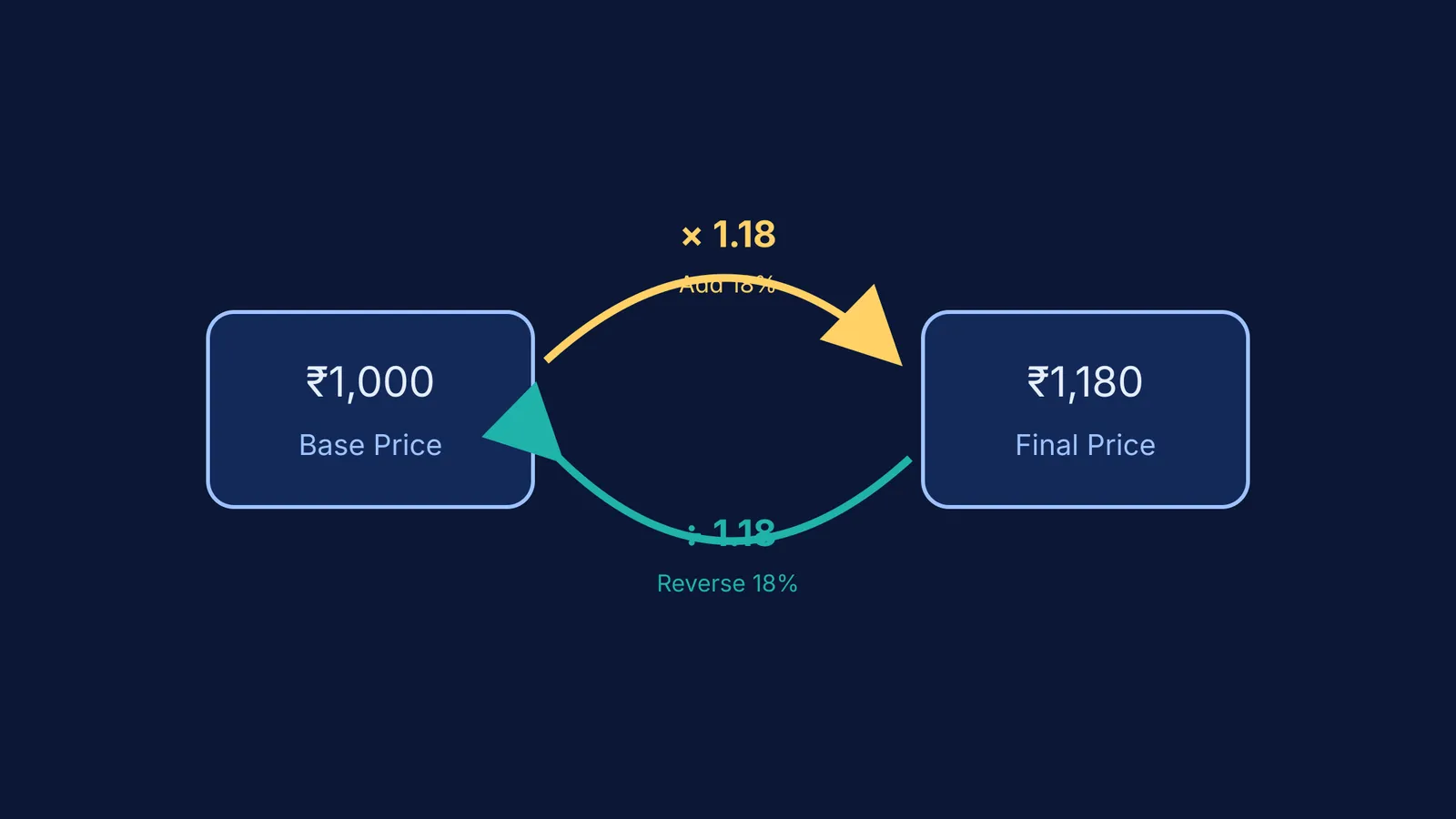
The official formula used in retail and finance relies on the exact same multiplier logic groww.in. If you know the final inclusive price, you find the base price by dividing it by the tax multiplier, which is written algebraically as (1 + GST Rate / 100).
For a standard 18% GST slab, the multiplier is 1.18.
If an electrical appliance costs ₹1,180 (inclusive of 18% GST), the base price is ₹1,180 ÷ 1.18 = ₹1,000.
The GST tax amount is then simply the difference between the two: ₹1,180 − ₹1,000 = ₹180.
Why does subtracting the percentage fail?
The error comes from shifting the base of the percentage mmerevise.co.uk. A percentage is not a fixed unit like a kilogram or a metre; it is a relative fraction.
When a store applies a 20% mark-up to a ₹500 shoe, the 20% is calculated out of ₹500 (which is ₹100). The new price is ₹600. If you try to reverse this by subtracting 20% of the new ₹600 price, you are subtracting ₹120. You end up at ₹480, completely missing the original ₹500 mark.
When wrong-method mistakes like this happen during homework, the Fermi Problem Library has a step-by-step solver that explains the algebraic reasoning rather than just printing a final answer.
A checklist for common multipliers
Whether you are unravelling a discount, checking an invoice, or stripping out sales tax, the reverse operation is always division by the adjusted percentage mmerevise.co.uk.
Identify the mathematical change: Did the original value go up or down?
Find the new percentage: If it went up by 5%, the new value is 105%. If it was a 20% discount, the new value is 80%.
Convert the percentage to a decimal: 105% becomes 1.05. 80% becomes 0.80.
Divide to reverse: Take your final number and divide it by this decimal.
Mastering this concept clears the way for harder algebraic topics. Once you know how to map percentages to decimals, dealing with repeated multipliers—such as those seen in Sums like 9 + 99 + 999 + …: rewriting them with a GP—becomes much more intuitive. It is also the exact same logic you will use to track changing totals in statistics, such as With and without replacement: probability problems compared.


