

On this page
When a fast-moving bullet strikes a target like a wooden block, it slows down rapidly and comes to a halt over a short distance. The wood exerts a strong, opposing force against the bullet, known as the retarding force or resisting force. Calculating this average force is a classic physics problem that connects motion (kinematics) with the laws of force (dynamics).
What is the average force on a bullet stopping in a wooden block?
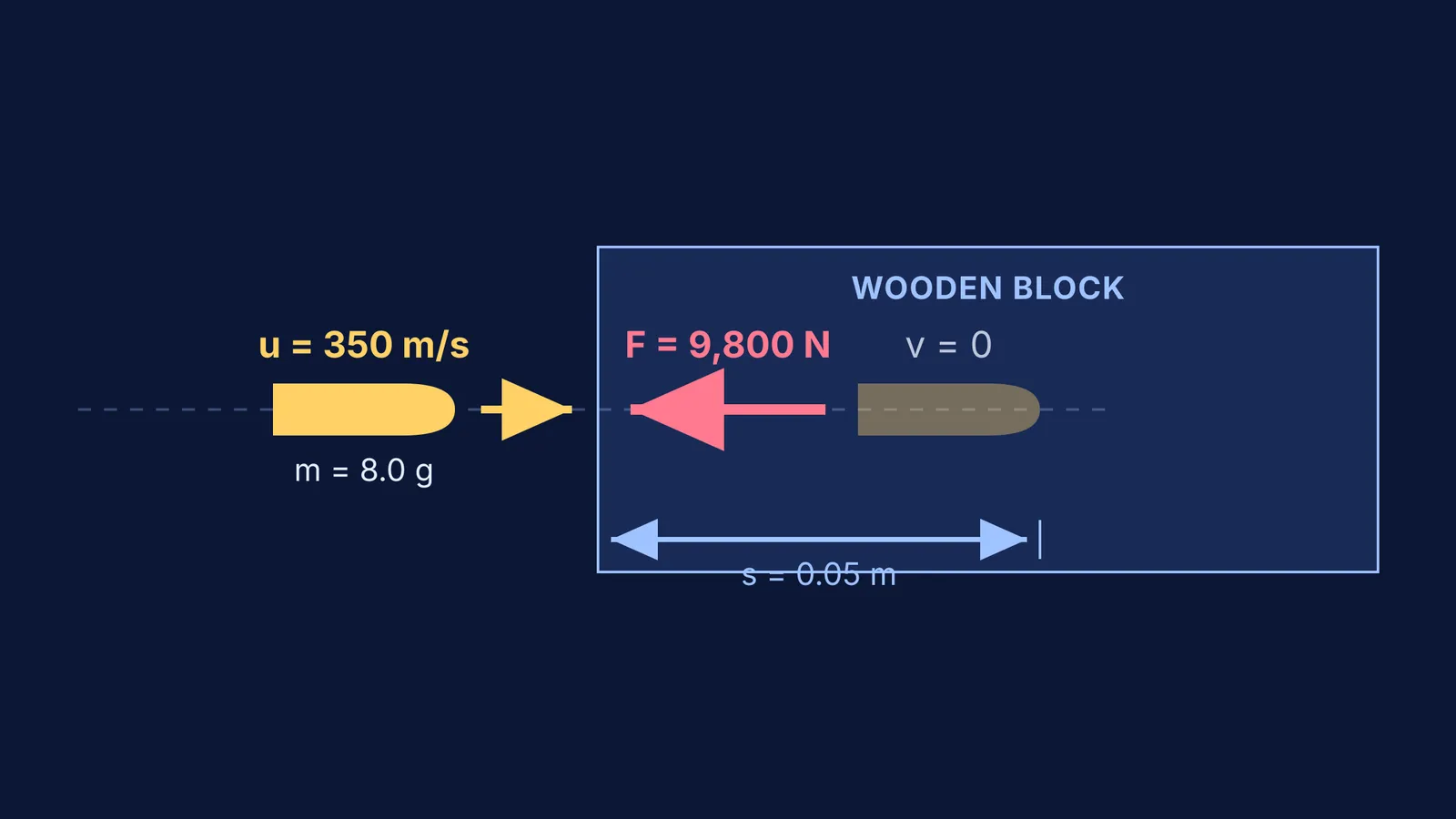
To find the stopping force, you need to know three things: the bullet's mass, its initial velocity as it hits the block, and the depth it penetrates before stopping. A typical 9 mm Full Metal Jacket bullet has a mass of about 8.0 grams and an impact velocity of 350 m/s (Koene & Broekhuis, 2017). When such a bullet strikes a medium-hard wood like pine, let us assume it penetrates 5 centimetres (0.05 metres) before coming to a stop.
To find the force, you first determine the bullet's acceleration. The time-independent kinematic equation relating velocity and distance is v² = v₀² + 2a(x − x₀) (OpenStax University Physics). After finding the deceleration, you calculate the force using dynamics. Newton's second law states that net force equals mass times acceleration, or F = ma (OpenStax University Physics).
What does this mean for different materials?
The penetration depth heavily depends on the density and hardness of the target material. As observed in ballistics tests, firing the same 9 mm bullet into a much harder wood like oak would result in a significantly shorter penetration depth compared to pine (Koene & Broekhuis, 2017).
Because the stopping distance (s) would be smaller, the deceleration (a) would be much larger. According to F = ma, a larger deceleration requires a proportionally larger retarding force. This is why harder materials exert a greater average stopping force to halt an object.
Step 1: Find the deceleration from penetration depth
Since the bullet comes to a complete stop inside the block, its final velocity (v) is zero. We substitute our 9 mm bullet values (Koene & Broekhuis, 2017) into our kinematic equation, which is often written as v² = u² + 2as:
Initial velocity (u) = 350 m/s
Final velocity (v) = 0 m/s
Displacement or penetration depth (s) = 0.05 m
Plugging these in: 0² = 350² + 2 × a × 0.05 0 = 122,500 + 0.10 × a
Solving for the acceleration (a): a = −122,500 / 0.10 a = −1,225,000 m/s²
The negative sign indicates deceleration, meaning the acceleration is directed opposite to the bullet's motion. If you need a refresher on other scenarios where acceleration varies, see how to handle acceleration given as a function of v or x.
Step 2: Calculate the force using F = ma
Now that we have the acceleration, we apply Newton's second law. Remember to convert the bullet's mass from grams to kilograms so that the resulting force is in newtons (N), using the mass of our 9 mm projectile (Koene & Broekhuis, 2017).
Mass (m) = 8.0 g = 0.008 kg
Acceleration (a) = −1,225,000 m/s²
F = 0.008 × (−1,225,000) F = −9,800 N
The magnitude of the average retarding force exerted by the wooden block is 9,800 newtons. The negative sign simply means the force pushes against the bullet's direction of travel.
Can you solve it using the work-energy theorem?
Yes. Instead of calculating acceleration, you can equate the work done by the wood to the change in the bullet's kinetic energy. Using the same 8.0-gram bullet at 350 m/s (Koene & Broekhuis, 2017) and a 0.05 m stopping distance, the calculation is more direct:
W = ΔKE −F × s = 0 − ½mu² −F × 0.05 = −½ × 0.008 × 350² 0.05 × F = 490 F = 9,800 N
This alternative method yields the exact same average force of 9,800 newtons. The work-energy theorem is often faster because it bypasses the intermediate step of finding the deceleration.
How do you find the stopping force from penetration depth?
If you are asked to solve this type of problem in an exam, here is a framework to keep your steps organized:
List your knowns in SI units: Convert mass to kg, velocity to m/s, and distance to m.
Apply v² = u² + 2as: Set v = 0 and solve for a.
Apply F = ma: Multiply the mass by your calculated acceleration.
State the magnitude: If the question asks for the "resisting force," you can drop the negative sign and simply give the positive value (e.g., 9,800 N for our 9 mm bullet, Koene & Broekhuis, 2017).
If you are exploring other mechanics problems, such as finding the distance in the nth second or analysing a shell exploding midair, the core skill is identifying which variables you have and which equation connects them.
If you get stuck combining kinematics and force equations, the Fermi Problem Library has worked problems with a step-by-step solver that explains the reasoning rather than printing an answer.


