

On this page
Why is rotation restricted in a double bond but free in a single bond?
In ethane, the carbon-carbon linkage is a single sigma (σ) bond formed by the head-on overlap of sp³ hybrid orbitals. Because a σ bond has cylindrical symmetry around the bond axis, rotating one methyl group preserves orbital overlap at every angle. According to the NIST Chemistry WebBook, the barrier to internal rotation in ethane is only 12.2 kJ/mol (2.9 kcal/mol). At 298 K, ambient thermal energy easily overcomes this small barrier, letting methyl groups spin past each other billions of times per second.
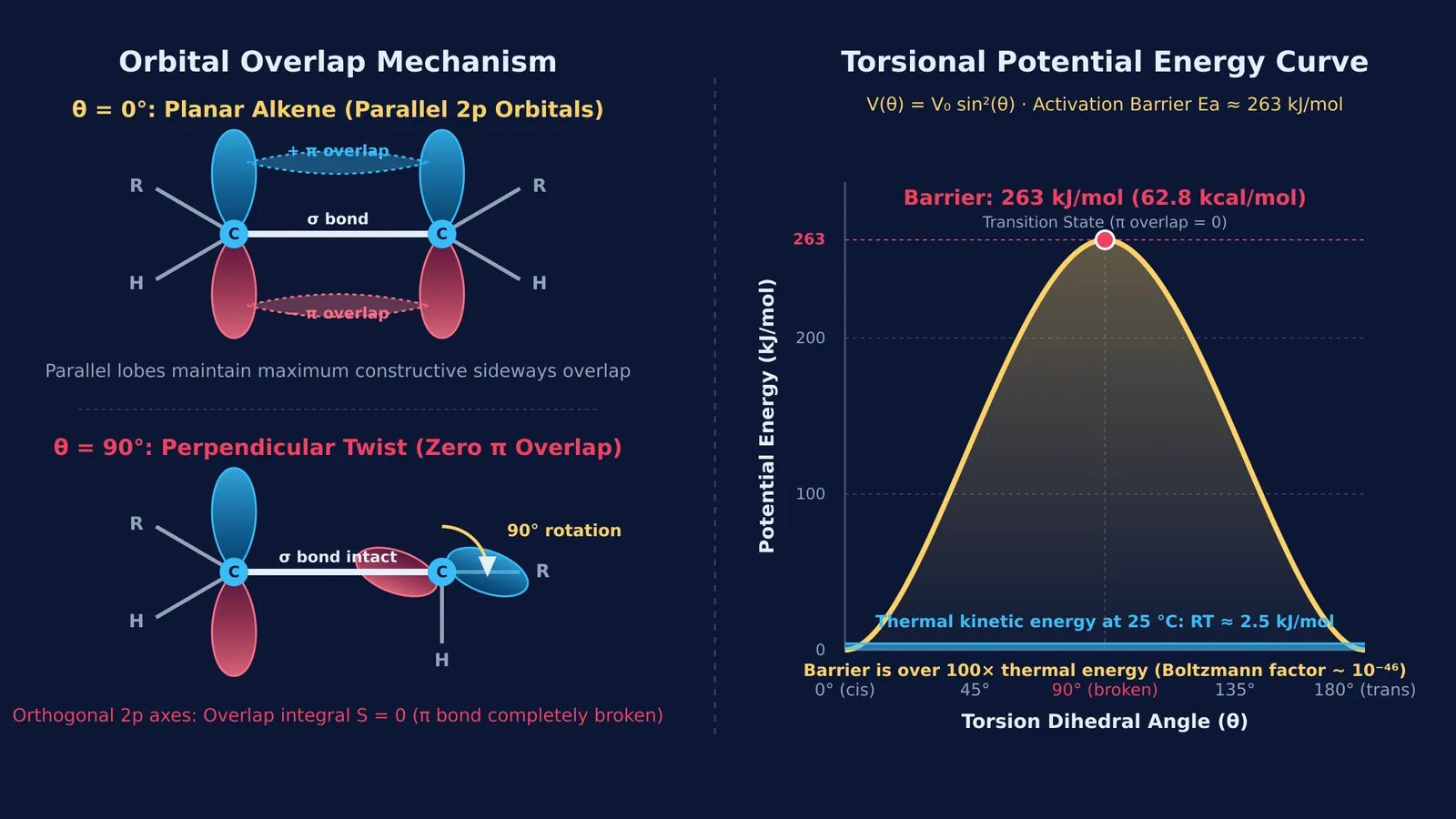
A carbon-carbon double bond introduces a rigid geometric constraint. In an alkene such as ethene, each carbon atom adopts sp² hybridization, forming a planar framework with bond angles near 120°. The double bond comprises one central σ bond and one lateral pi (π) bond formed by the sideways overlap of unhybridized 2p atomic orbitals perpendicular to the molecular plane. Constructive π overlap requires these 2p orbital axes to remain parallel.
Rotating one carbon relative to the other increases the angle between their 2p orbitals. Sideways overlap depends on the cosine of this dihedral angle. At a 90° twist, the two 2p orbitals become orthogonal, reducing overlap to zero. Twisting the double bond therefore requires breaking the π bond entirely while the σ bond stays intact.
How much energy does twisting a carbon-carbon double bond require?
Breaking a π bond requires substantial energy. In The Journal of Chemical Physics, John E. Douglas, B. S. Rabinovitch, and F. S. Looney measured the gas-phase thermal isomerization of 1,2-dideuteroethylene, establishing an activation energy of 272 kJ/mol (65.0 kcal/mol). Later measurements by B. S. Rabinovitch and K.-W. Michel in the Journal of the American Chemical Society found an activation energy of 262.8 kJ/mol (62.8 kcal/mol) for cis-2-butene.
To see why double bonds stay locked at ordinary conditions, compare this barrier with the thermal kinetic energy available at room temperature (298.15 K), where RT is roughly 2.48 kJ/mol:
Ambient thermal energy at 25 °C: RT ≈ 2.48 kJ/mol
Ethane single-bond barrier: 12.2 kJ/mol (about 5 times RT)
Alkene double-bond barrier: ~263 kJ/mol (more than 100 times RT)
Because thermal energy follows the Boltzmann distribution, the fraction of collisions surpassing 263 kJ/mol is proportional to exp(-Ea / RT). At 298 K, this factor is roughly 10⁻⁴⁶. The rate constant for uncatalyzed thermal rotation at 25 °C drops below 10⁻³² s⁻¹, yielding a half-life of billions of years. Without intense heat above 400 °C or ultraviolet light, the double bond remains locked.
Why does restricted rotation create cis and trans isomers?
Because rotation cannot occur at room temperature, substituents on doubly bonded carbons stay fixed in place. This rigidity creates cis-trans isomers: distinct configurational stereoisomers that cannot interconvert spontaneously and can be isolated in separate bottles.
In but-2-ene, having both methyl groups on the same side forms cis-2-butene, while opposite sides give trans-2-butene. Because their spatial geometries differ, their physical properties differ measurably. Data from the NIST Chemistry WebBook highlights this difference:
cis-2-Butene has a boiling point of 3.7 °C, a melting point of -138.9 °C, and a dipole moment of 0.30 D from its aligned polar bonds.
trans-2-Butene has a boiling point of 0.9 °C, a melting point of -105.5 °C, and a dipole moment of 0 D because its opposing bond dipoles cancel.
The higher melting point of trans-2-butene reflects its linear symmetry, which enables closer crystal packing. This structural principle connects directly to Van 't Hoff's model of tetrahedral carbon. Understanding this lock is foundational before counting stereoisomers from chiral centres or analyzing structural isomers in butane.
For students reviewing orbital geometry and stereochemistry, the Fermi Concept Library covers every concept in physics, chemistry, biology, mathematics and computing, each with its own lesson and its place in the map.
How can you test whether an alkene exhibits cis-trans isomerism?
Exam questions in JEE Main and NEET-UG regularly test whether a given alkene exhibits geometric isomerism. Restricted rotation is necessary, but not sufficient by itself. Any alkene can be evaluated with a simple two-step diagnostic:
Verify a rigid bond: Confirm the presence of a double bond (or ring) that prevents free rotation.
Verify substituent diversity: Each doubly bonded carbon must hold two different groups. For R₁R₂C=CR₃R₄, both R₁ ≠ R₂ and R₃ ≠ R₄ must hold true.
Applying this rule to standard examples:
But-2-ene (CH₃-CH=CH-CH₃): Both carbons carry -H and -CH₃. Meets both rules; exhibits cis-trans isomerism.
Propene (CH₂=CH-CH₃): C1 carries two identical hydrogens. Fails substituent diversity; lacks cis-trans isomers.
2-Methylbut-2-ene ((CH₃)₂C=CH-CH₃): C2 carries two identical methyl groups. Fails substituent diversity; lacks cis-trans isomers.
1-Bromo-2-chloroethene (CHBr=CHCl): C1 carries -H and -Br; C2 carries -H and -Cl. Meets both rules; forms cis-trans isomers.
When practicing stereochemical mechanisms and isomer identification, the Fermi Problem Library provides worked problems with a step-by-step solver that explains the reasoning rather than printing an answer.


