

On this page
When building an electrical circuit, you might need a specific resistance that you do not have on hand. Because adding new paths makes it easier for current to flow, connecting multiple identical resistors in parallel drops the total equivalent resistance of the circuit.
If you are asked how many resistors in parallel are needed to draw a given current from a specific voltage source, you are looking at a classic application of Ohm's law combined with parallel circuit rules. Here is how to break the problem down into two logical steps, using the standard 176 Ω example found in many physics textbooks.
How do you find the total resistance needed?
Before counting the individual resistors, you must determine what the entire resistor network needs to act like. You can treat the whole parallel combination as one single equivalent resistor connected to the battery.
According to Ohm's law, the resistance of a circuit is the voltage divided by the current, or R = V / I. This tells you the total resistance required to hold the current at the desired level.
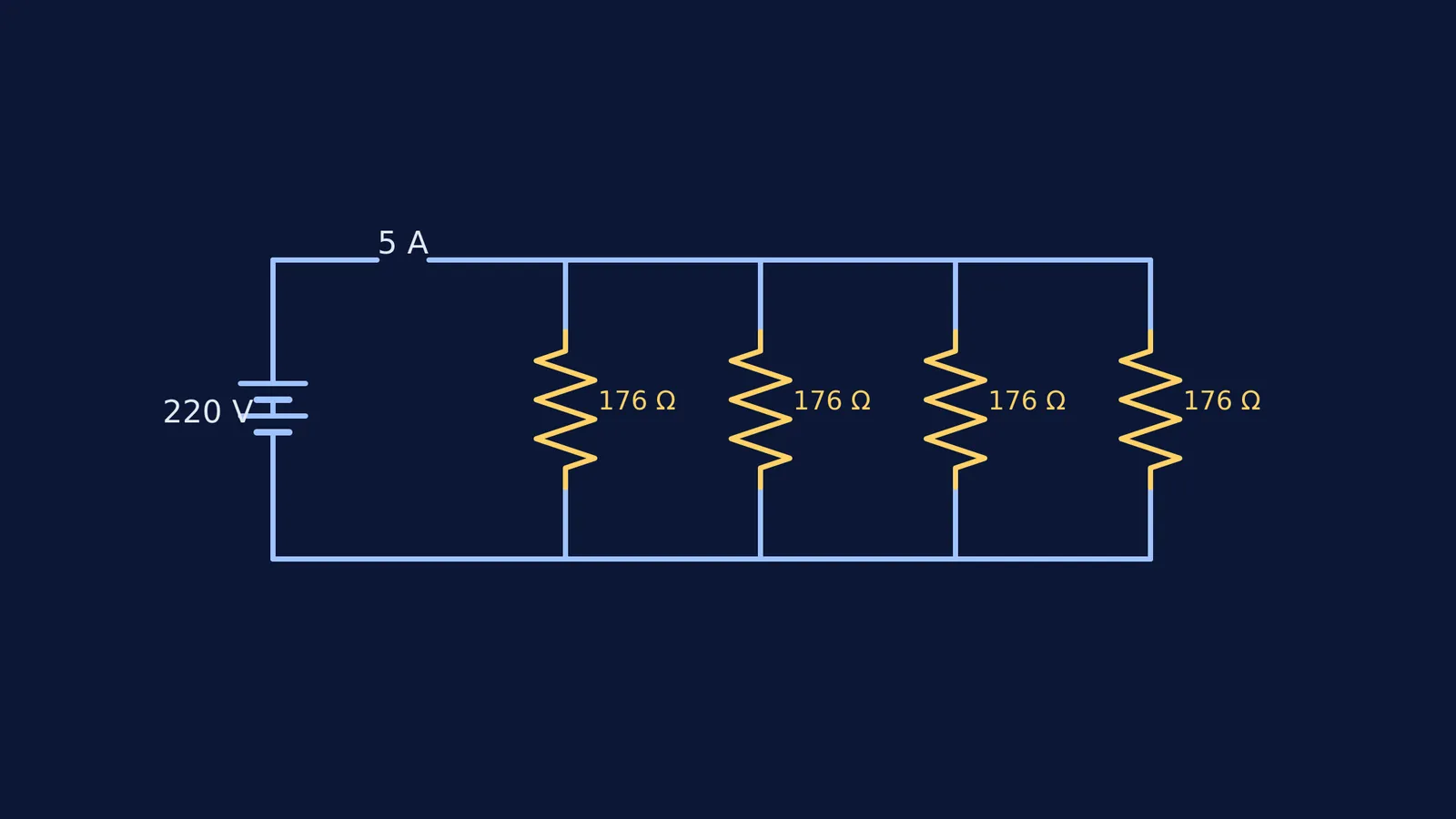
Suppose you have a 220 V line and you want it to draw exactly 5 A of current. To find the total resistance required, plug these values into Ohm's law: R = 220 V / 5 A = 44 Ω
This means that no matter how many resistors you use or how they are arranged, the entire network must behave as if it were a single 44 Ω resistor.
Why does adding paths reduce the total resistance?
When you add resistors in series, the current has to push through every single component one after the other. This makes the total resistance higher than any individual resistor. However, in a parallel circuit, each new resistor provides an entirely new path for the current to flow from the positive terminal to the negative terminal of the battery.
Think of it like adding more checkout lanes at a supermarket. Even if each new lane is slow, having more of them open allows more people to flow through at once. In an electrical circuit, opening a new path allows more charge to flow, which means the total current increases. If the voltage stays the same and the total current increases, the total resistance must have decreased.
This is why the total resistance of a parallel circuit is always smaller than the resistance of its smallest individual branch.
How do resistors in parallel combine?
For a set of n identical resistors connected in parallel, the total equivalent resistance is simply the resistance of one resistor divided by the total number of resistors, or R_total = R / n.
This formula makes intuitive sense based on the extra paths. If you put two 100 Ω resistors in parallel, the current has twice as many routes to take, so the total resistance drops in half to 50 Ω. If you use four of them, the resistance drops by a factor of four down to 25 Ω. When all branches have the same resistance, the math simplifies elegantly to dividing the single component's value by the number of branches.
How many 176 Ω resistors do you need?
Now we can bring the two ideas together. We know we need a total resistance of 44 Ω from our Ohm's law calculation, and we know that we are building this total out of individual 176 Ω resistors.
We can rearrange the parallel resistance formula to solve for the number of resistors: n = R / R_total
Substitute the values from our example into the equation: n = 176 Ω / 44 Ω = 4
So, you need exactly four 176 Ω resistors in parallel to draw 5 A on a 220 V line.
What if the math gives a decimal?
In textbook physics problems, dividing the single resistance by the target total resistance will almost always give you a clean integer like 3, 4, or 5. You cannot have a fraction of a resistor in these setups—if a question asks for a physical count of identical components, the answer must be a whole number. If you calculate that you need 4.2 resistors, you should immediately pause and re-check your arithmetic.
Usually, a non-integer result means that you either plugged the numbers into Ohm's law upside down (for example, using I / V instead of V / I), or you multiplied when you should have divided. It might also mean you have forgotten to convert a unit, such as plugging in milliamperes without converting them to amperes first. Because exam setters design these problems to test your algebraic reasoning rather than your calculator skills, the whole number check acts as a built-in safety net to verify your work.
When does this come up?
Questions like this appear frequently in board exams and physics tests to check your understanding of two core ideas at once: applying Ohm's law to a macroscopic circuit, and knowing the microscopic parallel resistance rule for individual components. It tests your ability to see the forest and the trees—you must treat the entire network as a single 'black box' resistor to find its total value, and then look inside the box to figure out how many pieces make up that total.
If you are stuck on similar problems, the Fermi Concept Library has a lesson for every concept in physics and its place in the map. If you know the formula but keep making algebraic errors, the Fermi Problem Library has worked problems with a step-by-step solver that explains the reasoning rather than just printing an answer.
For more practice, you can study Electricity in Class 10: Ohm's law, resistors and electric power to refresh the basics, or look at advanced combination of resistors: series, parallel and symmetry shortcuts for harder JEE-level challenges.


