

On this page
Every resistor comes with a power rating that tells you how much heat it can shed without burning up. If you push too much current through it, or drop too large a voltage across it, the resistor will overheat and fail.
But how do you translate that wattage into a safe voltage limit?
What is the maximum voltage across a resistor of given power rating?
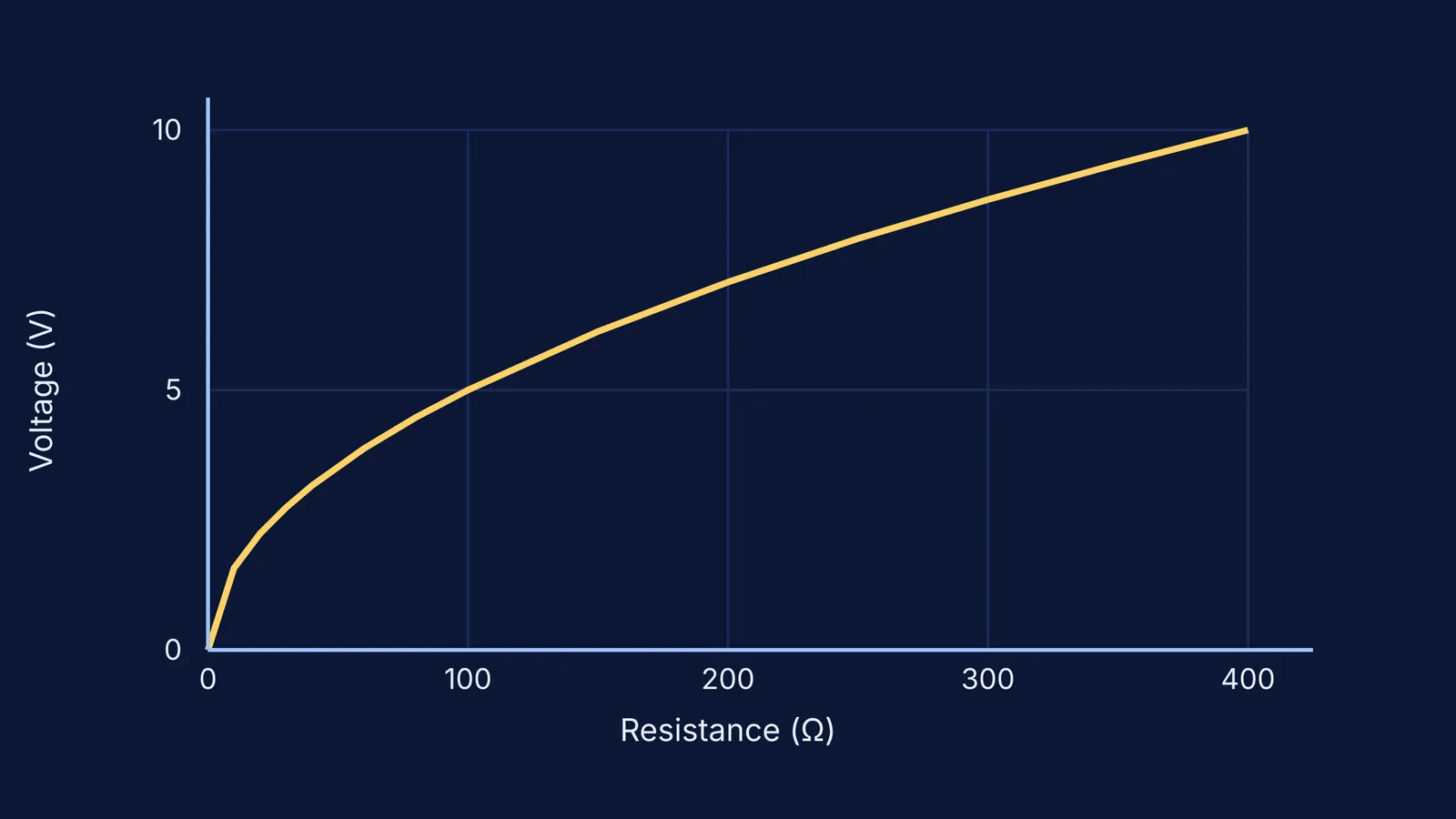
To find the highest voltage a resistor can handle thermally, you use the standard power equation, P = V² / R. By rearranging it for voltage, you get the maximum voltage formula detailed in electronics tutorials:
V = √(P × R)
For example, a standard quarter-watt (0.25 W) carbon resistor is one of the most common components in school and university electronics labs. If you have a 100 Ω quarter-watt resistor, the maximum voltage it can take is:
V = √(0.25 × 100) = √25 = 5 V
If you connect it to a 9 V battery, it will draw too much power and quickly burn out.
If you are reviewing these relationships before an exam, you can find derived formulas and circuit rules in the Fermi Concept Library. It maps out how power, voltage, and current connect, helping you spot the right equation for a given problem.
How do you find the maximum current through a resistor?
You can find the maximum safe current using a similar rearranged formula, which uses the same power rating limits. Power is also equal to current squared times resistance (P = I² × R). Rearranging this gives:
I = √(P / R)
Using the same quarter-watt resistor, but this time with a resistance of 1,000 Ω (1 kΩ):
I = √(0.25 / 1000) = √0.00025 = 0.0158 A, or 15.8 mA.
These calculations tell you the thermal limits. As long as you stay below these values, the resistor can shed heat fast enough to survive. We recommend checking Node potential method: solving circuits by assigning voltages for practical ways to find the actual voltages in a complex network before comparing them to your component limits.
What happens if you exceed the maximum working voltage?
There is a catch. As resistance gets very high, the V = √(P × R) formula predicts that the resistor can handle massive voltages.
If you have a 1 MΩ (1,000,000 Ω) quarter-watt resistor, the thermal formula suggests:
V = √(0.25 × 1,000,000) = √250,000 = 500 V
However, it will not survive 500 V. Resistors have a second limit called the maximum working voltage. This is a physical limit to prevent electricity from arcing directly across the component or breaking through its insulation.
For a standard quarter-watt (0.25 W) through-hole carbon film resistor, the maximum working voltage is typically 250 V, according to manufacturer datasheets. This means you must never exceed 250 V, even if the thermal calculation says the resistor would not overheat until 500 V. You must always obey the lower of the two limits.
How do you check resistor limits in a circuit?
To make sure your resistor is safe in a real circuit, follow a simple three-step checklist.
Find the expected voltage and current. Calculate the theoretical voltage drop across the resistor and the current flowing through it based on the rest of the circuit.
Check the thermal limit. Compare your expected values to the V = √(P × R) and I = √(P / R) limits. Ensure the power dissipated is less than half of the resistor's rating for a safe margin.
Check the maximum working voltage. If you are working with high voltages and high resistances, ensure your expected voltage drop is strictly below the manufacturer's maximum working voltage, such as those specified for standard components (e.g., 250 V for a 1/4 W resistor).
When you solve circuit problems, it is easy to assume an ideal resistor that has no limits. If you need a step-by-step solver that explains the reasoning rather than just printing an answer, try the Fermi Problem Library. It will guide you through checking both the thermal and physical constraints. You can also explore Resistance of a tapered conductor: setting up the integral for a deeper look at how physical shape affects resistance.


