

On this page
When you measure the resistance of a simple wire, you usually just plug its length and thickness into a formula. But what if the conductor is a rectangular block? A cuboid has three pairs of opposite faces, which means there are three different paths a current can take to pass through it.
The electrical resistance R of a uniform conductor is directly proportional to its length L and inversely proportional to its cross-sectional area A, given by the formula R = ρL/A (Wikipedia). Because of this, by choosing different faces for the current to enter and exit, you change both the path length L and the area A, resulting in three different resistance values for the very same piece of material.
Why does the resistance of a block change between faces?
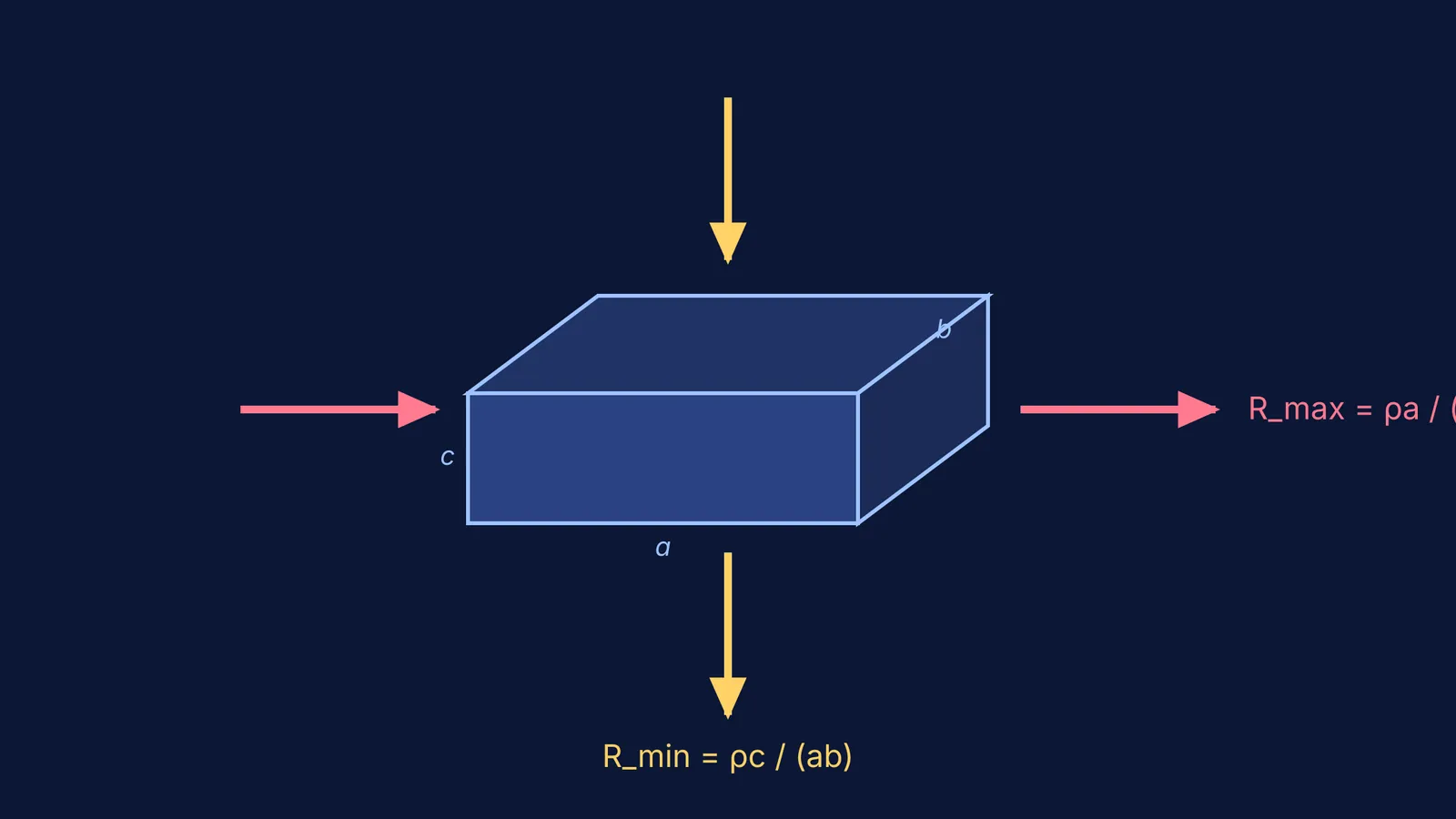
Imagine a rectangular block with a longest side a, a middle side b, and a shortest side c. When you connect a battery across a pair of faces, the current travels through the block.
If the current flows across the two smallest faces (each with area b × c), it must travel the entire longest distance a. In this case, L = a and A = b × c. This arrangement gives the highest possible resistance, because the current is squeezed through the narrowest cross-section over the longest distance.
Conversely, if the current flows across the two largest faces (each with area a × b), it only has to travel the short distance c. Here, L = c and A = a × b. This wide, short path offers the least opposition to the current flow, giving the block its minimum resistance.
If you are struggling to picture the geometry of these paths or setting up the 3D formulas, the Fermi Concept Library has a lesson on resistance that explains how each face maps back to the resistance equations.
What about the middle resistance?
While questions usually focus on the extremes, there is a third way to connect the block. If you connect the battery across the two faces with area a × c, the current travels along the middle side b.
In this scenario, L = b and A = a × c. The resistance is given by R_mid = ρb / (ac). Because b is shorter than a but longer than c, and the area a × c is larger than b × c but smaller than a × b, this configuration yields a resistance value squarely between the maximum and minimum.
This illustrates a fundamental principle of electricity: you cannot state the resistance of an irregular 3D object without specifying the direction of current flow. The material properties (represented by ρ) remain constant, but the geometry of the path dictates the final resistance.
How do you calculate the ratio of maximum to minimum resistance?
Questions asking for the ratio of the largest to smallest resistance are common in competitive exams like JEE Main and NEET. You can find this ratio purely algebraically, without even knowing the material's underlying resistivity (ρ).
Maximum resistance: R_max = ρa / (bc)
Minimum resistance: R_min = ρc / (ab)
To find the ratio, simply divide the maximum by the minimum:
Ratio = R_max / R_min = [ ρa / (bc) ] / [ ρc / (ab) ]
When you cancel out ρ and rearrange the terms, the formula neatly simplifies to:
Ratio = a² / c² = (a / c)²
This gives you a powerful shortcut: the ratio of the largest to smallest resistance for any rectangular block is simply the square of the ratio of its longest dimension to its shortest dimension.
How does this look in a worked example?
Let's apply this to a standard exam problem. Suppose you have a rectangular block made of a conductive material with dimensions 1 cm, 2 cm, and 3 cm.
First, you identify the sides:
Longest side (a) = 3 cm
Middle side (b) = 2 cm
Shortest side (c) = 1 cm
Using our shortcut rule, the ratio of maximum to minimum resistance is:
Ratio = (3 / 1)² = 3² = 9
So, the maximum resistance is exactly 9 times the minimum resistance.
You can verify this by calculating the individual resistances if you prefer. The maximum resistance is ρ(3) / (1 × 2) = 1.5ρ, and the minimum resistance is ρ(1) / (2 × 3) = 0.166ρ. Dividing 1.5ρ by 0.166ρ gives exactly 9.
If you make a sign error, forget to square the ratio, or plug the wrong cross-sectional area into a problem like this, the Fermi Problem Library will walk you through your working step-by-step, showing you exactly where the dimensions got swapped, instead of just printing the final answer.


