

On this page
When James Watson and Francis Crick proposed the double helix structure of DNA, they did not immediately prove how the molecule copied itself. Biologists debated three possible mechanisms for DNA replication.
What are the three models of DNA replication?
Before the experiment in 1958, there were three competing ideas for how a parent DNA molecule creates daughter molecules.
Semiconservative model: The two strands of the parent DNA separate, and each acts as a template for a new complementary strand Meselson and Stahl. Every new double helix contains one old strand and one newly synthesised strand.
Conservative model: The parent double helix remains completely intact. It serves as a template to build a separate, completely new double-stranded DNA molecule.
Dispersive model: The parent DNA breaks into smaller segments, and new DNA is synthesised in short pieces. The resulting daughter DNA molecules are a patchwork, with old and new segments interspersed along both strands.
How did Meselson and Stahl test the models?
To find out which model was correct, Matthew Meselson and Franklin Stahl used a technique called density labelling in 1958 Meselson and Stahl. They grew Escherichia coli bacteria in a medium containing a heavy isotope of nitrogen (¹⁵N). After many generations, all the bacterial DNA was heavy.
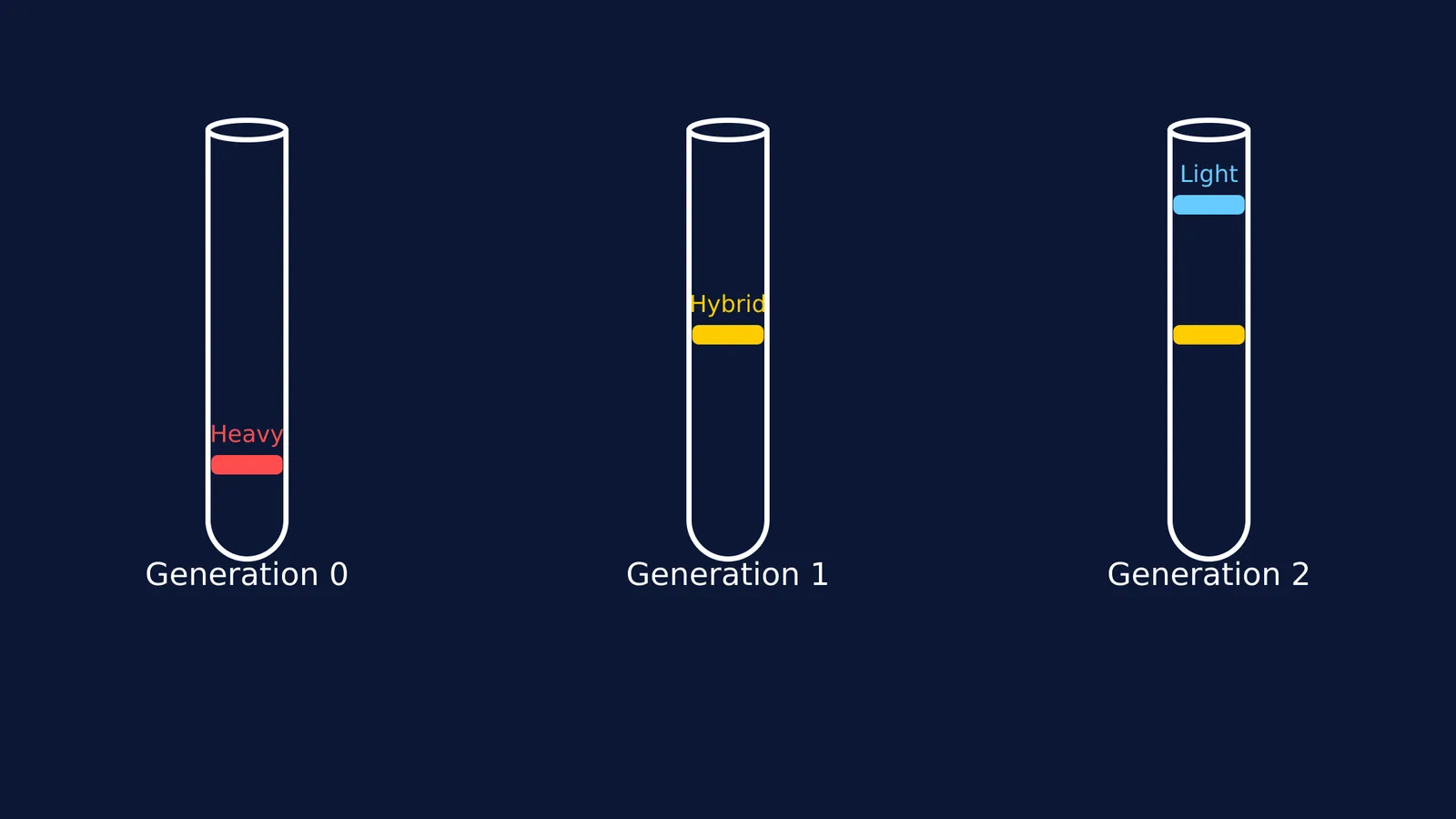
They then transferred the bacteria to a medium with common light nitrogen (¹⁴N) and allowed them to replicate. By extracting the DNA and spinning it in a centrifuge, they separated the molecules by density into distinct bands. Generation 0 produced a single heavy band, giving them a starting point to compare against.
How do band patterns eliminate the conservative model?
After exactly one generation of growth in the light medium, the scientists extracted the DNA again Meselson and Stahl. If the conservative model were true, the original heavy DNA would stay intact, and the new DNA would be completely light, creating two distinct bands.
Instead, the experiment produced exactly one band of intermediate density. This single hybrid band proved that every DNA molecule consisted of a mix of heavy and light nitrogen. Because there was no purely heavy or purely light DNA, the conservative model was eliminated.
Why does generation 2 eliminate the dispersive model?
After one generation, both the semiconservative and dispersive models predict a single hybrid band. To tell them apart, Meselson and Stahl allowed the bacteria to divide for a second generation in the light nitrogen Meselson and Stahl.
After two generations, the centrifuge revealed two distinct, equal bands: one intermediate band and one pure light band. This finding eliminates the dispersive model. If replication were dispersive, the original heavy nitrogen would be scattered evenly across all the new DNA, producing a single band that is lighter than the first generation but still a hybrid. The presence of a pure light band alongside the hybrid band confirmed that intact heavy and light strands had separated again. This proved that DNA replication is semiconservative.
How do you predict band patterns in genetics problems?
Exam questions often ask you to predict the ratio of DNA bands after three or four generations Meselson and Stahl. Here is a worked plan for solving them:
Identify the starting DNA: Assume generation 0 is entirely heavy.
Double the total strands: Each round of replication doubles the number of DNA molecules. After three rounds, one original molecule becomes eight.
Track the original strands: Because replication is semiconservative, the two original heavy strands remain intact forever. They will form two hybrid molecules with new light strands.
Count the light molecules: Subtract the two hybrid molecules from the total. After three rounds (8 molecules), there are 2 hybrid and 6 light molecules.
If you struggle to picture how these strands unzip and pair up over multiple generations, the Fermi Concept Library has every concept in physics, chemistry, biology, mathematics and computing, each with its own lesson and its place in the map. Understanding the physical separation of strands makes it easier to tackle related topics, such as how Okazaki fragments and DNA replication work on the lagging strand, or getting DNA into cells for genetic engineering. You can also test your grasp of the double helix structure by practising Chargaff's rule numericals.


