

On this page
A classic hurdle in quantitative exams—from JEE to general aptitude—is the "milk and water" dilution problem. You are told a container holds pure milk. A set amount is scooped out and replaced with water. Then, from that new mixture, the same amount is scooped out and replaced again. This is repeated several times. How much milk is left?
Attempting to track the exact amounts of milk and water at each individual step wastes precious exam time and invites arithmetic errors. Instead, we can use a single continuous mathematical expression.
What is the repeated replacement formula?
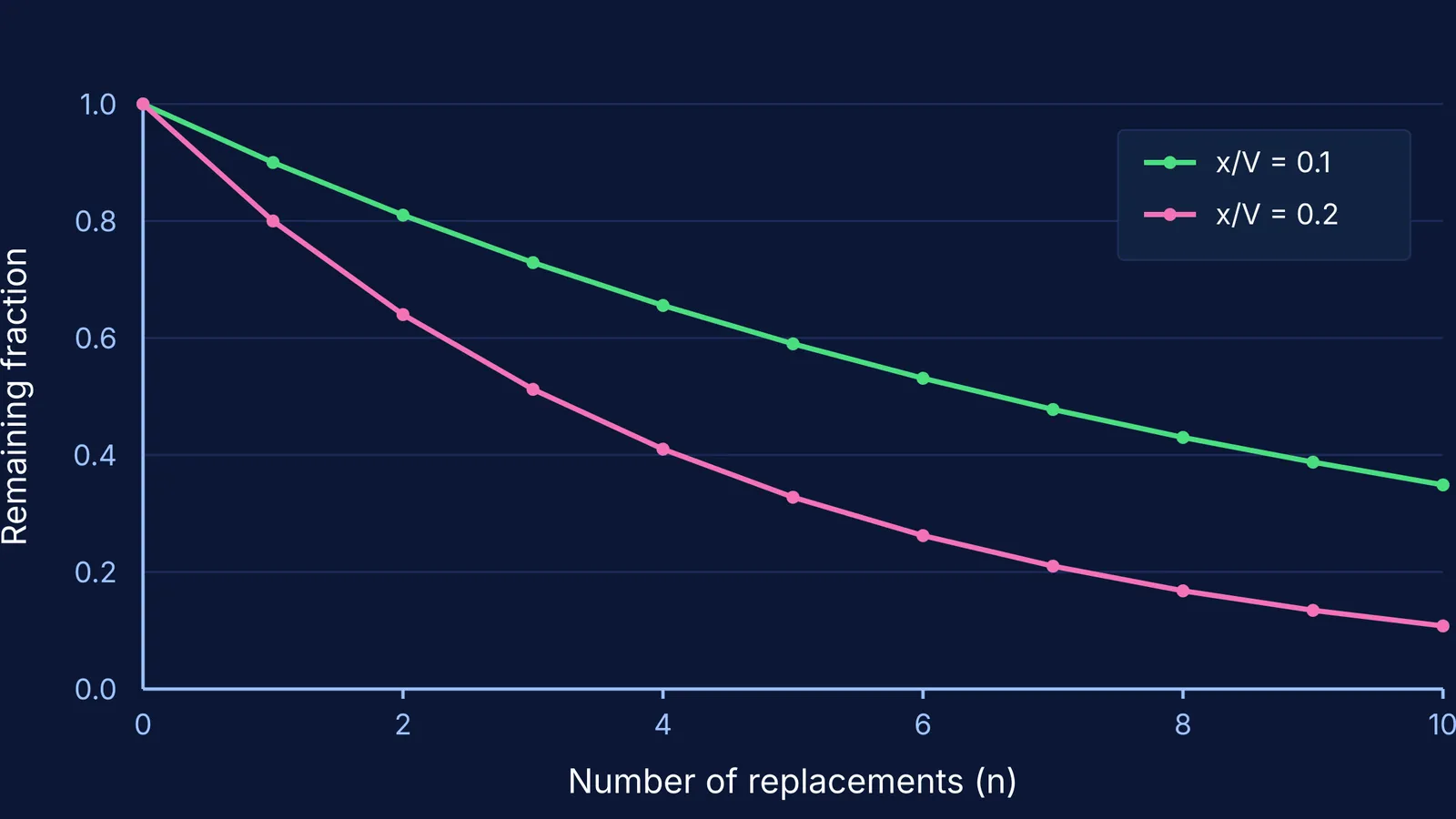
For any repeated replacement of liquid from a container, the formula for the amount of original liquid left is: Final quantity = V × (1 − x/V)ⁿ
Here, V is the total volume of the container (or the initial quantity of the pure liquid). The volume taken out and replaced each time is x, and n is the number of times this exact replacement operation is performed.
This rule is a standard application of alligation for repeated dilutions (Wikipedia). The core idea relies on the "retained fraction," which is (1 − x/V). Because you always replace the liquid with pure water, the total volume V stays exactly the same. However, every time you remove x litres of the mixture, you are removing the fraction x/V of whatever milk happens to be in the container at that moment. That means you always leave behind (1 − x/V) of the milk from the previous step.
How do you solve repeated replacement of liquid from a container?
In standard mixture problems (Wikipedia), we can track the dilution by identifying the three core variables. Let us look at a worked example using milk and water.
Suppose a container holds 50 litres of pure milk. A student removes 10 litres of the milk and replaces it with water. They then repeat this process two more times, for a total of 3 operations. How much milk remains?
First, list the variables:
Total volume V = 50 litres
Replacement volume x = 10 litres
Number of replacements n = 3
Next, find the retained fraction for a single step: Retained fraction = 1 − (10 / 50) = 1 − 1/5 = 4/5.
Now, apply the power of n and multiply by the starting volume: Final milk = 50 × (4/5)³ Final milk = 50 × (64/125) Final milk = 3200 / 125 = 25.6 litres.
After three rounds of replacement, 25.6 litres of pure milk remain, meaning the container now also holds 24.4 litres of water.
Why does the fraction multiply out?
Many students memorise the formula but forget it under pressure. Understanding the logic of alligation (Wikipedia) helps it stick. If you have 50 litres and remove 10, you removed 1/5 of the total liquid. Therefore, 4/5 of the milk stays behind.
When you do it a second time, the container holds a mixture. Because the milk is spread evenly, removing 1/5 of the total liquid again removes exactly 1/5 of the remaining milk. So you are left with 4/5 of the 4/5 you had. It becomes a geometric progression.
If you are losing time writing out the algebra step by step, the Fermi Problem Library has worked problems with a step-by-step solver that explains the reasoning rather than printing an answer. It helps you see why the fraction behaves this way across different setups, rather than just memorising the rule.
What if the replacement amounts change?
Sometimes an examiner makes the problem harder by using unequal replacement amounts, which is an extension of the same principle (Wikipedia). For example, 10 litres are replaced the first time, but 5 litres are replaced the second time.
Because the total volume V stays constant (you still add back what you took out), the logic of the retained fraction holds. You simply multiply the starting volume by each distinct fraction rather than using an exponent: Final quantity = V × (1 − x₁/V) × (1 − x₂/V)
Using our 50-litre container, if 10 litres were replaced, then 5 litres replaced: Final milk = 50 × (1 − 10/50) × (1 − 5/50) Final milk = 50 × (4/5) × (9/10) Final milk = 50 × (36/50) = 36 litres.
Read more:


