

On this page
When you have two weak acids at the same concentration, you often need to know how much more acidic one is than the other. The key is in their acid dissociation constants (Ka). To find the relative strength of two weak acids, the square root of the Ka ratio provides a direct shortcut without needing to solve the full equilibrium calculation for each.
What is the relative strength of two weak acids?
When chemists talk about the strength of an acid, they mean how much it dissociates in water to produce hydrogen ions (H⁺). Strong acids like hydrochloric acid split completely, leaving almost no intact molecules. Weak acids, however, only partially break apart, establishing an equilibrium between the intact acid and its ions.
To compare two weak acids, we look at the ratio of hydrogen ions they produce at the exact same initial concentration (C). If the first acid produces twice as many H⁺ ions as the second, it is twice as strong, meaning it will result in a lower pH. This simple ratio of [H⁺]₁ to [H⁺]₂ is defined as their relative strength.
Why use the square root of the Ka ratio?
The acid dissociation constant (Ka) tells us the extent of dissociation. For a general weak acid HA breaking down into H⁺ and A⁻, the equilibrium constant is written as:
Ka = [H⁺][A⁻] / [HA]
For typical weak acids at reasonable concentrations, the amount that actually dissociates is very small. If the initial concentration is C, the equilibrium concentration of the intact acid remains roughly C. Because every molecule of HA that splits produces one H⁺ and one A⁻, their concentrations are equal. This simplifies the equation to:
Ka = [H⁺]² / C
Rearranging this formula gives the hydrogen ion concentration directly:
[H⁺] = √(Ka × C)
This relationship is also tied to Ostwald's dilution law, which defines the degree of dissociation (α) as α = √(Ka / C). If you have two weak acids, Acid 1 and Acid 2, at the exact same concentration C, you can divide one equation by the other. The concentration C cancels out entirely, leaving:
[H⁺]₁ / [H⁺]₂ = √(Ka₁ / Ka₂)
This square root relationship is a powerful and quick shortcut. Because of the square root, a 100-fold difference in Ka means only a 10-fold difference in actual H⁺ concentration.
Which is stronger: formic acid or acetic acid?
Formic acid (HCOOH, naturally found in ant venom) and acetic acid (also called ethanoic acid) are two of the most frequently compared weak acids in organic chemistry.
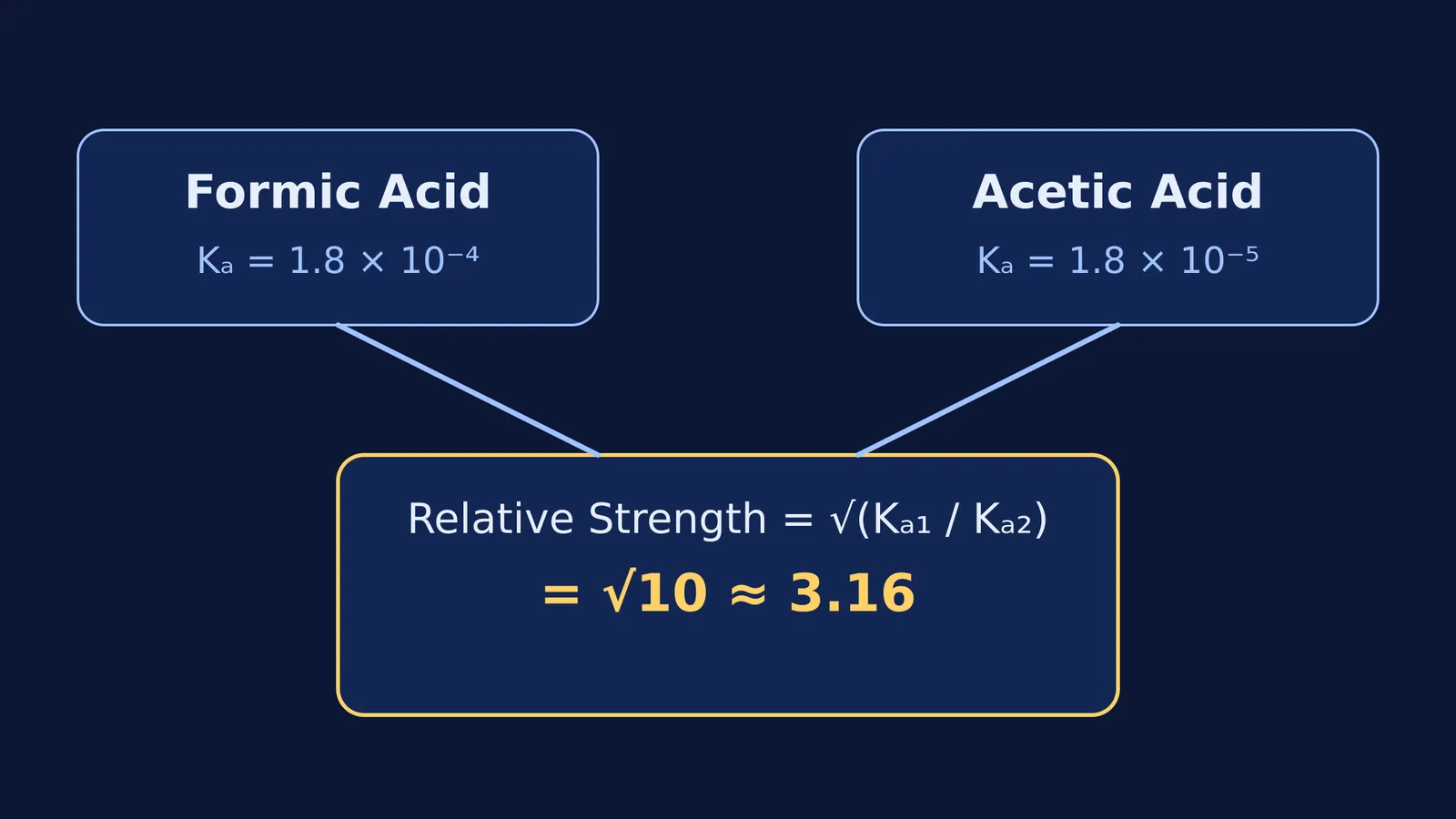
According to the OpenStax Chemistry curriculum, the Ka of formic acid is 1.8 × 10⁻⁴ at 25 °C, and the Ka of acetic acid is 1.8 × 10⁻⁵ at 25 °C.
Because formic acid has a larger Ka, it is the stronger acid. The reason lies in their molecular structures. The methyl group (CH₃) in acetic acid pushes electron density toward the carboxyl group through a phenomenon called the inductive effect. This added negative charge makes it harder for the positively charged hydrogen ion to leave. Formic acid, having only a single hydrogen atom attached to the carboxyl group, avoids this electron-donating effect and allows the proton to detach more easily.
Working out the math step by step
Let's find exactly how much stronger formic acid is than acetic acid when both are prepared at the same concentration, such as 0.1 M.
Identify the Ka values: Ka₁ (formic) = 1.8 × 10⁻⁴ and Ka₂ (acetic) = 1.8 × 10⁻⁵.
Set up the ratio inside the square root: Ka₁ / Ka₂ = (1.8 × 10⁻⁴) / (1.8 × 10⁻⁵).
Simplify the fraction: The 1.8 terms cancel out, and 10⁻⁴ / 10⁻⁵ equals 10.
Take the square root: √10 ≈ 3.16.
Formic acid will produce about 3.16 times as many hydrogen ions as acetic acid. If you were comparing their conjugate acid-base pairs, you would correspondingly find that the formate ion is a weaker base than the acetate ion.
When does this approximation fail?
The square root shortcut relies on the assumption that the initial concentration C is much larger than the amount of acid that dissociates. If the weak acid is actually quite strong (with a Ka greater than 10⁻²), or if the solution is extremely dilute, a significant percentage of the acid will dissociate. In those cases, the approximation [HA] ≈ C breaks down, and you must use the full quadratic equation to find the exact [H⁺].
When building a study plan, seeing the math behind chemical properties helps lock in the rules. If you need to trace how equilibrium formulas connect back to molecular structures, the Fermi Concept Library covers every concept in physics, chemistry, biology, mathematics and computing, each with its own lesson and its place in the map. Knowing these relationships speeds up your pH calculations during exams, saving time when comparing any two weak acids.


