

On this page
When a JEE problem asks for "the angular velocity of B with respect to A", it is asking how fast the line joining A to B turns. Stand at A, point at B, and ask how quickly your arm swings. Here is the rule, a three-step method and two worked examples with surprising answers.
How do you find the angular velocity of one particle relative to another?
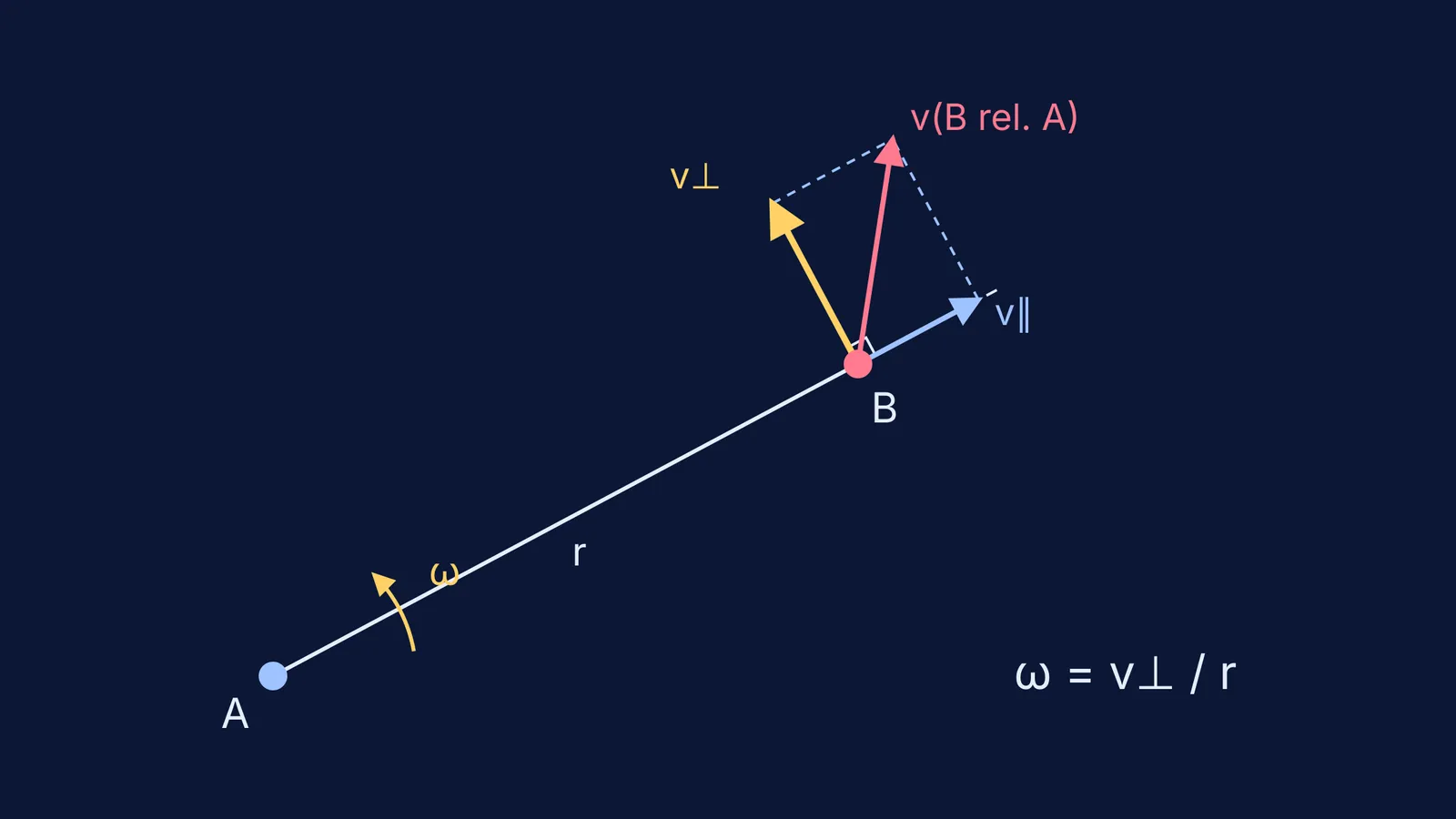
Start with relative velocity: a particle's velocity in one frame is its velocity in a second frame plus that frame's own velocity (OpenStax University Physics, section 4.5). So B's velocity as seen from A is v_BA = v_B − v_A.
Now split v_BA into two parts, along and across the line from A to B:
The part along AB changes only the distance between them.
The part perpendicular to AB swings the line round.
Angular velocity about a point is ω = v⊥/r, the velocity component perpendicular to the radius divided by the distance (Wikipedia: Angular velocity). In vector form it is ω = (r × v)/r², with r the position of B measured from A and v = v_BA. It is the familiar v = rω (OpenStax University Physics, section 10.1) with a moving observer at the centre.
How fast does the line between two runners on a circular track turn?
Two runners go anticlockwise round a circular track of radius 50 m, A at 5 m/s and B at 6 m/s, so from v = rω their angular speeds about the centre are 0.10 and 0.12 rad/s. At one instant B is a quarter-lap ahead: A is at (50, 0) m and B at (0, 50) m.
Velocities: v_A = (0, 5) m/s and v_B = (−6, 0) m/s, so v_BA = (−6, −5) m/s.
Separation: r = B − A = (−50, 50) m, of length 70.7 m.
Perpendicular part: the cross product is (−50)(−5) − (50)(−6) = 550 m²/s, so v⊥ = 550/70.7 ≈ 7.78 m/s.
Divide: ω = 7.78/70.7 ≈ 0.11 rad/s.
The leftover along-line part is only 0.71 m/s (7.78² + 0.71² ≈ 61 = 6² + 5²), so the line swings fast while the distance barely changes.
Notice that 0.11 is the average of 0.10 and 0.12, not their difference. For two particles on the same circle this holds at every instant: general angles give ω = (ω_A + ω_B)/2, the inscribed-angle theorem in motion. Meanwhile the angle between the runners at the centre grows at 0.12 − 0.10 = 0.02 rad/s, so B laps A after 2π/0.02 ≈ 314 s. Two different "relative angular velocities", measured about two different points.
How fast does one satellite turn as seen from another?
Take two satellites in coplanar circular orbits, going the same way. One is a low satellite with a round 90-minute period; NASA says the International Space Station orbits Earth about every 90 minutes (NASA: Space station facts and figures). The other is geostationary, with a period of one sidereal day, about 1,436 minutes, at 42,164 km from Earth's centre (Wikipedia: Geostationary orbit).
About Earth's centre, ω_low = 2π/5,400 s ≈ 1.164 × 10⁻³ rad/s and ω_geo = 2π/86,164 s ≈ 7.29 × 10⁻⁵ rad/s. The angle between them grows at the difference, 1.09 × 10⁻³ rad/s. That is the synodic period rule, 1/S = 1/T₁ − 1/T₂ (Wikipedia: Orbital period), giving S = 1/(1/90 − 1/1,436) ≈ 96 minutes between alignments.
Now look from the low satellite when the two line up on the same side of Earth. Both velocities are perpendicular to the line joining them, so v⊥ is the difference in speeds. Kepler's third law, T² ∝ a³ (Wikipedia: Kepler's laws), puts an ideal 90-minute orbit at 42,164 × (90/1,436)^(2/3) ≈ 6,650 km from the centre. From v = rω the speeds are about 7.74 km/s (low) and 3.07 km/s (geostationary). So ω = (3.07 − 7.74)/(42,164 − 6,650) ≈ −1.31 × 10⁻⁴ rad/s.
The minus sign means the high satellite drifts backwards across the low one's sky, about 8 times more slowly than the rate seen from Earth's centre. Different pivot, different answer.
Which mistakes cost marks on relative angular velocity?
Subtracting angular velocities about the centre when the question says "relative to A".
Dividing the whole relative speed by the distance instead of only its perpendicular part.
Dropping the sign, which tells you which way the line turns.
If the perpendicular component is where you get stuck, the Fermi Problem Library has worked problems with a step-by-step solver that explains the reasoning rather than printing an answer. For the vector idea underneath, the Fermi Concept Library gives each physics concept its own lesson.
The same split drives closest approach of two moving bodies; practise the subtraction with river-crossing and rain relative velocity problems, and orbital speeds with gravitation and satellite problems.
Try it yourself: redo the runner example with B running clockwise, and check that the line AB now turns at (0.10 − 0.12)/2 = −0.01 rad/s.


