

On this page
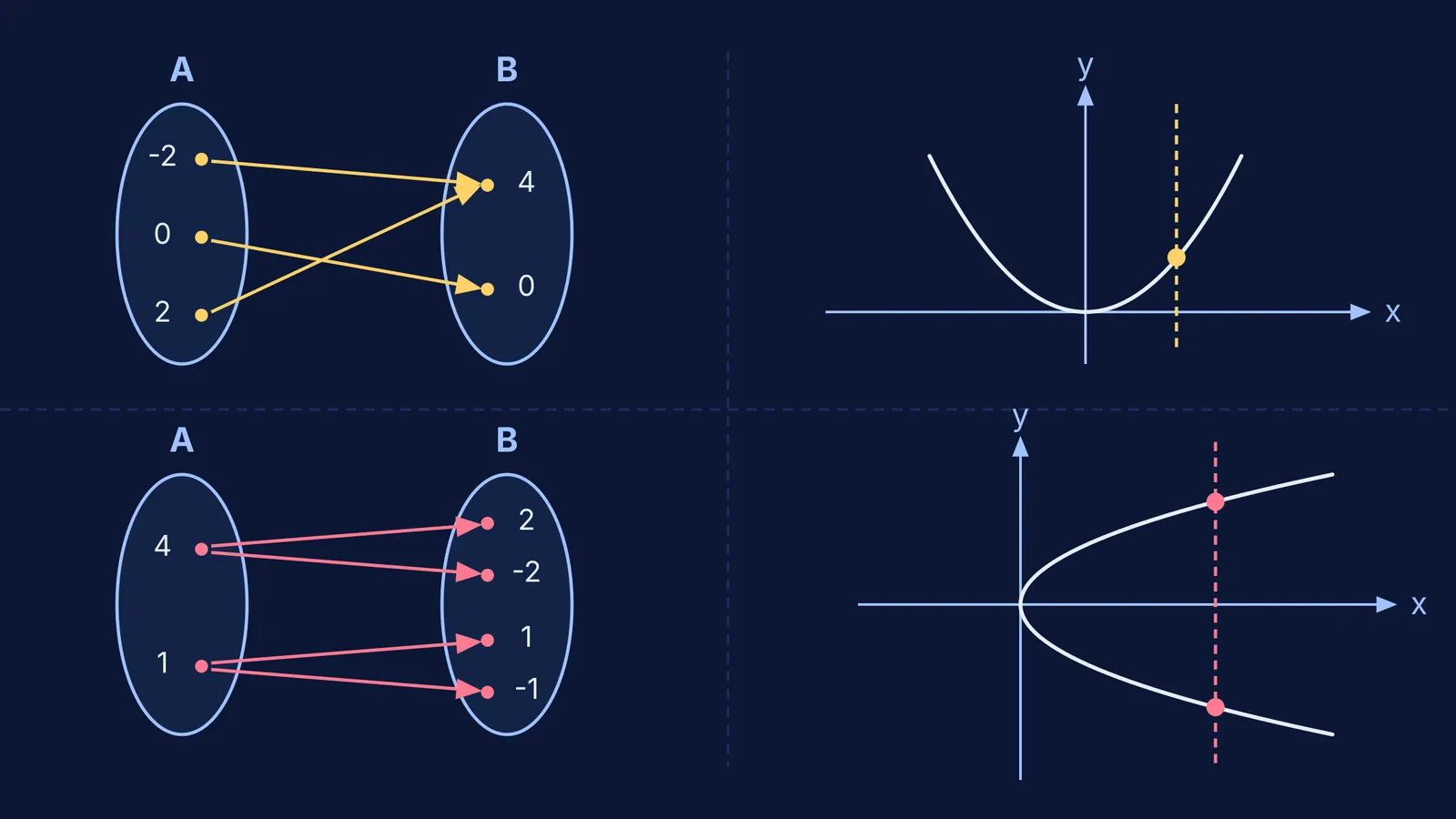
In mathematics, a relation connects elements of an input set to an output set. In curricula like CBSE Class 11 and JEE Main, a function is a disciplined relation: a relation from set A to set B is a function if and only if every element of set A has exactly one image in set B.
This definition establishes two simultaneous conditions:
Completeness of domain: Every element in set A must have an assigned partner in set B. No input is left unassigned.
Uniqueness of output: Each element in set A must associate with exactly one element in set B. An input cannot branch into multiple outputs.
When both conditions hold, the relation is a function. Like a vending dispenser where each button code must deliver a single predictable item, a function guarantees a deterministic output for every valid input.
Set theory quantifies how selective functions are. If set A has p elements and set B has q elements, the total number of possible relations is 2^(p × q), while the number of valid functions is only q^p, as explored in counting relations and functions between finite sets.
Why do students confuse many-to-one with one-to-many?
The common trap is confusing many-to-one with one-to-many relationships. A function allows multiple inputs to share an output: in y = x², inputs 2 and -2 both yield 4. Each input still has exactly one output. Constant functions like y = 5 work the same way.
By contrast, one-to-many relations fail. In y² = x, the input 4 yields both 2 and -2. Because a single input produces two outputs, the relation violates univalence.
In the *Journal for Research in Mathematics Education*, Shlomo Vinner and Tommy Dreyfus surveyed 271 college students and 36 teachers. Among participants who correctly recited the formal definition of a function, 56% failed to apply it when classifying relations. Many rejected constant or many-to-one functions because their mental images demanded different outputs for different inputs—a condition for one-one and onto functions, not general functions.
Similarly, Ruhama Even surveyed 152 prospective secondary mathematics teachers, finding that many treated univalence as an arbitrary rule rather than a structural necessity for calculus and physics, where operations require single-valued outputs.
The Fermi Concept Library maps every concept in mathematics, each with its own lesson and its place in the curriculum, demonstrating how univalence connects fundamental sets to limits and calculus.
How does the vertical line test work on graphs?
On the Cartesian plane, univalence takes the visual form of the vertical line test:
Sweep a vertical line across the domain along the x-axis.
If any vertical line intersects the curve at more than one point, the relation is not a function.
If every vertical line intersects the curve at at most one point, the relation is a function.
A vertical line represents a constant x-value. Intersecting a curve at two points means one input produces two outputs. For example, the circle x² + y² = 25 fails because x = 3 intersects at (3, 4) and (3, -4). To define a function, one must restrict the curve to a single branch, like y = √(25 - x²).
In *The Mathematics Teacher*, Lisa L. Clement showed that students often treat the vertical line test as a mechanical trick without linking it to ordered pairs, stumbling on discrete scatter plots, piecewise rules, or algebraic equations without graphs.
The Fermi Problem Library features worked problems with a step-by-step solver that explains the reasoning rather than printing an answer, helping you bridge graphical tests with algebraic proofs.
How do you test algebraic equations and ordered pairs?
When graphs are not provided, use these algebraic checks:
Ordered pairs: Examine each first coordinate. If any x-value repeats with different y-values, the relation is not a function. For example, {(1, 2), (2, 5), (1, 6)} fails because 1 maps to both 2 and 6. However, {(1, 3), (2, 3), (4, 3)} is a function because every input appears once, a key distinction when finding the domain and range of functions.
Algebraic equations: Solve for y in terms of x. The linear equation 2x + 3y = 6 simplifies to y = (6 - 2x)/3, giving one output for each real x. Conversely, x² + y² = 9 yields y = ±√(9 - x²). The ± symbol gives two real outputs for each x in (-3, 3), failing the test.
How can you quickly test whether a relation is a function?
Before deciding whether a relation is a function, verify three checks:
Domain coverage: Every element in the domain must have an assigned output.
Uniqueness: No input may produce multiple outputs. Check for branching arrows, repeated x-values with different y-values, or two vertical intersections.
Permit shared outputs: Many-to-one relations are valid functions. Never reject a relation simply because multiple inputs share an output.
When working through functional equations or piecewise definitions, Fermi's AI tutor can work out what you already know and build a plan for the session, checking your understanding of domain rules and mappings as you solve each problem.


