

On this page
A set or relation is written in roster form when we specify it by enumerating its elements explicitly, usually inside curly brackets 1. For a relation, these elements are listed as ordered pairs, showing exactly which inputs connect to which outputs.
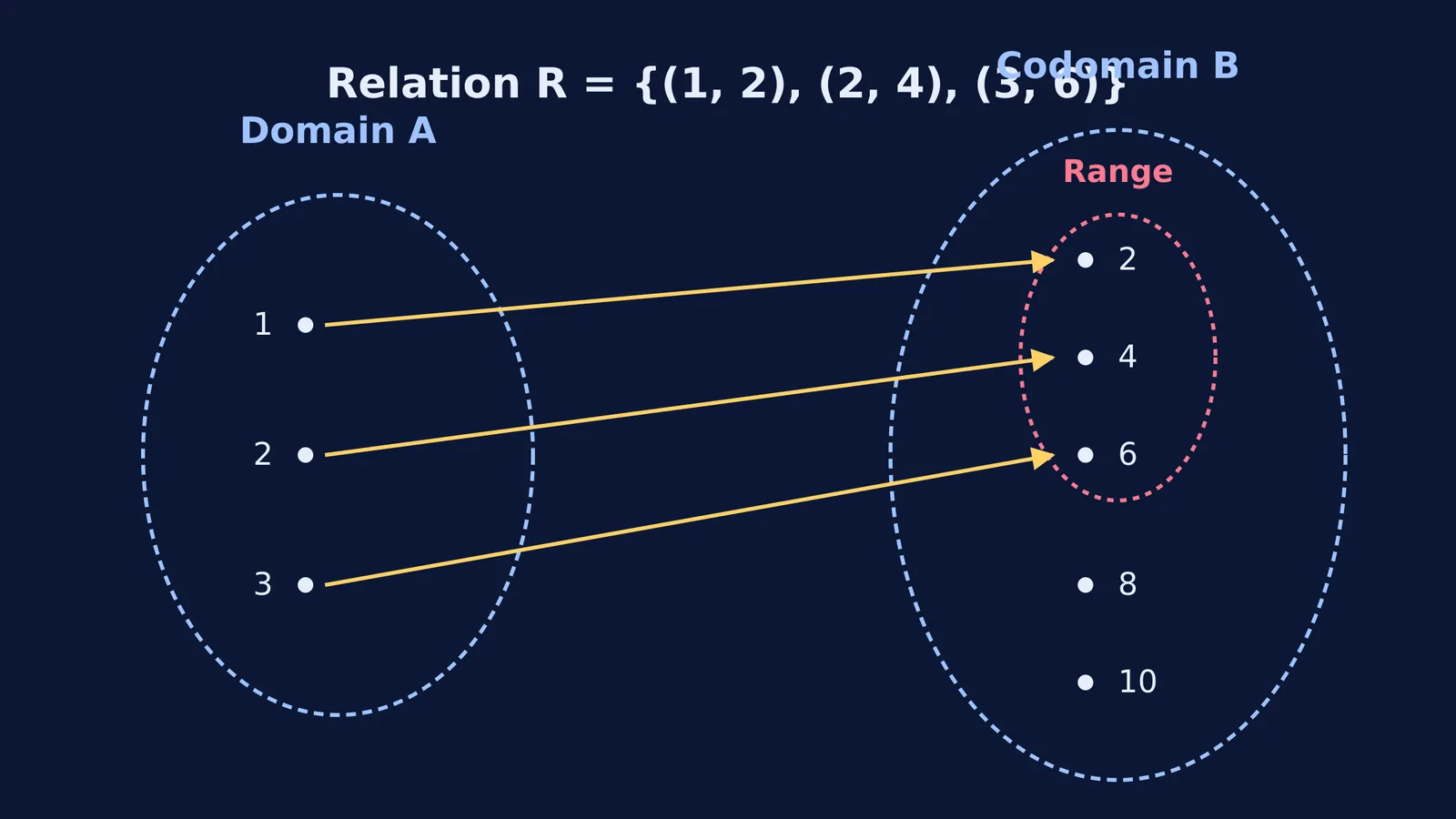
For example, if the relation R takes a number and pairs it with its double, the roster form might look like this: R = {(1, 2), (2, 4), (3, 6)}
How to find domain and range of a relation in roster form?
A binary relation associates elements of one set, called the domain, with elements of a target set, called the codomain, by forming a set of ordered pairs (x, y) 2. When you have a relation R written out in roster form, finding the domain and range is just a matter of reading the first and second entries of those pairs.
Domain: The domain is the set of all first elements (the x-values) from the ordered pairs. In our example R = {(1, 2), (2, 4), (3, 6)}, the first elements are 1, 2 and 3. Domain = {1, 2, 3}
Range: The range is the set of all second elements (the y-values) from the pairs. These are the specific outputs the relation actually maps to. For our example, the second elements are 2, 4 and 6. Range = {2, 4, 6}
What is the difference between range and codomain?
The range is what the relation actually hits, but the codomain is the entire target set that the relation maps into. The range is always a subset of the codomain.
Imagine we defined our relation R from Set A = {1, 2, 3} to Set B = {2, 4, 6, 8, 10}. Because R only links to 2, 4, and 6, the range is just {2, 4, 6}. However, the codomain is the entire Set B: {2, 4, 6, 8, 10}.
When you are asked for the codomain, look at the set the relation points to. You cannot find the codomain just by looking at the roster form of R unless you also know the full target set B. This distinction is also crucial in functions, such as when finding the principal range of inverse functions like sin⁻¹(sin x).
How do you find domain and range from a rule?
Often, you are given a rule and asked to write the relation in roster form before finding its parts.
Example: Let A = {1, 2, 3, 4, 5}. Define a relation R from A to A by R = {(x, y) : y = x + 2}. Find the domain, range and codomain of R.
Write the roster form: Test each element of A to see if x + 2 is also in A.
If x = 1, y = 3. Both are in A, so (1, 3) is in R.
If x = 2, y = 4. Both are in A, so (2, 4) is in R.
If x = 3, y = 5. Both are in A, so (3, 5) is in R.
If x = 4, y = 6. Since 6 is not in A, we stop here.
R = {(1, 3), (2, 4), (3, 5)}
Read the domain: The first entries of the pairs.
Domain = {1, 2, 3}
Read the range: The second entries of the pairs.
Range = {3, 4, 5}
Identify the codomain: The relation goes from A to A, so the codomain is the entire target set A.
Codomain = {1, 2, 3, 4, 5}
If you get stuck translating a rule into a list of pairs, the Fermi Concept Library explains how to map sets and apply these constraints.
How to find domain and range with negative numbers?
Let us try a relation on the set of integers, ℤ. Define R = {(x, y) : x² + y² = 25, where x, y ∈ ℤ}.
First, list all integer pairs that satisfy the equation. If your relation rule involves absolute values or squares, you may need to rely on the same case-split methods used to solve equations and inequalities with modulus.
The integer pairs whose squares add up to 25 are: (0, 5), (0, -5), (3, 4), (3, -4), (-3, 4), (-3, -4), (4, 3), (4, -3), (-4, 3), (-4, -3), (5, 0), (-5, 0).
In roster form, R is the set of all these pairs.
Domain: Extract the first elements and remove duplicates. Domain = {-5, -4, -3, 0, 3, 4, 5}
Range: Extract the second elements and remove duplicates. Range = {-5, -4, -3, 0, 3, 4, 5}
If you have a tricky relation problem with complex conditions, try putting it into the Fermi Problem Library. The step-by-step solver will walk through testing each element to build the roster form, helping you see where the domain ends.


