

On this page
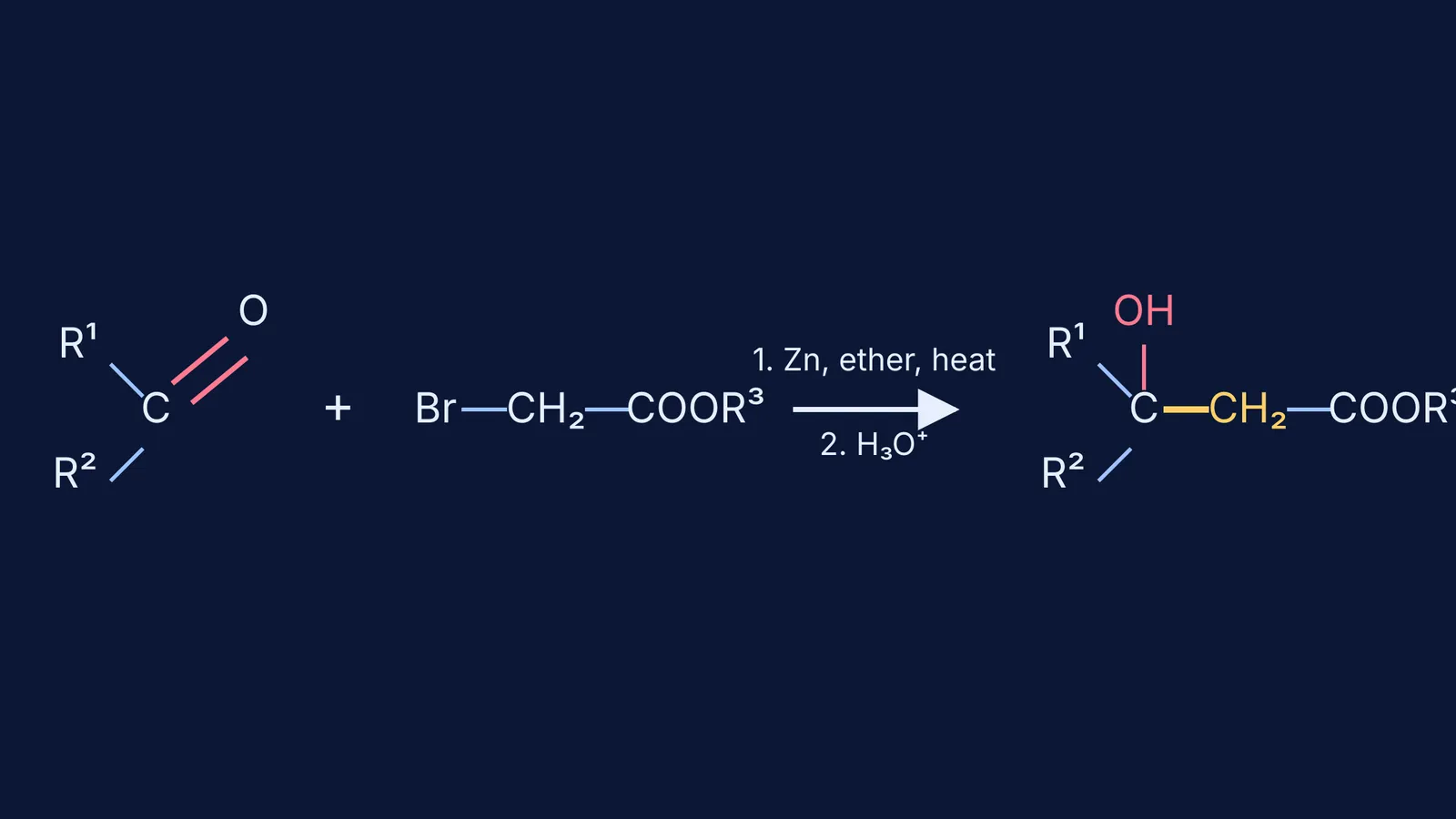
In organic synthesis, building carbon-carbon bonds without triggering unwanted side reactions is a primary goal. The Reformatsky reaction achieves exactly this by using zinc to couple an α-halo ester (usually an α-bromo ester) with an aldehyde or a ketone. First discovered by Sergius Reformatsky in 1887, this highly selective method reliably yields a β-hydroxy ester.
What is the Reformatsky reaction?
At its core, this reaction connects two distinct pieces into a larger carbon framework:
A carbonyl compound (an aldehyde or a ketone).
An α-bromo ester (an ester with a bromine atom on the carbon next to the carbonyl).
When these two reactants are mixed with metallic zinc dust—typically in a solvent like ether or tetrahydrofuran (THF)—they form an intermediate organozinc reagent known as the Reformatsky enolate. After a final acid workup, the product is a β-hydroxy ester.
Why use zinc instead of a Grignard reagent?
This is a classic conceptual trap that examiners love to test. If you were to use magnesium to form a standard Grignard reagent from the α-bromo ester, the resulting molecule would be highly nucleophilic. It would rapidly attack the ester group of a neighbouring α-bromo ester molecule, leading to a messy self-condensation rather than the desired product.
Zinc, however, is less electropositive than magnesium. This makes the carbon-zinc bond more covalent and less polarized, rendering the Reformatsky enolate significantly less nucleophilic than a Grignard reagent. It is stable enough to ignore other ester groups but remains reactive enough to attack the more electrophilic carbonyl carbon of an aldehyde or ketone.
Much like deciding between the Clemmensen and Wolff-Kishner reductions for removing a carbonyl entirely, choosing zinc over magnesium here is about matching the reactivity to the functional groups present.
What is the mechanism of the Reformatsky reaction?
The mechanism follows a logical progression from the metal surface to the final product:
Oxidative addition: Solid zinc dust inserts itself into the carbon-bromine bond of the α-bromo ester, forming the zinc enolate.
Coordination: The carbonyl oxygen of the aldehyde or ketone coordinates with the zinc atom. This sets up a stable, six-membered chair-like transition state.
Addition: The α-carbon of the enolate attacks the carbonyl carbon of the aldehyde or ketone. The electrons shift, forming a new carbon-carbon bond and creating a zinc alkoxide intermediate.
Acid workup: A mild acid (like dilute HCl) is added to protonate the oxygen, stripping away the zinc salt and leaving the final β-hydroxy ester.
If your starting aldehyde lacks alpha-hydrogens, you might instead be looking at the Cannizzaro reaction, but when an α-bromo ester is present with zinc, the Reformatsky pathway dominates.
Predicting the product: a step-by-step framework
If you are facing a reaction mechanism problem on an exam, use this mental checklist to draw the final structure correctly:
Identify the carbonyl carbon on your aldehyde or ketone. This will become the β-carbon (bearing the –OH group) in the final product.
Identify the α-carbon on your halo ester (the carbon originally attached to the bromine).
Erase the carbonyl double bond and the C–Br bond.
Draw a new single bond connecting the carbonyl carbon directly to the α-carbon.
Change the former carbonyl oxygen into a hydroxyl (–OH) group.
If you struggle to spot which bonds break and form in complex molecules, the Fermi Problem Library has worked problems with a step-by-step solver that explains the reasoning rather than printing an answer.
Spotting the pattern in exam questions
Questions about the Reformatsky reaction frequently test your understanding of relative reactivity. Examiners will try to trick you by offering Grignard conditions (Mg/ether) alongside an ester. Remembering that zinc acts as a chemoselective "tamer" of the enolate is often the key to spotting the right product.
If you find yourself confusing which reagents attack which functional groups, every organic reaction has its place in the Fermi Concept Library, where Fermi's AI tutor works out what you already know and builds a plan for the session to clear up any gaps.


