

On this page
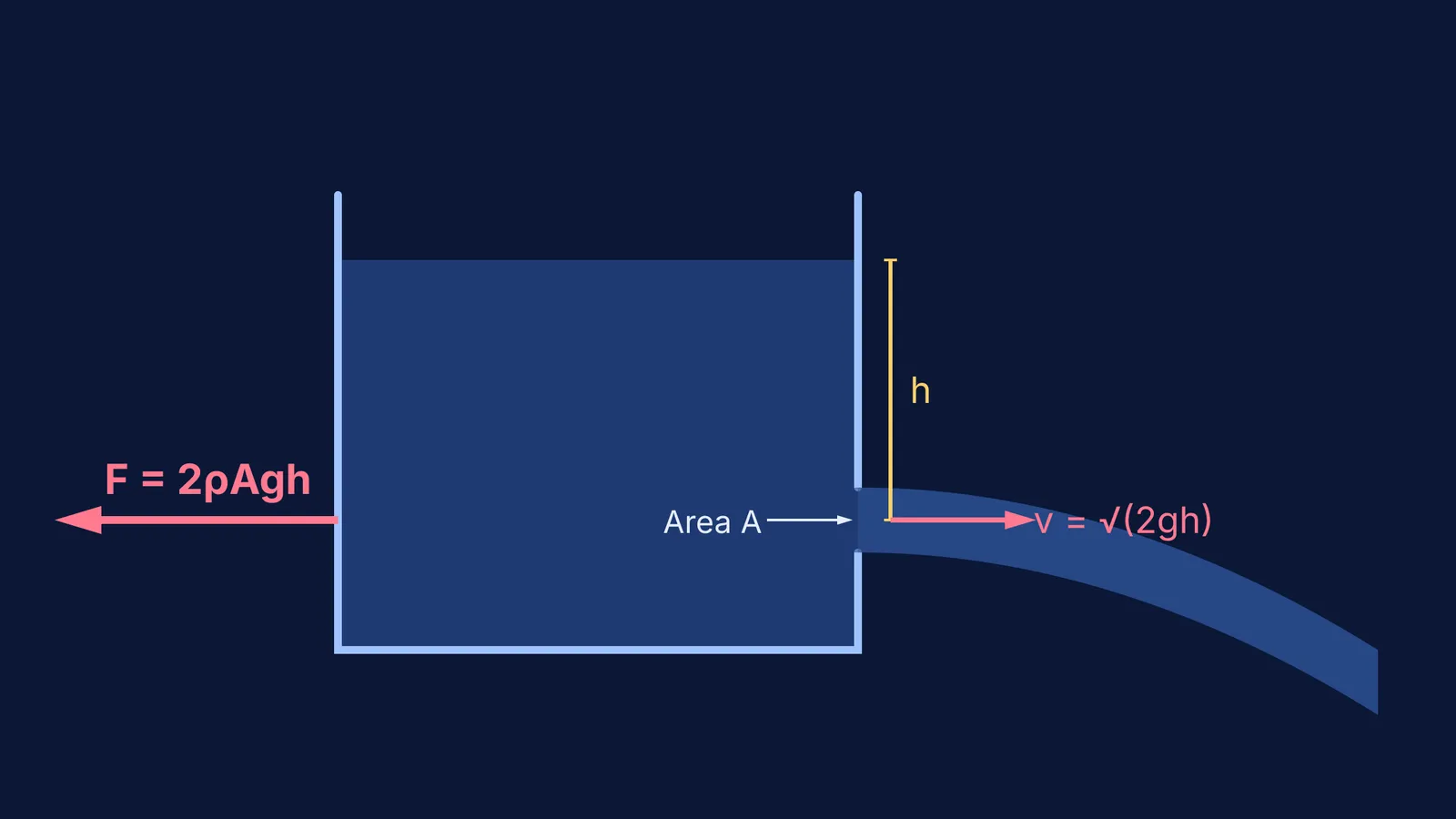
If you punch a hole of cross-sectional area A in a water tank at a depth h below the surface, water shoots out. By Newton's third law, the tank pushes the water out, and the water pushes the tank in the opposite direction.
But what is the exact reaction force on the tank?
Many students calculate the hydrostatic pressure at that depth (P = ρgh) and multiply it by the area of the hole (A), concluding the force is ρAgh. This is incorrect. The actual reaction force is F = 2ρAgh, derived from the momentum flux [1].
This classic fluid mechanics problem tests your understanding of hydrostatics versus momentum. Here is why the static pressure approach fails when the water starts moving.
What is the velocity of the water jet?
To find the force, you first need to know how fast the water is moving. According to Torricelli's law [2], the velocity (v) of a fluid exiting a small hole at a depth h is the same as if it had fallen freely from that height: v = √(2gh).
This formula comes directly from Bernoulli's equation. At the top surface of the tank, the water has potential energy but practically zero kinetic energy, because the surface area is large and the level drops very slowly. At the hole, that potential energy converts entirely into kinetic energy.
Why is the reaction force 2ρAgh and not ρAgh?
The mistake in the ρAgh calculation is assuming the fluid inside the tank is static. Before the hole is opened, the pressure on the wall opposite the hole is indeed ρgh × A. When you open the hole, the fluid near the opening is no longer at rest. It accelerates toward the exit.
To find the true force, you must use the conservation of momentum [1]. The reaction force equals the rate at which momentum leaves the tank in the water jet.
Mass flow rate: The mass of water leaving per second is the density (ρ) times the volume flow rate. Because a cylinder of water of area A and length v leaves every second, the mass flow rate is ρAv.
Momentum flow rate: Momentum is mass times velocity. The rate of momentum leaving is (ρAv) × v = ρAv².
According to Newton's second law, this rate of change of momentum is exactly equal to the force pushing the water out, and by reaction, pushing the tank back. So, the reaction force on the tank is F = ρAv².
Now, substitute Torricelli's law (v² = 2gh) into the momentum equation: F = ρA(2gh) = 2ρAgh
The extra ρAgh of force comes from the dynamic pressure drop around the orifice. As the water accelerates toward the hole from inside the tank, it creates a larger pressure imbalance than the static pressure alone would suggest. The total force imbalance pushing the tank backwards is 2ρAgh, replacing the static pressure on the missing plug.
How do you solve water jet problems?
When tackling these problems in physics exams, you should rely on the macroscopic momentum balance.
First, identify the area A of the orifice and the depth h.
Write down the exit velocity v = √(2gh).
Calculate the thrust or recoil force as F = ρAv² = 2ρAgh.
This same principle applies to a shell exploding midair: momentum, fragments and energy, where internal forces cause parts to fly apart while conserving the total momentum of the system. It is also the physics behind rockets, which thrust forward by ejecting mass backwards at high speed.
If you are asked to find where the water lands, you will use the time it takes to fall to the ground. From a height H above the ground, the time of fall is √(2H/g), and the horizontal range is the velocity multiplied by this time. This is much like finding the equation of trajectory of a projectile: finding u and θ from it.
If you keep confusing static pressure with dynamic flow, the Fermi Concept Library has every concept in physics, chemistry, biology, mathematics and computing, each with its own lesson and its place in the map.
Does the shape of the hole matter?
In the real world, the water jet often contracts slightly after it leaves the hole. This pinch in the stream is called the vena contracta. Because the effective area of the jet becomes smaller than the physical hole A, the actual force is slightly less than 2ρAgh. However, in textbook physics problems, you assume the jet area is exactly A unless you are given a discharge coefficient.
The key takeaway is simple: once the water starts flowing, static rules no longer apply. Trust the conservation of momentum.


