

On this page
A chemical reaction's rate tells you how fast the reactants turn into products. But this speed usually depends on how much reactant you have. The exact relationship is called the rate law, and the key number inside it is the reaction order. By seeing what happens to the rate when you double the concentration of a reactant, you can figure out its order.
The mathematical relationship between a reactant's concentration and the reaction rate is defined by the rate law, Rate = k[A]ⁿ 1.
Here, k is the rate constant, [A] is the concentration, and n is the reaction order. The value of n tells you how sensitive the rate is to changes in concentration.
How does rate change when concentration is doubled?
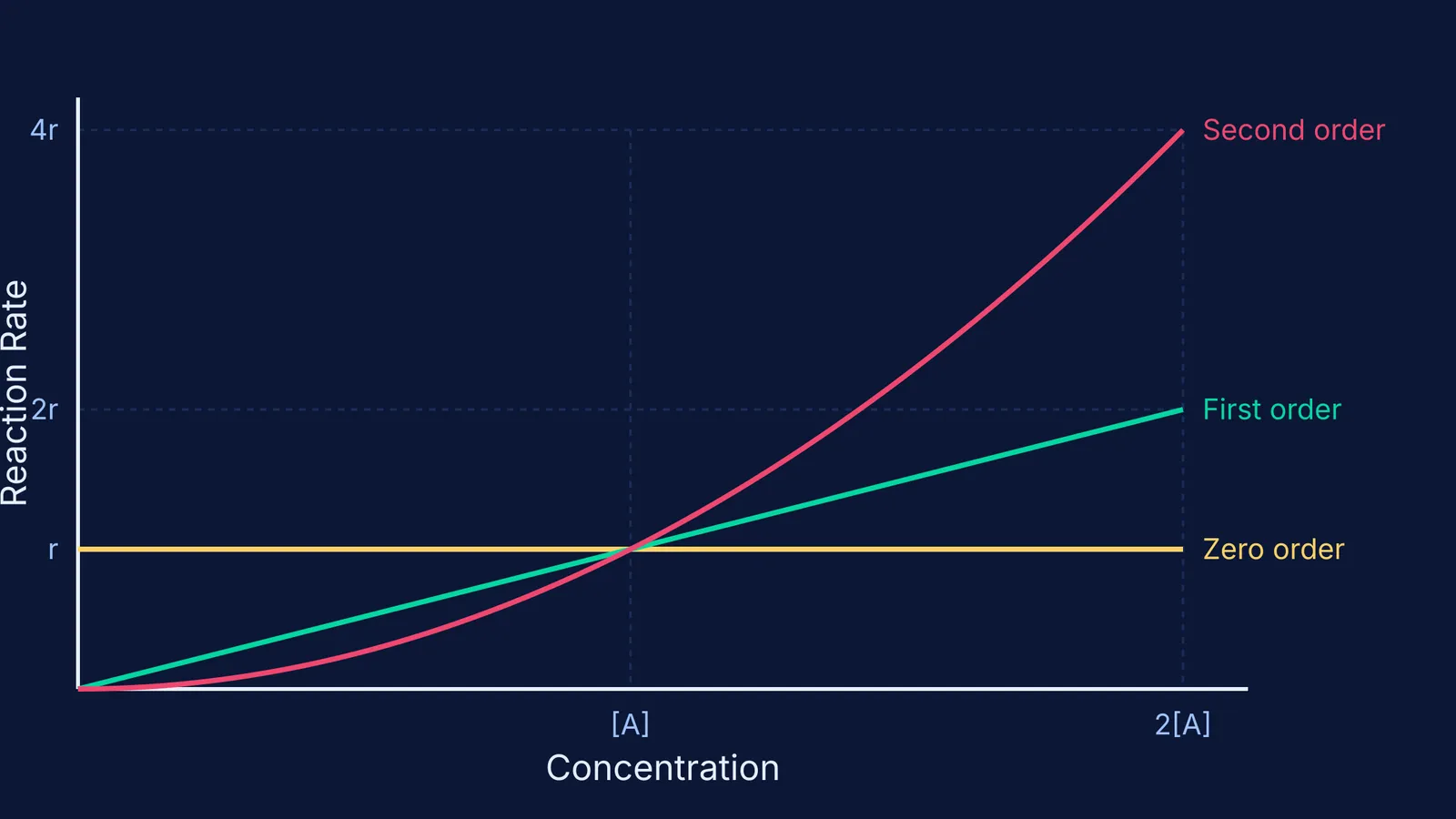
If you run an experiment and then run it again with twice as much reactant, the new concentration is 2[A]. The new rate will be k(2[A])ⁿ, which is exactly 2ⁿ times the old rate, as explained by the rate law 1. This gives three common outcomes:
Zero-order (n = 0): The rate does not change. Since 2⁰ = 1, doubling the concentration multiplies the rate by 1.
First-order (n = 1): The rate doubles. Since 2¹ = 2, multiplying the concentration by two multiplies the rate by two.
Second-order (n = 2): The rate quadruples. Since 2² = 4, doubling the concentration makes the reaction go four times as fast.
How do you find reaction order from a rate ratio?
Chemists and students use this exact math in reverse, using a technique called the initial rate method 1. If you want to find the order of a reactant, you set up two experiments. You keep everything else constant, double the concentration of that one reactant, and measure the initial rate of the reaction.
Let's say you double the concentration of A, and you observe that the initial rate goes from 0.015 M/s to 0.060 M/s.
First, find the rate ratio: 0.060 / 0.015 = 4.
Since the rate went up by a factor of 4 when the concentration was doubled, you know that 2ⁿ = 4. Therefore, the order n must be 2.
What if there are multiple reactants?
Often, a reaction involves more than one reactant, for example, A and B reacting together. In these cases, the overall rate law looks like Rate = k[A]ᵐ[B]ⁿ 1.
To find the order with respect to each reactant, you must run a series of experiments where you change the concentration of one chemical while keeping the other completely constant.
For instance, if you want to find the order with respect to A (the value of m), you might double the concentration of A while leaving the concentration of B exactly the same. Because B does not change, any change in the initial rate must be entirely due to the change in A.
Once you have determined that A is, say, first-order, you look at another pair of experiments where A is kept constant and B is doubled. If the rate quadruples when B is doubled, you know the reaction is second-order with respect to B. The overall reaction order is then the sum of the individual orders, which in this example would be 1 + 2 = 3.
This systematic approach of isolating variables ensures you can decode even complex rate laws without confusion.
What if the numbers aren't exactly double?
In a lab or a tricky exam question, you might not be given concentrations that exactly double. Perhaps the concentration goes up by a factor of 1.5, or you are given messy experimental data.
You can always find the order by setting up a ratio of the two rate laws 1: Rate₂ / Rate₁ = ([A]₂ / [A]₁)ⁿ
If you take the logarithm of both sides, you can solve for n: n = log(Rate₂ / Rate₁) / log([A]₂ / [A]₁)
If you are stuck on a kinetics problem where the data feels overwhelming, the Fermi Problem Library has a step-by-step solver that explains the reasoning for finding the order from initial rates.
Understanding this ratio method gives you the tools to break down any rate law. To see how these rates play out over the entire course of a reaction, explore the integrated rate law graphs to see how concentration drops with time. For a look at how heat, rather than concentration, speeds up a reaction, read about the temperature coefficient of rate.


