

On this page
In short
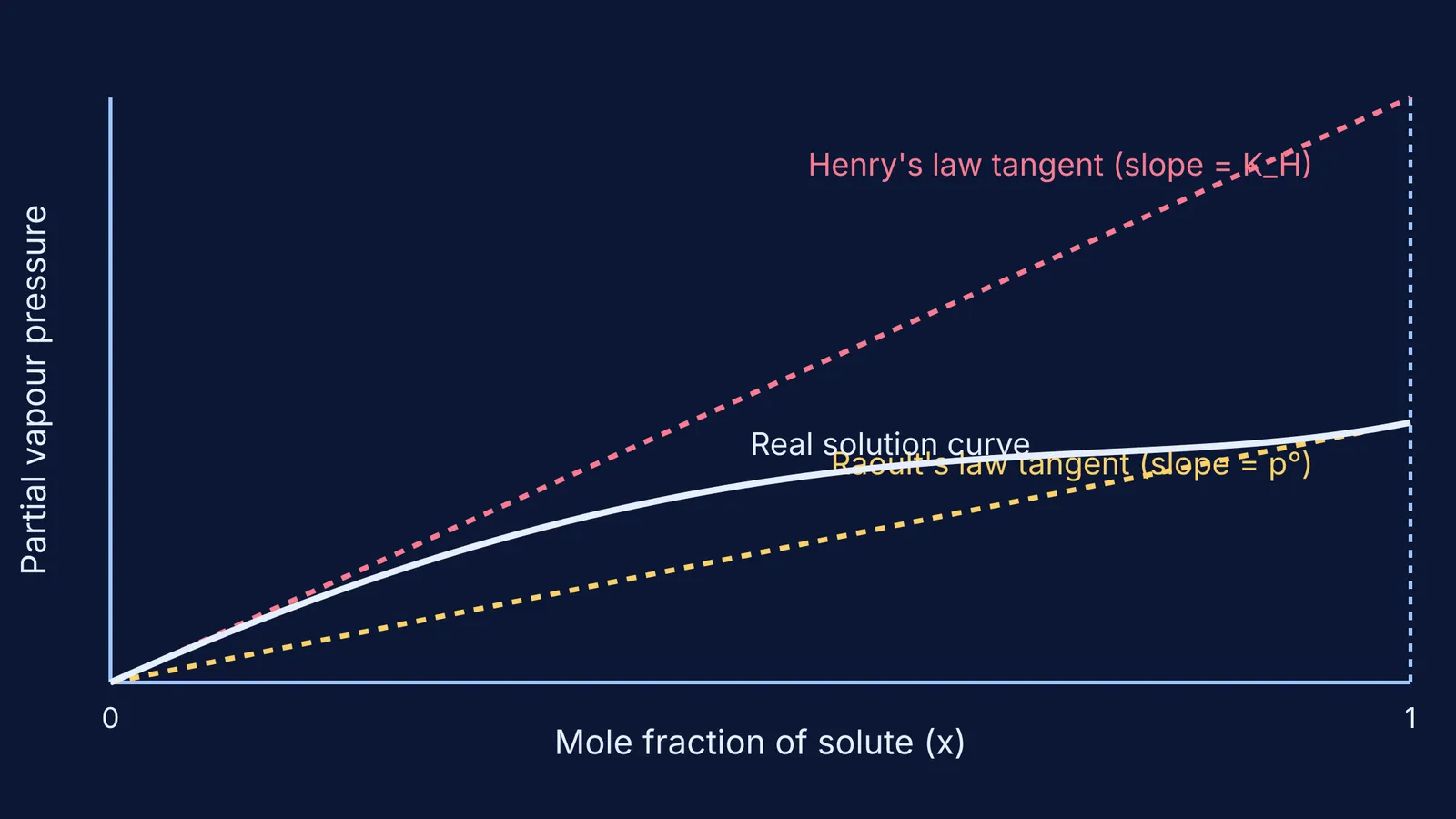
Raoult's law states that the partial pressure of a component is proportional to its mole fraction, with the pure vapour pressure as the constant. It is a special case of Henry's law, which uses the same proportional relationship but a different constant for dissolved gases. According to chemical principles, Raoult's law becomes a special case of Henry's law when the Henry's law constant (K_H) becomes equal to the vapour pressure of the pure component (p°).
In physical chemistry, two fundamental laws describe how substances escape from a liquid mixture into the vapour phase above it. François-Marie Raoult published his foundational work on the vapour pressures of solvents in 1887, while William Henry had previously described the behaviour of dissolved gases.
Though these two scientists studied entirely different physical scenarios, the algebra they left behind is identical. When you plot their equations on a graph, one emerges as the extreme, perfect-world limit of the other.
What is the mathematical connection?
Both laws state that the partial vapour pressure of a volatile component is directly proportional to its mole fraction in the solution. The mole fraction, denoted by x, is simply the ratio of the moles of that component to the total moles in the mixture.
For a dissolved gas, Henry's law is written as p = K_H × x, where K_H is the Henry's law constant.
For a volatile liquid solvent, Raoult's law is written as p = p° × x, where p° is the vapour pressure of the pure liquid component.
If you compare the two equations side by side, their structure is exactly the same. The only mathematical difference lies in the proportionality constant used. According to chemical principles, Raoult's law becomes a special case of Henry's law when the Henry's law constant (K_H) becomes equal to the vapour pressure of the pure component (p°).
Why do they have different constants?
The constants differ because the molecules in a real solution find themselves in entirely different physical environments.
Henry's law applies to trace amounts of a solute, such as a gas dissolved in a large body of liquid. In this scenario, the solute molecules are almost entirely surrounded by solvent molecules. The escape tendency, measured by K_H, is therefore dictated heavily by the intermolecular forces between the solute and the solvent. Because gases naturally resist staying confined in a liquid, K_H is typically very high.
For example, for carbon dioxide dissolved in water at 298 K, the Henry's law constant (K_H) is a staggering 1.6 × 10³ atm. This massive value reflects how strongly CO₂ prefers the gas phase over the aqueous phase.
Raoult's law, on the other hand, applies to the solvent when it is nearly pure. Here, the solvent molecules are mostly surrounded by their own kind. Their tendency to escape into the vapour phase is naturally just the vapour pressure of the pure liquid, p°, slightly scaled down by the few solute molecules in the way.
When does Raoult's law become Henry's law?
Imagine an ideal solution where the solute and solvent molecules are practically identical in size and intermolecular forces, such as a mixture of benzene and toluene.
In this perfect mixture, a solute molecule experiences the exact same push and pull whether it is surrounded by solvent molecules or by itself. Consequently, its escape tendency does not change regardless of its concentration. The steep Henry's law tangent flattens out, the real vapour pressure curve becomes a straight line, and the experimental constant K_H drops to exactly match the pure vapour pressure p°.
When exam questions mix gases and volatile liquids, choosing the right constant is often the first hurdle. If you are not sure where to start your revision, the Fermi Concept Library contains every concept in physics, chemistry, biology, mathematics and computing, each with its own lesson and its place in the map. For numericals that stubbornly refuse to balance, the Fermi Problem Library offers worked problems with a step-by-step solver that explains the reasoning rather than printing an answer.
How do you choose the right law in an exam?
When faced with a partial pressure numerical in JEE or NEET, use this framework to pick the correct formula:
Check the physical state. If the solute is a gas at room temperature (like O₂, N₂ or CO₂), use Henry's law. If the mixture consists of two volatile liquids (like ethanol and water, or benzene and toluene), apply Raoult's law to both components.
Look at the given constant. If the problem provides a value in atm or kbar and explicitly names a "Henry's law constant", apply the formula p = K_H × x. If the problem provides the "vapour pressure of pure A", use p = p° × x.
Check the concentration. Henry's law is an approximation that holds true only for very dilute solutions, where the mole fraction of the solute approaches zero. Raoult's law holds true for the solvent when it is nearly pure, meaning the mole fraction of the solvent approaches one.
For calculating the masses of these vapours once they escape the liquid, see our step-by-step guide on the Average molar mass of a gas mixture: worked air and vapour examples. If you are looking at other ways concentration drives physical properties, you can review Finding molar mass from osmotic pressure: a worked example.


