

On this page
Finding the range of a reciprocal trigonometric function like 1 / (2 - cos 3x) is a standard exam problem. It tests two things: your knowledge of trigonometric bounds and your ability to work with inequalities without making sign errors.
Rather than plotting the whole curve or finding the derivative, you can solve this in three steps by bounding the denominator.
How to bound the denominator?
The expression has a cos 3x in its denominator. According to Wolfram MathWorld, the range of the cosine function for any real angle is exactly [-1, 1]. The multiplier 3x speeds up the oscillation, but it does not change the maximum and minimum values.
Start with the core inequality:
-1 ≤ cos 3x ≤ 1
Next, build the exact expression found in the denominator by multiplying by -1. When you multiply an inequality by a negative number, the direction of the signs must flip:
1 ≥ -cos 3x ≥ -1
Rewrite it in standard left-to-right order:
-1 ≤ -cos 3x ≤ 1
Now, add 2 to all parts of the inequality to match the denominator 2 - cos 3x:
2 - 1 ≤ 2 - cos 3x ≤ 2 + 1
1 ≤ 2 - cos 3x ≤ 3
The denominator always evaluates to a positive number between 1 and 3.
How do transformations affect the domain and range?
When dealing with trigonometric functions, it is crucial to distinguish between changes to the domain and changes to the range. The inner multiplier 3x in cos 3x compresses the horizontal period of the wave, affecting the domain of a single cycle, but it does not alter the vertical amplitude. The range remains strictly [-1, 1].
In contrast, an external multiplier, such as the 2 in 2 cos x, directly scales the vertical amplitude, expanding the range to [-2, 2]. Understanding this difference helps prevent common mistakes when building bounding inequalities.
Why do we flip the inequality for reciprocals?
The original problem asks for the range of the reciprocal, 1 / (2 - cos 3x). When taking the reciprocal of an inequality where all terms have the same sign (all positive or all negative), the inequality signs must reverse.
For instance, 3 is greater than 1, but 1/3 is less than 1. Applying this rule to our bounded denominator:
1 ≤ 2 - cos 3x ≤ 3
Take the reciprocal and flip the signs:
1/1 ≥ 1 / (2 - cos 3x) ≥ 1/3
Rearranging this from smallest to largest gives the final range:
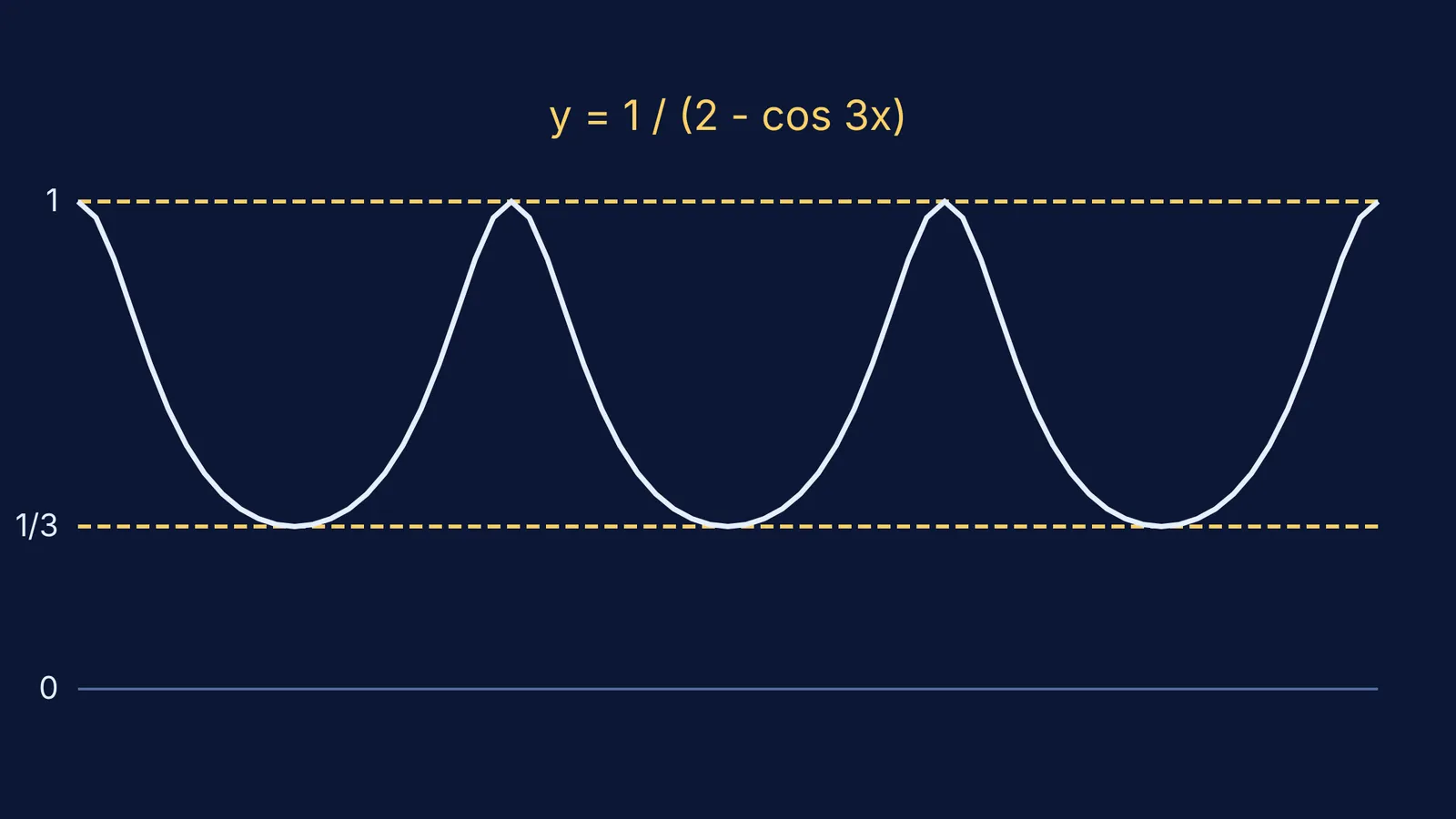
1/3 ≤ 1 / (2 - cos 3x) ≤ 1
The range of the expression is [1/3, 1].
What happens if the denominator crosses zero?
If a denominator's range crosses zero—for example, if it evaluates to [-2, 3]—you cannot flip the inequality in one step. Division by zero is undefined, and the graph of the function will have vertical asymptotes.
In our case, since the denominator 2 - cos 3x is strictly between 1 and 3, it never equals zero. The reciprocal is continuous and bounded, making the direct flip safe.
You might use this same bounding logic when exploring the range of a rational function using the discriminant method or when working with sin 3x, cos 3x and tan 3x formulas. If you are ever unsure whether an expression crosses zero, Fermi's AI tutor can work out what you already know and build a plan for the session, stepping through the sign checks safely. For more bounding exercises, explore the Fermi Problem Library for worked problems with a step-by-step solver that explains the reasoning.


