

On this page
The rule of a function usually looks like y = f(x). Here, x is the independent variable (the input) and y is the dependent variable (the output). Finding the domain is about asking: what values of x are allowed?
Finding the range is about asking: what values of y actually come out of the function? As explained in the OpenStax guide to domain and range, the range is the set of all possible output values.
For many algebraic functions, especially rational functions, the most direct way to answer this is to reverse the roles of the variables. If you solve the original equation for x, you get x as a function of y. The y-values that make this new expression undefined are exactly the values that the original function can never reach.
What does it mean to express x in terms of y?
When a function is given as y = f(x), it is explicitly set up to calculate y if you know x. For example, if y = 2x + 1, you can plug in x = 3 to find y = 7.
Expressing x in terms of y means performing algebra to isolate x on one side of the equals sign. You are rearranging the furniture of the equation until it reads x = g(y). For y = 2x + 1, subtracting 1 and dividing by 2 gives x = (y − 1) / 2.
This reversed equation is incredibly useful. It tells you exactly what input x was required to produce a specific output y. If an output y is physically impossible to reach—say, because it would require dividing by zero in your new expression—then that y is not in the range.
How do you find the range of a rational function?
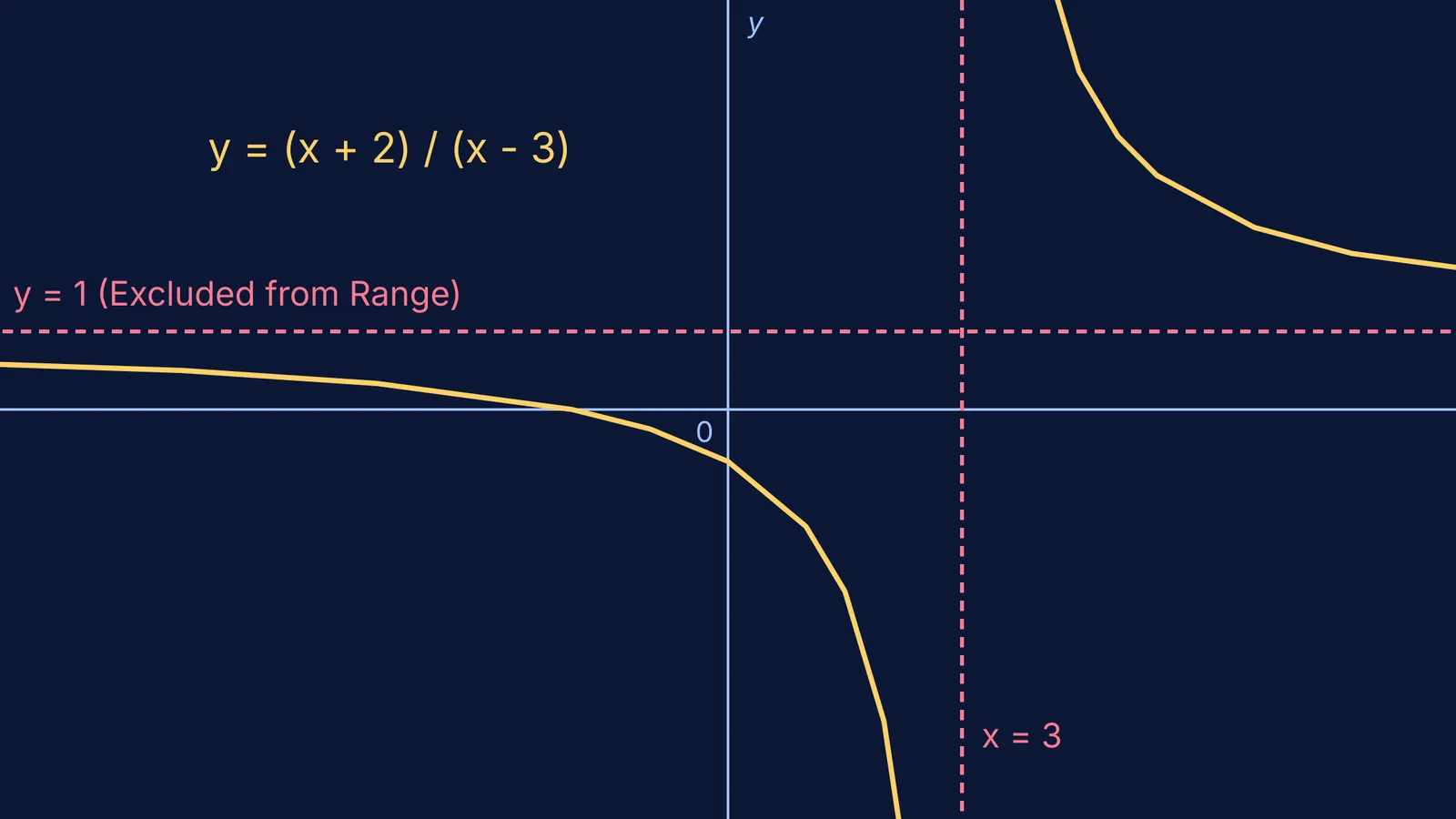
Let us find the range of the rational function y = (x + 2) / (x − 3).
Write the equation with y on one side: y = (x + 2) / (x − 3)
Multiply both sides by the denominator (x − 3): y(x − 3) = x + 2
Expand the left side: yx − 3y = x + 2
Gather all terms containing x on one side: yx − x = 3y + 2
Factor out x to isolate it from the y terms: x(y − 1) = 3y + 2
Divide by (y − 1) to isolate x: x = (3y + 2) / (y − 1)
Now, look at this new expression. It tells you what x you need to plug in to get any chosen y. For example, if you want the function to output y = 5, you plug in y = 5 to find x = 17 / 4.
However, the fraction (3y + 2) / (y − 1) is undefined when its denominator is zero. Setting the denominator equal to zero gives y − 1 = 0, which means y = 1.
There is no real number x that will output y = 1. Therefore, the range of this function is all real numbers except 1. In interval notation, the range is (−∞, 1) ∪ (1, ∞).
When does this method work best?
Expressing x in terms of y is the standard textbook method for linear rational functions. These are expressions where both the numerator and the denominator are linear, taking the form y = (ax + b) / (cx + d).
If the function contains quadratic terms (like x²), expressing x in terms of y directly will leave you with a quadratic equation in x. In those cases, you do not isolate x completely. Instead, you rearrange the equation into the standard quadratic form A x² + B x + C = 0. Then, you use the condition that for x to be a real number, the discriminant (B² − 4AC) must be greater than or equal to zero. We explain this step by step in our guide to the range of a rational function using the discriminant method.
How can you avoid algebraic mistakes?
Algebraic manipulation takes practice. When you are expressing x in terms of y, it is easy to drop a minus sign when moving terms across the equals sign, or to forget to factor out x from both terms correctly.
When you solve these problems in the Fermi Problem Library, Fermi's AI tutor watches each step. If you write yx − 3 = x + 2 instead of yx − 3y = x + 2, Fermi will not just print the final answer and leave you to figure out where you went wrong. It will stop you, point out the missing y in your expansion, and ask you to correct the line. The tutor teaches rather than answers, holding a line of reasoning across the session and building a plan to ensure you grasp the linear method before you move on to quadratics.


