

On this page
Word arrangement problems are a staple of combinatorics and probability exams. A classic variation asks: if the letters of a word are arranged at random, what is the probability that all the vowels are kept together?
According to the classical definition, the probability of an event is the ratio of the number of favourable outcomes to the total number of possible outcomes. To find this probability for a word arrangement, you must calculate both the total number of possible arrangements (the denominator) and the number of arrangements where the vowels stay together (the numerator).
What is the probability that letters arranged at random keep vowels together?
Finding the probability that letters arranged at random keep vowels together requires three steps. First, you calculate the total number of ways the letters can be permuted. Second, you calculate the favourable outcomes using the block method—where you tie the vowels into a single unit. Finally, you divide the favourable outcomes by the total outcomes.
When a student brings a problem like this to the Fermi Problem Library, the step-by-step solver does not just print the final fraction. Fermi's AI tutor works out what you already know and builds a plan for the session, teaching you how to set up the numerator and denominator so you can apply the reasoning to any word.
How do you calculate the total number of arrangements?
The total number of outcomes is simply the number of ways to arrange all the letters in the word without any restrictions.
For a word with n distinct letters, the total number of arrangements is n! (n factorial). For example, the word "ARTICLE" has 7 distinct letters. The total number of unconstrained arrangements is 7! = 5,040.
If the word contains repeating letters, you must divide the total factorial by the factorials of the repeat counts to avoid counting identical arrangements multiple times. For a word with n letters where one letter repeats p times and another repeats q times, the formula is n! / (p! × q!).
How do you treat vowels as one unit?
To find the favourable outcomes, you use a technique known in combinatorics as the block method (or string method). When items must stay together, you treat that entire group as a single unit.
For the word "ARTICLE", the vowels are A, I, and E, and the consonants are R, T, C, and L.
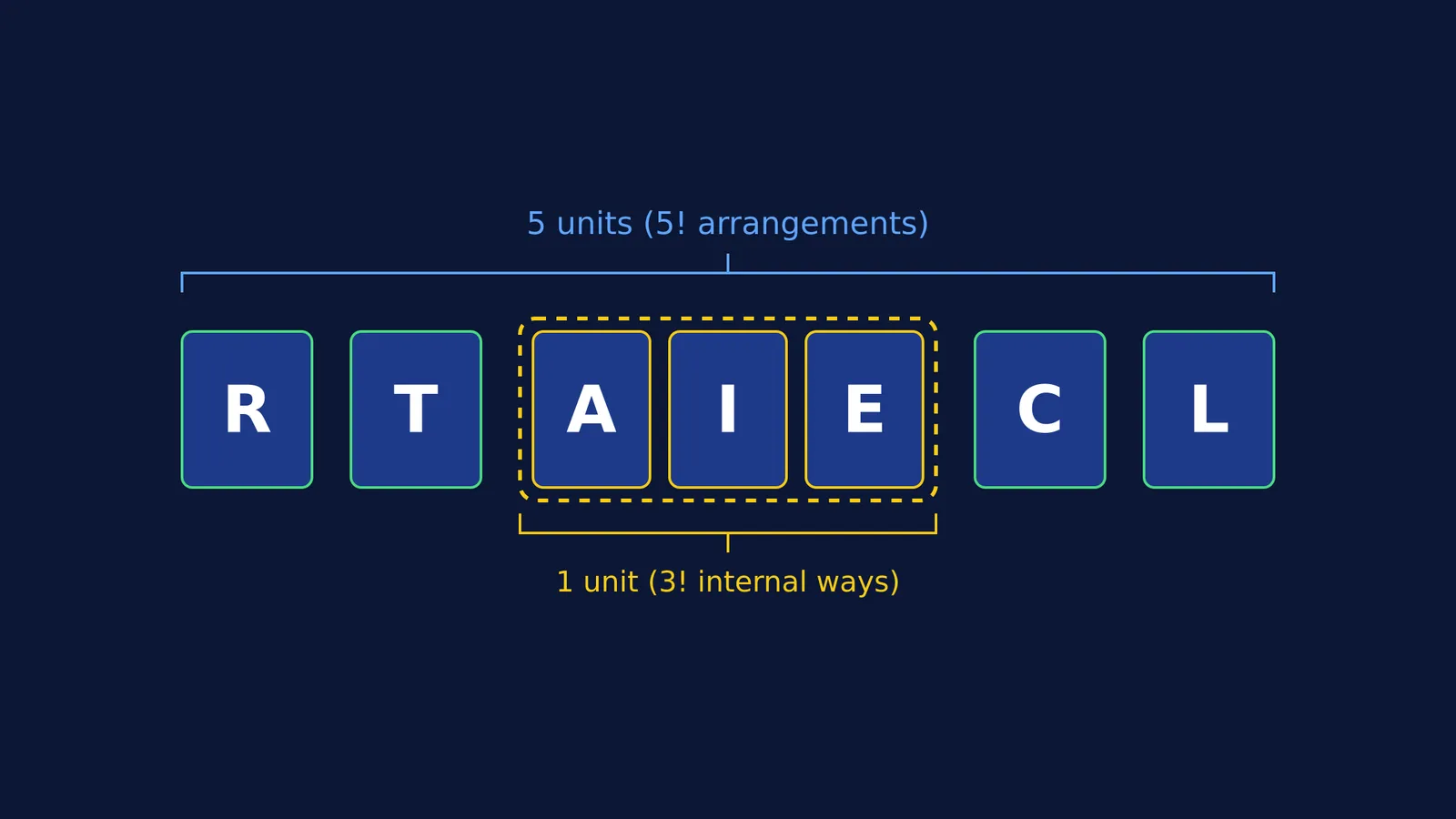
Group the vowels: Tie the 3 vowels (A, I, E) together into one block.
Count the units: You now have 4 individual consonants plus 1 block of vowels, giving 5 total units.
Arrange the units: These 5 units can be arranged in 5! ways, which equals 120.
Arrange inside the block: The 3 vowels within the block can also swap places with each other. They can be arranged in 3! ways, which equals 6.
To find the total number of favourable arrangements, multiply the two results: 120 × 6 = 720.
Now, apply the probability formula: Probability = 720 / 5040 = 1/7
If you want to practice more counting techniques, the Fermi Concept Library contains interactive lessons for every concept in mathematics, mapping out how permutations connect to probability.
How do you deal with repeated letters?
The method holds even if the word has repeating letters; you just need to adjust your factorials. Consider the word "ENGINEER".
Total letters: 8 (E repeats 3 times, N repeats 2 times).
Total arrangements: 8! / (3! × 2!) = 3,360.
Now apply the block method for the favourable outcomes:
Vowels: E, I, E, E (4 letters, with E repeating 3 times).
Consonants: N, G, N, R (4 letters, with N repeating 2 times).
Treat the 4 vowels as 1 block. You now have 4 consonants + 1 block = 5 units. Because the consonant 'N' repeats twice among the units, the number of ways to arrange the 5 units is 5! / 2! = 60.
Next, arrange the vowels inside their block. Since there are 4 vowels and 'E' repeats 3 times, the internal arrangements are 4! / 3! = 4.
Multiply these together for the favourable outcomes: 60 × 4 = 240.
Finally, calculate the probability: Probability = 240 / 3360 = 1/14
Once you master the block method, these probability questions become straightforward arithmetic. For more strategies on setting up these equations, see our guides on quadratic word problems in Class 10 and how changing the origin and scale affects variance.


