

On this page
Word problems involving footraces and head starts are standard fixtures in competitive mathematics and quantitative aptitude examinations. A problem might state that runner A beats runner B by 20 metres in a 100-metre race, or gives runner B a 5-second head start. While these statements look like simple subtraction, calculating what happens over longer distances or comparing multiple runners frequently trips students up.
The core issue is treating dynamic motion as static subtraction. In an empirical study published in *Cognition and Instruction*, Van Dooren and colleagues (2010) demonstrated that learners systematically default to additive thinking when dealing with proportional relationships. In a race with constant speeds, a distance deficit is not a fixed quantity; it is the physical footprint of a speed ratio operating over a shared duration.
How do you convert 'A beats B by 20 m' into a speed ratio?
When a problem states that in a 100-metre race 'A beats B by 20 metres', it captures a single instant: the moment runner A crosses the finish tape. Because both runners started simultaneously, both have been running for the exact same duration t.
At time t:
Runner A has completed the full race: d_A = 100 m.
Runner B is 20 metres behind: d_B = 100 − 20 = 80 m.
Because distance equals speed multiplied by time (d = v × t), and time is identical, distance is directly proportional to speed: v_A / v_B = d_A / d_B = 100 / 80 = 5 / 4.
Runner A covers 5 metres for every 4 metres runner B runs. If the race extends to 400 metres, runner B will not finish 20 metres behind. Instead, runner B covers 400 × (4 / 5) = 320 metres when A finishes, resulting in an 80-metre deficit.
How do you combine two races to compare runners A and C?
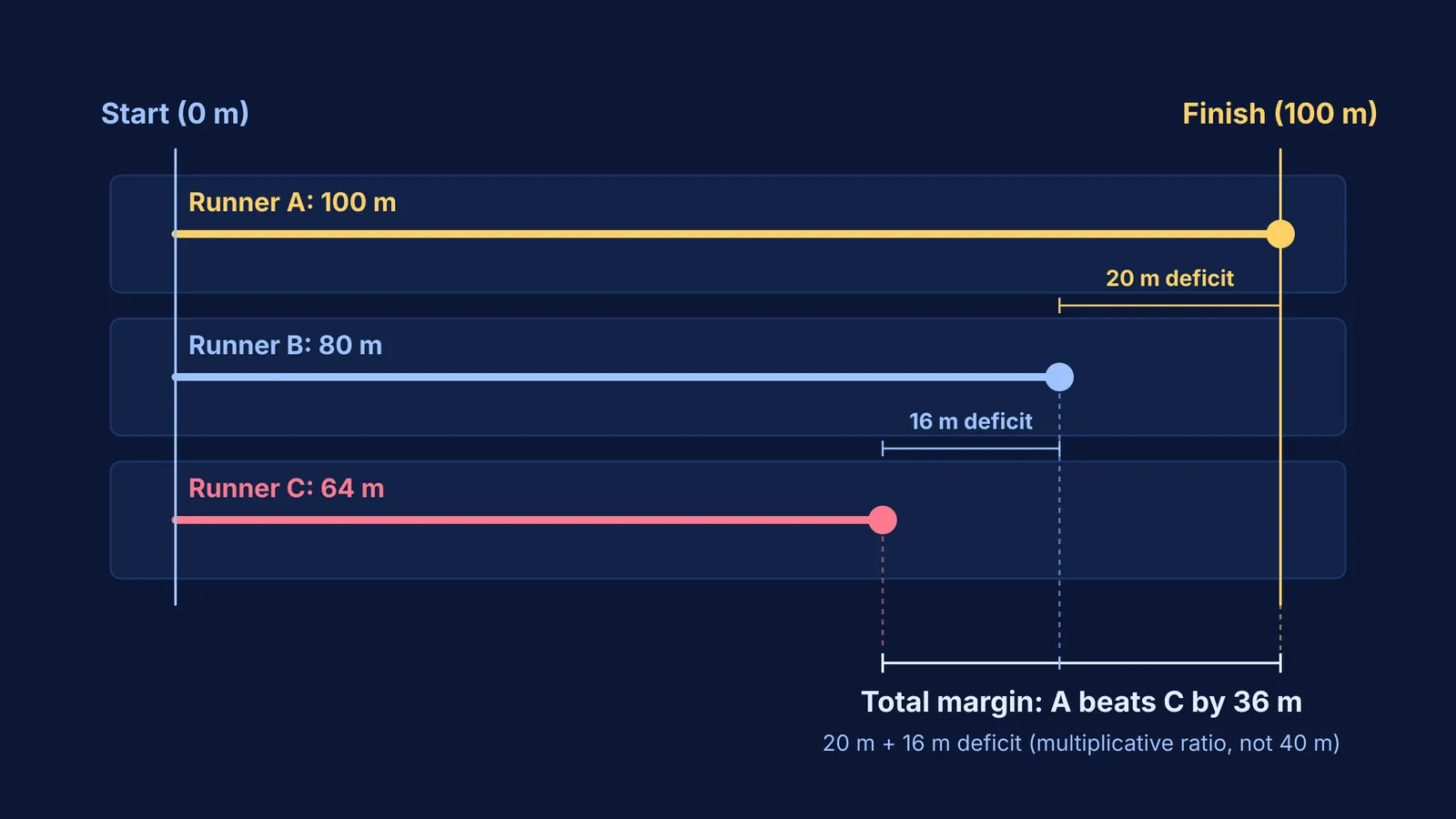
Consider a standard puzzle: in a 100-metre race, runner A beats runner B by 20 metres, and runner B beats runner C by 20 metres. By how many metres does runner A beat runner C?
The intuitive additive response—adding 20 and 20 to get 40 metres—is wrong. In an analysis of student errors in proportional reasoning published in the *Journal for Research in Mathematics Education*, Carol Lawton (1993) showed that learners systematically default to additive strategies when problem structures obscure the underlying multiplicative comparisons.
Runner B is the shared link, but runner B is evaluated under two different conditions:
When A runs 100 m, B runs 80 m: v_A / v_B = 100 / 80 = 5 / 4.
In a separate race, when B runs 100 m, C runs 80 m: v_B / v_C = 100 / 80 = 5 / 4.
To compare A directly with C, chain the ratios by multiplication: v_A / v_C = (v_A / v_B) × (v_B / v_C) = (5 / 4) × (5 / 4) = 25 / 16.
When runner A finishes 100 metres, runner C covers: d_C = 100 × (16 / 25) = 64 metres.
Runner A beats runner C by 100 − 64 = 36 metres, not 40 metres. When runner A finished, runner B was only at 80 metres; runner C trailed runner B proportionally, not at the finish tape.
For track length L where A beats B by x and B beats C by y, the margin of A over C simplifies to (x + y) − (x × y) / L. For x = 20, y = 20, and L = 100: (20 + 20) − 4 = 36 metres.
What is a head start, and how do you calculate a dead heat?
A head start can be awarded in distance or in time:
Distance start: 'A gives B a start of 20 metres in a 100 m race.' Runner B starts at the 20-metre mark and needs only 80 metres to finish, while runner A runs 100 metres.
Time start: 'A gives B a start of 5 seconds.' Runner B starts 5 seconds before runner A leaves the blocks.
A 'dead heat' occurs when competitors cross the finish line simultaneously. If A gives B a head start of x metres over track length L and they tie, their speed ratio is v_A / v_B = L / (L − x).
In a common variation, runner A beats runner B by 50 metres or 10 seconds in a 1000-metre race:
When A finishes 1000 metres, B has run 950 metres.
B needs 10 seconds to cover the remaining 50 metres, so B's speed is v_B = 50 / 10 = 5 m/s.
B's total time is 1000 / 5 = 200 seconds.
A finishes 10 seconds earlier in 190 seconds, giving v_A = 1000 / 190 ≈ 5.26 m/s.
For a dead heat over 1000 metres, A must give B a head start equal to what B cannot cover in 190 seconds: 1000 − (190 × 5) = 50 metres.
How should students practise race and motion word problems?
Translating word statements into speed ratios builds the same modeling discipline required for quadratic word problems and relative motion problems, connecting naturally to classic pursuit paradoxes like Zeno's paradoxes of motion.
When practising, students often wonder whether a missed answer came from an arithmetic slip or a misapplied ratio. The Fermi Problem Library provides worked problems with a step-by-step solver that explains the reasoning rather than printing an answer. For multi-stage kinematics, Fermi's AI tutor notices where a student is stuck and decides whether to explain, ask or show, while the Fermi Simulation Lab provides interactive simulations for ideas easier to see than read.


