

On this page
When you first learn about polynomials, you are taught that a quadratic equation can have two real roots, one repeated root, or no real roots at all. But what happens if you find a quadratic equation that works for three distinct values of x?
In short
If a quadratic equation is satisfied by three or more distinct values of x, its coefficients must all be exactly zero (a = b = c = 0). This makes it an identity, meaning the equation is not just a parabola with roots, but a statement that holds true for every possible value of x.
Why can a quadratic equation have only two roots?
The rule that limits the number of roots comes from the fundamental theorem of algebra, which states that a non-zero, single-variable polynomial of degree n has exactly n complex roots, counted with multiplicity. Because a standard quadratic equation (ax² + bx + c = 0) has a degree of 2, it can intersect the x-axis a maximum of two times.
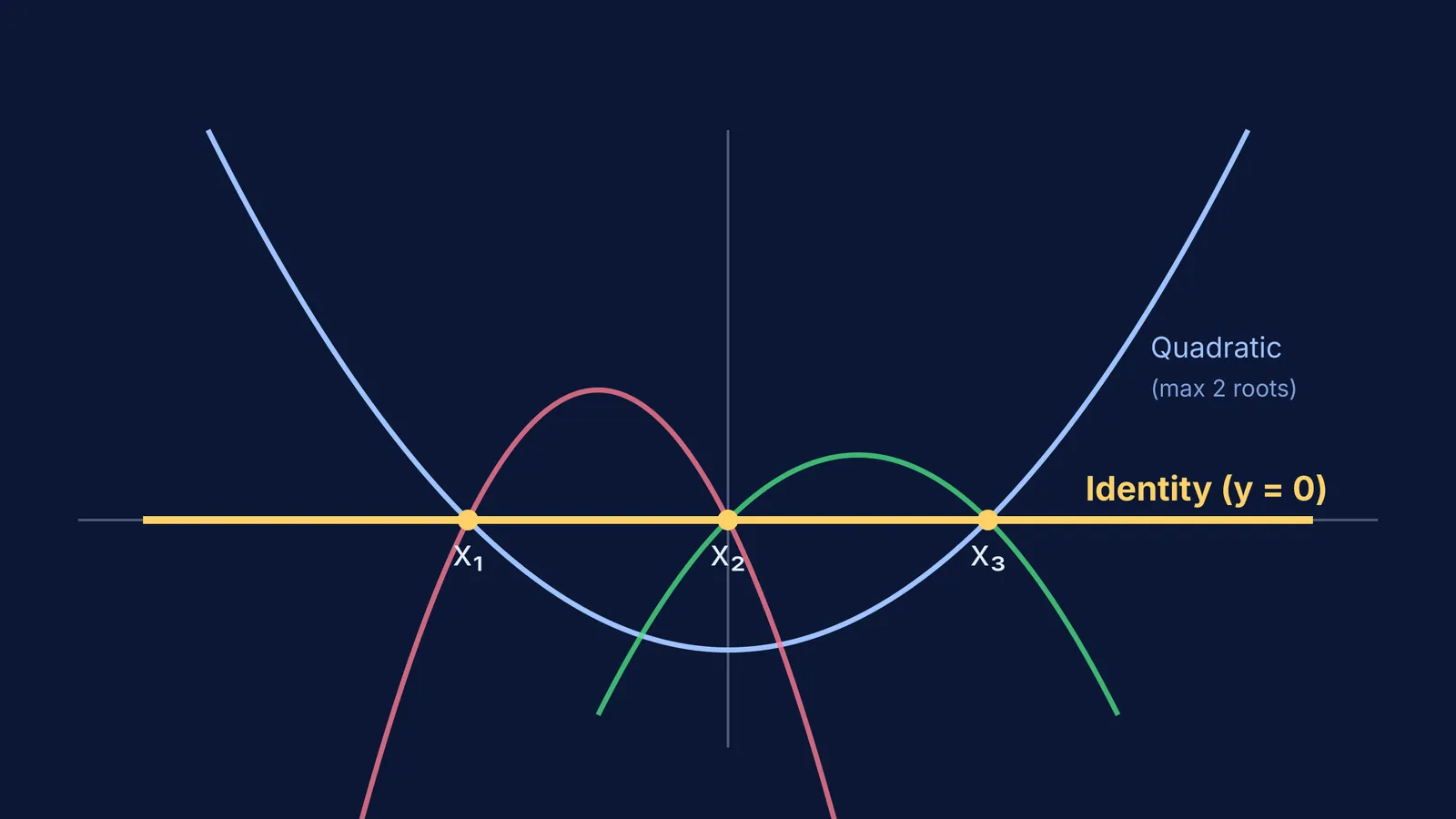
If you plot it on a graph, a quadratic equation forms a parabola. A parabola can dip below the x-axis and come back up (two roots), touch it exactly at the vertex (one root), or hover entirely above or below it (zero real roots). Geometrically, there is no way to draw a single U-shaped curve that crosses a straight line three times without bending backwards, which would break the rules of a function.
What if a quadratic equation has three roots?
If an equation that looks like ax² + bx + c = 0 is somehow satisfied by three distinct values of x, the only mathematical explanation is that it is the "zero polynomial".
For the equation to evaluate to zero at three different points, the curve must lie completely flat on the x-axis. This means all of its coefficients must be zero:
a = 0
b = 0
c = 0
When a = b = c = 0, the equation becomes 0x² + 0x + 0 = 0. This statement is true for *every* real and complex number, not just the three roots you found. An equation that is true for all possible values of its variable is called an identity.
How do exams use this to prove identities?
Examiners for competitive tests like JEE Main and Advanced often use this property to build intimidating algebra questions. They will give you a messy equation that is secretly a quadratic, ask you to find its roots, or ask you to evaluate it for a strange value of x.
Consider this classic expression:
f(x) = (x−b)(x−c) / (a−b)(a−c) + (x−c)(x−a) / (b−c)(b−a) + (x−a)(x−b) / (c−a)(c−b) − 1 = 0
If you multiply this out, the highest power of x is x², so this is a quadratic equation. But watch what happens when you substitute specific values:
If you plug in x = a, the second and third terms become zero because they contain (a−a). The first term becomes (a−b)(a−c) / (a−b)(a−c), which is 1. You are left with 1 − 1 = 0.
If you plug in x = b, the first and third terms vanish, leaving 1 − 1 = 0.
If you plug in x = c, the first and second terms vanish, leaving 1 − 1 = 0.
This single quadratic equation has three distinct roots (a, b, and c). Therefore, it must be an identity. The expression f(x) will equal 0 for *any* value of x you choose. If an exam asks you to find the value of f(2026), the answer is instantly 0.
Checklist: Is this tricky equation an identity?
When you face a complicated algebraic equation in a timed exam, how do you know if you should solve it normally or check for an identity? Use this framework to spot the trick quickly:
Check the degree: Look at the numerators and multiply out the highest powers of x. If the highest power is x², you are dealing with a quadratic.
Look for obvious substitutions: Do the denominators look like (a−b)(a−c)? This cyclic pattern is a massive hint to test x = a, x = b, and x = c.
Count the working roots: If you can quickly find three separate values that make the degree-2 equation equal 0, you can stop calculating.
Apply the rule: Three roots in a quadratic means it is an identity. The expression is equal to 0 for all real numbers.
If you are making wrong-method mistakes on tricky algebraic fractions, the Fermi Problem Library has worked problems with a step-by-step solver that explains the reasoning rather than printing an answer. For filling any concept gaps around polynomials, the Fermi Concept Library has every concept in mathematics, each with its own lesson.
More on quadratic equations
To see how these rules apply to inequalities and graphs, read When is ax² + bx + c positive for all x? The discriminant test. If you want to visualise how roots work geometrically, check out How many roots? Counting intersections of two sketched curves.


