

On this page
Probability and quadratic equations frequently meet in entrance exams, and one classic problem asks: if you roll three fair dice to choose the coefficients a, b and c, what is the chance that the quadratic equation ax² + bx + c = 0 has real roots?
When three dice are rolled to choose the coefficients a, b and c, there are exactly 43 combinations that give real roots. This is exactly the kind of counting puzzle that traps students if they try to list combinations randomly.
Here is how to set up the count so you do not miss any pairs.
What is the condition for real roots?
A quadratic equation ax² + bx + c = 0 has real roots if its discriminant is greater than or equal to zero. That means:
b² − 4ac ≥ 0
Or, rearranged to make the check easier:
b² ≥ 4ac
Because each coefficient is chosen by rolling a standard six-sided die, the values for a, b and c can only be integers from 1 to 6.
How many total outcomes are there?
With three dice, every combination of (a, b, c) is equally likely. Since each die has 6 faces, the total number of possible combinations is 216.
To find the probability, we just need to count how many of those 216 combinations satisfy b² ≥ 4ac, and then divide by 216.
How do you count the favourable outcomes?
Let us test the possible values of b one by one.
When b = 1 or b = 2: For b = 1, we need 1 ≥ 4ac, which is impossible. (0 pairs) For b = 2, we need 4 ≥ 4ac, meaning 1 ≥ ac. The only solution is (1, 1). (1 pair)
When b = 3: We need 9 ≥ 4ac, meaning 2.25 ≥ ac. The product ac can be 1 or 2, giving (1, 1), (1, 2) and (2, 1). (3 pairs)
When b = 4: We need 16 ≥ 4ac, meaning 4 ≥ ac. The possible products are 1, 2, 3 or 4. If a = 1, c can be 1, 2, 3, 4. (4 pairs) If a = 2, c can be 1, 2. (2 pairs) If a = 3 or 4, c is 1. (2 pairs) This gives 4 + 2 + 2 = 8 pairs.
When b = 5: We need 25 ≥ 4ac, meaning 6.25 ≥ ac. The product ac can be up to 6. If a = 1, c can be up to 6. (6 pairs) If a = 2, c can be up to 3. (3 pairs) If a = 3, c can be up to 2. (2 pairs) If a = 4, 5 or 6, c is 1. (3 pairs) Total: 6 + 3 + 2 + 3 = 14 pairs.
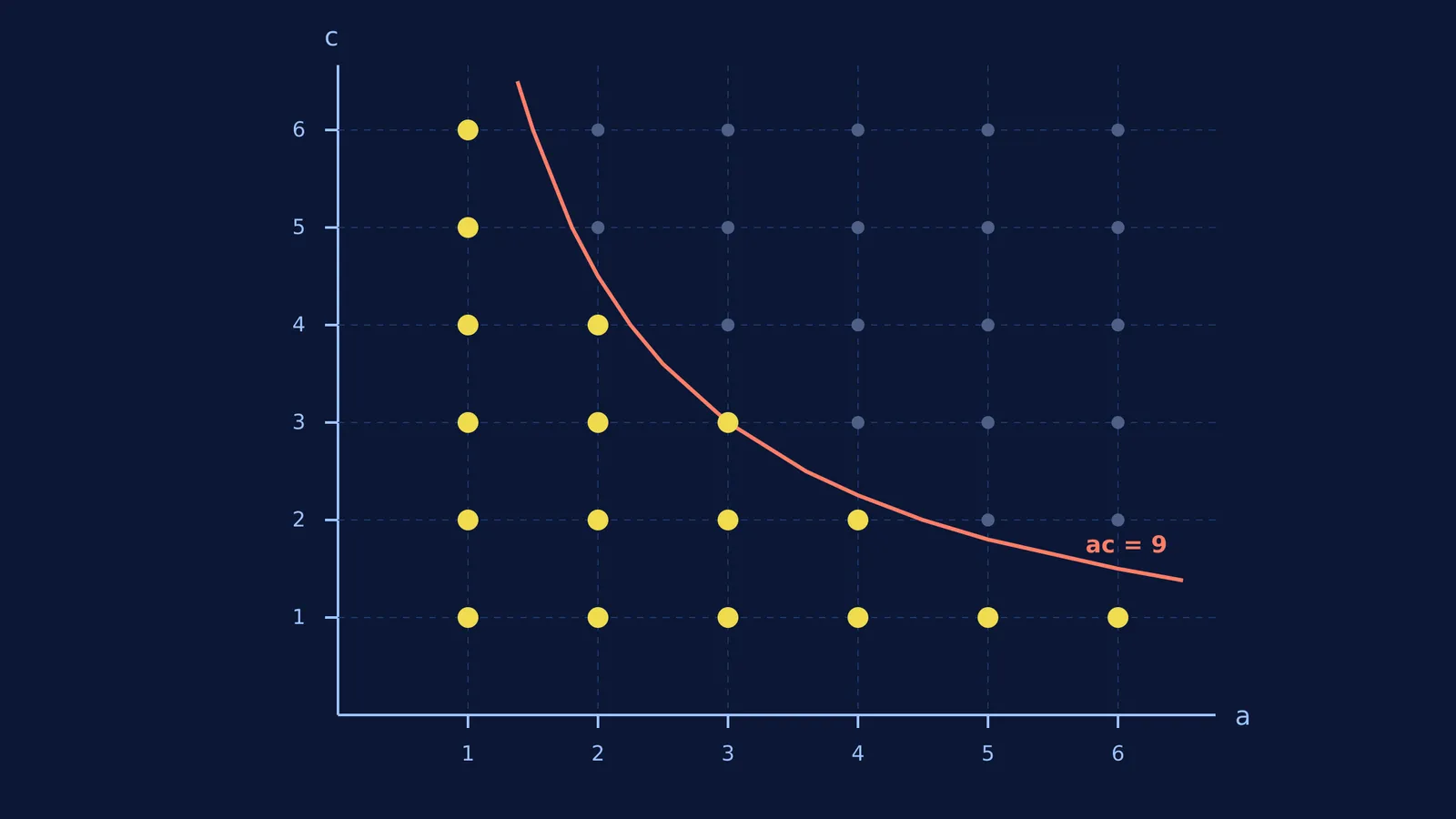
When b = 6: We need 36 ≥ 4ac, meaning 9 ≥ ac. The product ac can be up to 9. If a = 1, c can be up to 6. (6 pairs) If a = 2, c can be up to 4. (4 pairs) If a = 3, c can be up to 3. (3 pairs) If a = 4, c can be up to 2. (2 pairs) If a = 5 or 6, c is 1. (2 pairs) Total: 6 + 4 + 3 + 2 + 2 = 17 pairs.
Adding them all up, the number of successful combinations is 0 + 1 + 3 + 8 + 14 + 17 = 43.
If you often make mistakes while listing cases like this, the Fermi Problem Library breaks counting problems into stages. The solver explains how to split the cases systematically instead of just handing you the final number.
What is the final probability?
With 43 favourable combinations out of 216 total possibilities, the probability of rolling a quadratic with real roots is exactly 43/216.
This is roughly 19.9%. You are far more likely to roll a quadratic with complex roots.
A checklist for combinations in exams
When a JEE or maths competition problem asks you to count pairs or triples that fit an inequality:
Find the restrictive variable. The variable that is squared or cubed limits the others fastest. We picked b first because b² gave us a hard ceiling for ac.
List systematically. Once b is chosen, organise the inner count by a. Going in order (a = 1, then a = 2) stops you from skipping (4, 1) after counting (1, 4).
Watch the boundaries. Remember that dice only go up to 6. For b = 5 and a = 1, the product ac ≤ 6.25 technically allows c = 6.25, but the die stops at 6.
Counting without a system is where most marks are lost in probability. Building a rigid framework for listing is the only way to be sure you have found every pair.
If you are reviewing quadratics, you should also brush up on when ax² + bx + c is positive for all x, which relies on a similar discriminant test. For probability, understanding the difference between with and without replacement is another common stumbling block in exam prep.


